
Hormone optimization is a phased biological ramp, not an overnight switch. If you’ve just received your implants, it’s completely normal to scrutinize every physical cue, whether you’re wondering why your energy hasn’t spiked by day four or questioning whether localized soreness is standard. Knowing what to expect from hormone pellets first month removes the anxiety from your recovery, giving you clinical clarity on how your body absorbs bioidentical therapy over time.
You shouldn’t have to wonder whether your physical sensations represent standard tissue acclimation or something requiring attention. In this clinical guide, you’ll discover the exact week-by-week physical, mental, and procedural milestones that unfold during your first 30 days. We’ll outline essential insertion site care, physical activity boundaries, and the crucial four-week follow-up blood testing window that confirms your hormone levels are stabilizing safely.
Key Takeaways
- Understand the dual-phase timeline to discover what to expect from hormone pellets first month, moving from wound closure to systemic hormone absorption.
- Track realistic physiological milestones across 30 days, recognizing why sleep and mood improve before physical stamina or libido fully peak.
- Distinguish between normal receptor acclimation, such as mild fluid retention, and symptoms that require medical assessment.
- Protect your pellet placement during the first seven days by following vital incision care and activity restrictions.
- Learn why clinical laboratory evaluations at weeks four to six are essential for verifying optimal peak hormone absorption and safety.
What to Expect from Hormone Pellets in the First Month: The Biological Timeline
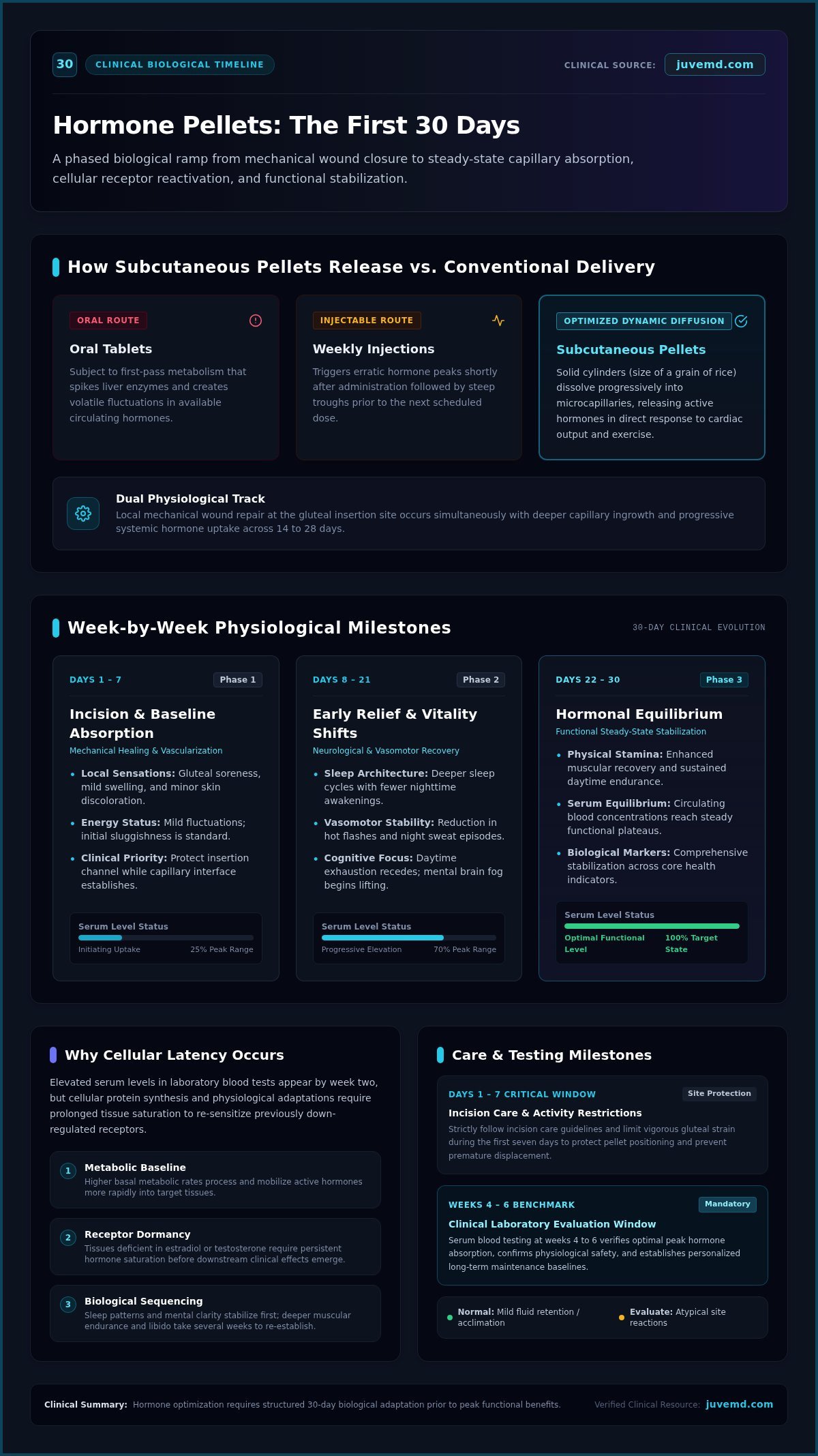
Evaluating what to expect from hormone pellets first month requires looking at two distinct physiological tracks. Your body is managing mechanical tissue repair at the gluteal insertion site while simultaneously initiating systemic absorption in your deeper capillary beds. These processes occur in tandem, yet they follow completely different biological clocks.
Subcutaneous implants don’t dump their contents immediately. Instead, steady-state blood serum concentrations develop progressively across 14 to 28 days as local capillary ingrowth interfaces with the implant surface. Recognizing this biological curve keeps you grounded, preventing the common worry that therapy isn’t working when day five feels identical to day one.
How Bioidentical Pellets Release into the Bloodstream
Pellets consist of micro-crystallized estradiol or testosterone compressed into solid cylinders roughly the size of a grain of rice. Placed directly into the subcutaneous fat layer, they dissolve slowly through physical contact with surrounding capillary networks.
Unlike oral tablets that spike liver enzymes or weekly injections that trigger erratic hormone spikes, pellets release in response to physical capillary perfusion. When you walk, exercise, or experience increased cardiac output, tiny increments of active hormones diffuse directly into your microcirculation. This dynamic diffusion makes bioidentical hormone replacement therapy uniquely steady, establishing consistent physiological baselines without dramatic hormonal peaks and troughs.
Immediate Systemic Uptake vs. Symptom Resolution
Circulating hormone levels begin climbing within days of insertion, yet comprehensive symptom relief rarely happens overnight. Understanding what to expect from hormone pellets first month means recognizing cellular latency. If your body has endured months or years of hormonal deficiency, cellular target receptors have down-regulated to cope with low supply.
Re-sensitizing these receptor sites takes time. While lab-measured serum levels elevate by week two, cellular protein synthesis and physiological adaptations require a sustained hormonal environment to take hold. Individual response times depend on baseline health:
- Metabolic baseline: Higher basal metabolic rates often mobilize and process active hormones more rapidly.
- Receptor dormancy: Tissues starved of estrogen or testosterone require persistent saturation before downstream clinical effects emerge.
- Biological sequencing: Sleep architecture and mental clarity generally stabilize first, while deeper muscle stamina and libido take several weeks to re-establish.
Week-by-Week Breakdown: Your First 30 Days with Hormone Pellets
Patients often wonder how quickly their daily vitality will shift. Clinical observations show that the average 21-to-30 day window marks the threshold for optimal symptomatic stabilization across major biological markers. Tracking what to expect from hormone pellets first month helps you align your personal expectations with real physiological recovery.
Week 1: The Incision Phase and Baseline Absorption
The first seven days center almost entirely on mechanical tissue healing. You’ll likely feel localized gluteal soreness, mild swelling, or minor skin discoloration. Your energy levels may fluctuate slightly as baseline circulation initiates compound uptake. Don’t worry if you don’t feel a surge of vitality yet; initial sluggishness is completely standard. Under physician-led bioidentical hormone replacement therapy las vegas protocols, early priority is placed on protecting the insertion channel while the body establishes local vascularization.
Weeks 2 and 3: Early Symptom Relief and Vitality Shifts
Around days 8 to 14, subtle shifts emerge. Many patients report deeper sleep cycles and fewer nighttime awakenings as the initial signal of progress. Daytime exhaustion gradually recedes, replaced by clearer morning focus and reduced vasomotor episodes like hot flashes and night sweats. By week three, as systemic concentrations build, mental fog begins lifting. As highlighted in an FDA clinical review on compounded bioidentical hormones, individualized monitoring remains essential to track these rapid metabolic shifts safely.
Week 4: Establishing New Hormonal Equilibrium
By the fourth week, blood concentrations reach steady functional levels. Patients typically experience enhanced muscular recovery, sustained daytime endurance, and improved emotional resilience. For men undergoing testosterone pellet therapy las vegas, this stage frequently brings marked improvements in physical strength and libido. Women similarly report renewed vitality and stable moods. Understanding what to expect from hormone pellets first month ensures you give your body the full 30 days needed to establish balance. If you want personalized oversight during your optimization journey, consider connecting with a specialist at JuveMD.
Normal Acclimation vs. Side Effects: What Is Expected in Month One?
Beginning pellet therapy initiates rapid cellular recalibration. As target tissues re-engage with active hormones, you may notice temporary physiological shifts that feel unfamiliar. Discerning between normal endocrine adjustments and symptoms requiring medical review is central to understanding what to expect from hormone pellets first month.
Most early physical sensations are self-limiting. As detailed in the Cleveland Clinic’s guide to bioidentical hormones, shifts in fluid balance and mild tissue sensitivity frequently occur during early systemic distribution. These transient reactions indicate that dormant cellular receptors are actively responding to restored hormone levels.
Expected Temporary Adaptation Responses
During the first two to three weeks, cellular receptors awaken after prolonged deficiency. This metabolic awakening can trigger several benign, short-lived bodily responses:
- Mild fluid retention: A temporary two to three pound fluctuation can occur as estrogen and testosterone receptors equilibrate cellular hydration.
- Breast or nipple sensitivity: Enhanced estrogen receptor activity often creates mild fullness or localized tenderness that dissipates as levels plateau.
- Skin changes: Mild skin oiliness or small facial blemishes can appear temporarily as androgen receptors adapt to new circulating levels.
- Sensory and mood shifts: Brief emotional sensitivity or mild temperature fluctuations can emerge as your central nervous system recalibrates its set points.
Signs That Require Clinical Evaluation
While biological adaptation is expected, procedural complications require swift clinical attention. Retrospective clinical data shows that serious procedural complications occur in less than 1% of cases, but proper monitoring remains vital.
Examine your gluteal insertion site during routine hygiene. Contact your medical provider if you observe spreading erythema extending beyond two inches from the incision, local warmth, fever above 100.4 degrees, or purulent drainage. Additionally, avoid aggressive rubbing or vigorous lower-body training to prevent pellet extrusion, a rare complication where the tiny cylinder migrates toward the skin surface. Maintaining open communication with specialized clinicians at hormone pellet therapy for women las vegas practices ensures that any unexpected physical response is addressed promptly and professionally.
Essential Post-Insertion Care: First 7 Days to Protect Your Results
Understanding what to expect from hormone pellets first month starts with protecting your insertion site during the initial healing window. The small gluteal incision requires physical stabilization so the underlying subcutaneous pocket can seal securely around each implant. Neglecting procedural care can disrupt wound healing, trigger localized inflammation, or dislodge the pellets before local capillary beds establish their vascular matrix.
A structured post-insertion routine minimizes tissue trauma and reduces hematoma risks. Following clear guidelines on physical movement, bandaging, and hygiene ensures the pellets remain safely seated in your adipose layer.
Activity and Exercise Restrictions (Days 1–7)
Mechanical shear stress is the primary cause of early pellet displacement. When you contract the gluteus maximus against heavy resistance, intramuscular tension increases pressure along the trocar insertion channel. To prevent pellet extrusion, adhere to these activity parameters:
- Women: Pause vigorous lower-body strength training, running, high-impact aerobics, and cycling for 3 to 5 days.
- Men: Refrain from heavy squats, deadlifts, and intense lower-body exertion for 5 to 7 days.
- Safe movements: Leisurely flat-ground walking, gentle upper-body resistance work, and light arm stretches are encouraged immediately to support gentle circulation.
Bathing, Bandages, and Wound Site Hygiene
Proper wound management prevents retrograde bacterial infection along the tract. Your insertion site is secured with two separate layers: an inner closure and an outer pressure bandage.
Keep the outer pressure dressing clean, dry, and undisturbed for 24 to 48 hours. This controlled compression stops minor micro-bleeding and shields the area. After 48 hours, you can peel away the outer bandage, leaving the underlying Steri-Strips in place. Let these adhesive tapes curl and fall off on their own over 5 to 7 days.
You can shower after 24 hours, provided you avoid spraying water directly onto the site and gently pat the area dry with a clean towel. Submersion in water, including bathtubs, hot tubs, swimming pools, and lakes, is strictly prohibited for at least 7 days to protect the healing tract from waterborne pathogens. If you notice unexpected swelling or have questions about your recovery timeline, contact JuveMD for personalized post-insertion guidance.
The 4-Week Milestone: Laboratory Testing and Long-Term Optimization
Completing your initial 30 days brings you to a decisive diagnostic checkpoint. While physical changes offer valuable subjective clues about what to expect from hormone pellets first month, clinical precision requires objective biochemical verification. Scheduling follow-up blood panels between weeks four and six captures your peak therapeutic absorption, confirming that your systemic levels align safely with real symptom improvements.
Why Follow-Up Lab Panels are Critical at 4 to 6 Weeks
Capillary integration reaches steady-state diffusion by day 28. Drawing blood during this four-to-six-week window provides empirical insight into how your unique metabolic biology processes bioidentical compounds. A thorough post-insertion panel evaluates several key biomarkers:
- Total and Free Testosterone: Assesses circulating and bioavailable androgen support to ensure improvements in stamina, mental focus, and muscle tone.
- Sensitive Estradiol: Confirms target estrogen levels necessary for vasomotor stability, bone density support, and cognitive health.
- Complete Blood Count and SHBG: Monitors sex hormone-binding globulin and tracks hematocrit percentages to safeguard cardiovascular and metabolic wellness.
Comparing these lab values against your personal symptom reports ensures that hormone levels remain in an ideal therapeutic range without drifting into excess.
Long-Term Optimization with JuveMD in Las Vegas
Endocrine balance should never rely on guess-work or rigid, one-size-fits-all dosing. At JuveMD in Las Vegas, Dr. Andrea Dempsey prioritizes physician-directed care that adjusts directly to your biological feedback. Your first-month lab metrics serve as an essential calibration blueprint, allowing your physician to fine-tune dosages for future pellet insertions every three to six months.
Establishing steady hormone levels also creates a stable biological foundation for broader vitality goals. When systemic balance is restored, patients often achieve better outcomes with complementary wellness and aesthetic services, including medical weight loss programs, targeted skin treatments, hair restoration, and injectables. Understanding what to expect from hormone pellets first month transforms early acclimation into a predictable, physician-guided path toward lasting vitality.
Your Path to Long-Term Hormonal Equilibrium
Achieving sustained endocrine balance is a progressive physiological ramp rather than an instantaneous shift. Knowing what to expect from hormone pellets first month gives you confidence at every stage, from respecting incision healing during week one to enjoying renewed sleep and mental clarity by week three. When paired with essential four-week lab evaluations, bioidentical therapy establishes a steady, reliable baseline designed around your cellular metabolic needs.
At JuveMD in Las Vegas, care is directed by Dr. Andrea Dempsey, bringing specialized clinical expertise to every patient protocol. We design customized bioidentical pellet formulations matched directly to your comprehensive blood markers, so you don’t have to settle for standardized care. Take the next step toward reclaiming your energy, mental focus, and physical stamina. Schedule your personalized hormone evaluation with Dr. Andrea Dempsey today to begin your tailored optimization journey.
Frequently Asked Questions
How quickly do you start feeling the effects of hormone pellets in the first month?
Most patients begin noticing early physiological shifts between days 7 and 14, typically starting with deeper sleep and stabilized morning energy. Mental focus and reduced hot flashes follow in weeks two and three, while physical stamina and libido peak between weeks three and four. Knowing what to expect from hormone pellets first month helps set realistic expectations, as dormant cellular receptors require steady saturation before delivering noticeable changes.
Is bruising or swelling at the pellet insertion site normal during the first week?
Mild bruising, swelling, and local tenderness at the gluteal insertion site are completely normal throughout your first seven days. The procedure involves a small trocar channel in subcutaneous tissue, which naturally provokes an inflammatory healing response. A firm, pea-sized nodule under the incision simply reflects healing tissue. If redness spreads past two inches, warmth increases, or drainage develops, contact your Las Vegas clinical provider for evaluation.
Can I work out or go to the gym immediately after getting hormone pellets inserted?
No, you must pause vigorous lower-body workouts and heavy gym lifting for several days post-insertion. Women should avoid squats, running, and high-impact lower-body training for 3 to 5 days, while men should refrain for 5 to 7 days. Engaging gluteal muscles under heavy loads creates internal pressure that risks dislodging pellets through the healing channel. Leisurely walking and gentle upper-body movements remain safe right away.
What happens if I do not feel any difference after two weeks with hormone pellets?
Not feeling substantial shifts by day 14 is common and doesn’t indicate treatment failure. Individual metabolism, body composition, and receptor sensitivity dictate how quickly active hormones take effect. Many patients require 21 to 30 days of consistent capillary diffusion before experiencing noticeable symptomatic relief. If you don’t feel a difference by week four, your scheduled blood panel will provide the diagnostic data your physician needs to evaluate absorption.
Can hormone pellets cause mood swings or emotional changes during the first month?
Mild, temporary mood fluctuations can occur during the second or third week as your endocrine receptors recalibrate to rising hormone levels. When understanding what to expect from hormone pellets first month, it helps to recognize that receptor re-sensitization can produce transient emotional shifts. These feelings generally balance out as circulating levels plateau toward the end of the month, establishing steady emotional stability and improved stress resilience.
Why is blood testing necessary four to six weeks after hormone pellet insertion?
Follow-up blood testing between weeks four and six measures your peak therapeutic hormone concentrations. At JuveMD in Las Vegas, Dr. Andrea Dempsey utilizes this diagnostic milestone to verify that circulating free and total hormone levels align safely with symptom improvements. Evaluating markers like estradiol, testosterone, and hematocrit guarantees individual safety margins and provides an empirical blueprint for personalizing your future pellet dosing cycles.
How do hormone pellets differ from weekly hormone injections during the first 30 days?
Hormone pellets provide consistent, continuous capillary release rather than the dramatic peaks and troughs associated with weekly injections. During month one, injections often trigger an initial surge followed by mid-week crashes as serum levels drop. In contrast, subcutaneous bioidentical pellets dissolve steadily in response to your physical circulation, creating a smooth biological ramp without the rollercoaster of energy dips, mood swings, or frequent self-administered needle sticks.