
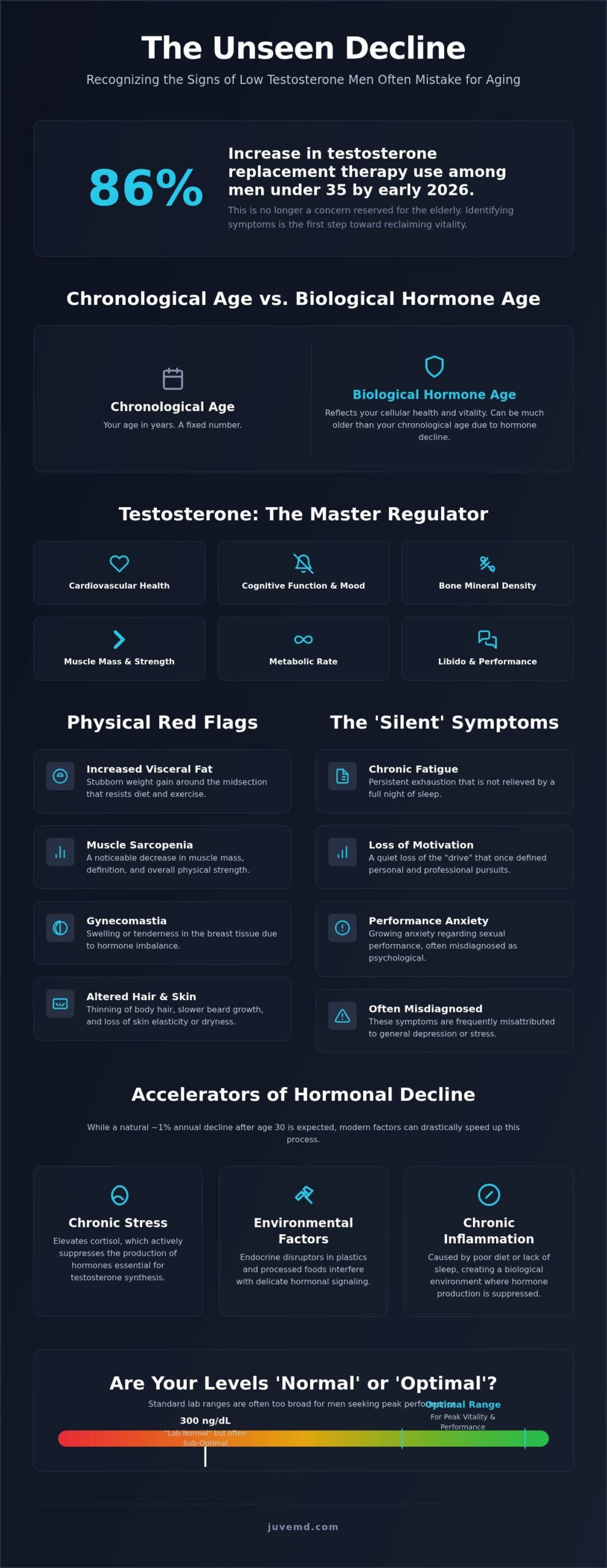
By early 2026, clinical data revealed a staggering 86% increase in testosterone replacement therapy use among men under 35; this proves that identifying the signs of low testosterone men face is no longer a concern reserved for the elderly. It’s exhausting to face each day with chronic fatigue despite a full night of sleep or to feel a growing anxiety regarding your sexual performance. You may have noticed unexplained weight gain around your midsection and a quiet loss of the “drive” that once defined your career. It is easy to dismiss these changes as personal failings, but they are often valid medical signals that require a professional, clinical perspective.
This article provides the clinical validation you’ve been seeking by detailing the subtle and overt symptoms of hormonal decline. You’ll learn how to distinguish between normal aging and a treatable deficiency, moving from frustration to a position of medical empowerment. We will examine the 2026 checklist of symptoms, explore the physiological impact of hormone loss, and provide a clear roadmap for the diagnostic testing required to reclaim your vitality and restorative balance.
Key Takeaways
- Learn to identify the physical and emotional signs of low testosterone men often mistake for normal aging, such as midsection weight gain and chronic fatigue.
- Discover the neurological “silent” symptoms of hormone decline, including the loss of motivation and performance anxiety that can be misdiagnosed as general depression.
- Gain a structured 14-day framework for tracking your daily symptoms and learn the clinical steps to prepare for an accurate hormonal blood panel.
- Understand the critical difference between your chronological age and your biological hormone age to better advocate for your long-term wellness.
- Explore how personalized bioidentical pellet therapy provides a steady, optimized release of hormones to help you reclaim your peak vitality.
Understanding Testosterone: The Foundation of Male Vitality
Testosterone is the primary androgenic hormone in the male body, acting as a master regulator for a vast array of physiological systems. It is not merely a driver of libido or muscle growth; it is a critical signaling molecule that influences mood, cognitive function, and metabolic stability. When these levels fall below the clinical threshold, a condition known as Hypogonadism occurs. This medical state represents a systemic shift that can alter how your body processes energy and maintains its structural integrity. Understanding the signs of low testosterone men face requires looking beyond simple physical appearance to the underlying cellular health of the individual.
There is a significant distinction between your chronological age and your biological hormone age. You might be 45 years old, but if your endocrine system is struggling, your body may exhibit the cellular health and fatigue of someone decades older. Recognizing the signs of low testosterone men encounter is the first step in closing this gap. Standard medical practices often rely on “lab normal” ranges that are far too broad. A level of 300 ng/dL might be considered “normal” by a general laboratory; however, for a man seeking peak performance and vitality, it is rarely “optimal.” At JuveMD, we focus on this optimization, moving past the limitations of standard testing to find a balance that feels right for your specific biology.
The Systemic Role of Testosterone
Testosterone’s influence extends to nearly every organ system in the body. It is essential for cardiovascular health, as it supports the production of red blood cells and helps maintain the integrity of arterial walls. It also plays a vital role in preserving bone mineral density. Men with chronically low levels face a higher risk of osteoporosis and unexpected fractures. Additionally, this hormone is a primary driver of your metabolic rate. It improves insulin sensitivity and helps the body prioritize muscle mass over fat storage, which is why a deficiency often leads to stubborn weight gain around the midsection.
Why Levels Decline: Age vs. Environment
While men typically experience a natural 1% annual decline in testosterone after age 30, age is only one part of the equation. Modern environmental factors have accelerated this process for many. Chronic stress leads to elevated cortisol, which actively suppresses the production of luteinizing hormone. Endocrine disruptors found in plastics and processed foods further interfere with delicate hormonal signaling. Chronic inflammation, often caused by poor diet or lack of sleep, creates a biological environment where natural hormone production remains suppressed. To address these deficiencies, Bioidentical Hormone Replacement Therapy (BHRT) offers a natural-mimicking solution. Unlike synthetic alternatives, BHRT utilizes hormones that are molecularly identical to those your body produces, allowing for a more seamless and effective restoration of balance. For men entering their fifth decade and beyond, BHRT for men over 40 has emerged as a scientifically backed strategy to counteract these accelerated declines and restore peak physiological function.
Physical Signs of Low Testosterone: A Diagnostic Checklist
Physical changes are usually the first measurable signs of low testosterone men notice in their daily lives. These shifts aren’t just aesthetic concerns. They are outward manifestations of a complex internal hormonal imbalance. When testosterone levels drop, the body’s ability to synthesize protein diminishes, leading to a visible loss of muscle integrity even if you maintain a strict gym schedule. Understanding why these changes occur is essential for moving from frustration to clinical action.
Use the following checklist to evaluate your current physical state. If you identify with three or more of these indicators, it may be time to consider a professional hormonal assessment:
- Increased Visceral Fat: Stubborn weight gain specifically around the midsection that resists diet and exercise.
- Muscle Sarcopenia: A noticeable decrease in muscle mass, definition, and overall physical strength.
- Gynecomastia: Swelling or tenderness in the breast tissue caused by an imbalance between testosterone and estrogen.
- Altered Hair Growth: Thinning of body hair or a significant slowing in the rate of beard growth.
- Skin Changes: A loss of skin elasticity or an increase in dryness that wasn’t present in previous years.
Body Composition and Muscle Integrity
Loss of lean muscle mass, clinically referred to as sarcopenia, is a hallmark of hormonal decline. Testosterone is highly anabolic; it drives the growth and repair of muscle fibers. Without adequate levels, your body struggles to maintain its “engine,” leading to a softer appearance. This is often accompanied by increased visceral adiposity. This deep belly fat is biologically active and produces aromatase, an enzyme that converts your remaining testosterone into estrogen. This cycle can lead to gynecomastia, creating a “hormonal rollercoaster” that is difficult to break without targeted medical intervention.
Energy Levels and Physical Stamina
Many patients report a “3 PM Crash” that no amount of caffeine can resolve. This isn’t just simple tiredness; it is a profound lack of physical stamina. You might find that your exercise tolerance has plummeted or that you require several days to recover from a workout that used to be routine. These signs of low testosterone men experience are often linked to changes in sleep architecture. Low T is frequently associated with fragmented sleep and a higher prevalence of sleep apnea, which prevents the body from entering the deep, restorative stages of rest required for hormone production. Addressing these physical red flags is the first step toward restoring your biological edge and long-term health.
Mental and Emotional Red Flags: The ‘Silent’ Symptoms
While physical changes are overt, the neurological signs of low testosterone men encounter are often much more insidious. Testosterone receptors are densely concentrated in areas of the brain responsible for memory, mood regulation, and executive function, such as the hippocampus and amygdala. When these levels fluctuate or drop, the brain’s neurochemistry shifts, leading to symptoms that are frequently dismissed as standard stress or the inevitable result of a high-pressure career. It is a fundamental change in how your brain processes complex data and manages daily stressors.
Many men find themselves in a primary care office being screened for clinical depression or generalized anxiety. While these conditions are real, they are often misdiagnosed when the root cause is actually a hormonal deficiency. Standard antidepressants may mask the symptoms without addressing the underlying androgen decline. This “loss of edge” is a common clinical observation; it is a noticeable dip in the competitive drive, decisional confidence, and mental sharpness that once felt effortless. If you feel like a spectator in your own life, it is essential to consult a specialized hormone specialist in Las Vegas who understands this systemic connection.
Cognitive Function and Brain Fog
Cognitive decline associated with low T often manifests as a persistent “brain fog” that impairs daily productivity. You might notice increasing difficulty with spatial memory, such as navigating familiar routes, or a sudden struggle with mathematical processing that was previously second nature. Verbal memory can also suffer. This often appears as word-finding struggles or the inability to maintain long-term focus on complex, multi-layered tasks. These aren’t signs of early dementia; they are often the brain’s reaction to a lack of hormonal support, which is necessary for maintaining synaptic plasticity and cognitive endurance.
Emotional Regulation and Mood
Emotional stability is closely tied to androgen levels. A deficiency can lead to what clinicians call “Irritable Male Syndrome,” characterized by increased grumpiness, sarcasm, and a low tolerance for minor frustrations. This isn’t a personality flaw. It is a physiological response to hormonal depletion. You may also experience a loss of enthusiasm for social interactions or hobbies that used to bring you joy. This link between low T and low-grade persistent dysthymia, or a chronic “flat” mood, can be corrected through precise optimization. Reclaiming your emotional balance starts with recognizing that these feelings are medical signals, not personal failings.
Assessing Your Risk: A Step-by-Step Self-Evaluation Guide
Identifying the signs of low testosterone men encounter is the first phase of recovery, but clinical data is required to confirm a diagnosis. A single blood test often fails to tell the whole story. You must understand the difference between “Total” and “Free” testosterone. Total testosterone measures the entire reservoir in your bloodstream, but much of it is bound to proteins like Sex Hormone Binding Globulin (SHBG). Free testosterone is the unbound, bioavailable portion that actually enters your cells to perform its work. Without measuring both, along with markers like Estradiol, your clinical picture remains incomplete.
Hormone optimization isn’t about chasing a single number; it’s about finding the balance that restores your specific physiological function. When SHBG levels are too high, they act like a sponge, soaking up your testosterone and leaving very little “free” for your body to use. This is why some men feel symptomatic even when their total levels appear within a standard range. Tracking these nuances is what separates a boutique clinical approach from a one-size-fits-all model. Understanding the full spectrum of low testosterone treatment Las Vegas options available in 2026 can help you make a more informed decision about which delivery method and protocol best suits your biology and lifestyle.
The 14-Day Symptom Journal
Before your appointment, maintain a 14-day log to provide your specialist with actionable data. This helps differentiate between a temporary stressful period and a chronic hormonal deficit. Monitor these three specific areas daily:
- Libido and Physiological Markers: Note the frequency of morning erections and any noticeable changes in sexual desire or performance.
- Energy Fluctuations: Rate your energy on a scale of 1 to 10 at 8 AM, 2 PM, and 8 PM. This reveals if you’re experiencing the sharp afternoon dips common in low T cases.
- Cognitive and Emotional State: Record specific instances of word-finding difficulty, “brain fog,” or uncharacteristic irritability that affects your work or relationships.
Preparing for Clinical Testing
To ensure the most accurate results, timing is critical. Testosterone levels follow a diurnal rhythm, peaking in the early morning hours. Clinical guidelines require blood draws to be performed before 10 AM while in a fasting state. This provides the most reliable baseline for your total and free levels. During your medical weight loss or hormone consultation, your provider will likely use the ADAM (Androgen Deficiency in the Aging Male) questionnaire to correlate your lab results with your lived experience.
If your self-evaluation confirms several signs of low testosterone men typically report, don’t wait for the symptoms to worsen. You can schedule a comprehensive hormonal assessment at our Las Vegas clinic to begin your journey toward optimization and long-term vitality.
Optimizing Male Hormones: The JuveMD Approach in Las Vegas
At JuveMD, our approach to men’s health is built on the philosophy of personalized optimization rather than the “one-size-fits-all” model found in primary care. Dr. Andrea Dempsey recognizes that identifying the signs of low testosterone men encounter is only the beginning of the journey. To truly reclaim your vitality, you need a protocol that respects your individual biology and lifestyle. Our boutique Las Vegas clinic provides a supportive, high-end environment where medical-grade science meets patient-centered care, ensuring you feel heard and empowered at every stage of your treatment.
Many traditional clinics rely on weekly injections to manage hormonal decline. While effective for some, these often create a “hormonal rollercoaster” where levels spike immediately after the shot and crash significantly before the next dose. This cycle can lead to mood swings and inconsistent energy. To solve this, we specialize in testosterone pellet therapy in Las Vegas. This method offers a steady-state release of hormones that mimics the body’s natural rhythm, providing a foundation of stability that other delivery methods struggle to match.
The Pellet Advantage: Consistency is King
Bioidentical pellets are the preferred choice for men seeking long-term health and convenience. These pellets are molecularly identical to the testosterone your body produces, which allows for better absorption and fewer side effects compared to synthetic alternatives. Once a specialist inserts the pellets during a brief in-office procedure, they release a consistent dose of testosterone over a period of three to six months. This eliminates the need for messy gels or frequent needles. You can simply live your life with the confidence that your hormone levels remain in an optimal, balanced state. Men in their 40s and beyond who are exploring this approach can find a comprehensive overview of the latest clinical protocols in our dedicated BHRT for men over 40 hormone optimization guide.
Your Path Forward at JuveMD
The journey toward restoration begins with a comprehensive initial evaluation. We conduct a deep dive into your lab work, looking far beyond the standard “normal” ranges to find your unique optimal level. This evaluation is a collaborative process where we review your symptom journal and discuss your specific goals for health and performance. Because hormonal balance affects your entire appearance, we also offer the ability to integrate your therapy with aesthetic services like hair restoration or skin treatments. This holistic approach ensures that as your internal health improves, your external confidence follows suit.
Reclaiming your drive and focus is a clinical process that requires expertise and precision. If you’ve been living with the signs of low testosterone men often ignore, it is time to choose a path of medical clarity. You can book your personalized consultation at our Las Vegas clinic today to begin the process of hormone optimization and rediscover your peak self.
Reclaiming Your Biological Edge
Identifying the signs of low testosterone men encounter is the essential first step toward a more vibrant and focused life. These symptoms are not inevitable parts of aging; they are clinical indicators of a systemic deficiency that impacts your neurological, cardiovascular, and metabolic health. By utilizing a structured symptom journal and pursuing precise clinical testing, you move from frustration to medical clarity. True restoration requires moving beyond “lab normal” results to achieve a level of optimization that reflects your body’s unique biological needs.
Led by Dr. Andrea Dempsey, our boutique medical environment in Las Vegas offers a specialized, patient-centered approach to hormone health. We prioritize long-term stability through bioidentical pellet therapy, helping you avoid the hormonal rollercoasters associated with traditional treatments. You don’t have to navigate these changes alone. Our team is dedicated to helping you restore your drive and physical stamina through evidence-based, personalized care. Schedule Your Comprehensive Hormone Consultation at JuveMD Las Vegas today and begin your journey toward a balanced, optimized future.
Frequently Asked Questions
What is the most common sign of low testosterone in men?
Fatigue and low energy are the most frequently reported signs. While sexual dysfunction is widely discussed, many men first notice a profound drop in daily stamina and motivation. This persistent tiredness often occurs despite adequate sleep and is a primary indicator that hormone levels are no longer optimal. Identifying these early signs of low testosterone men encounter is vital for seeking a timely clinical evaluation in Las Vegas.
Can you have low T even if your lab results are in the ‘normal’ range?
Yes, it is possible to experience significant symptoms even with “normal” lab results. Standard laboratory ranges are broad and based on a general population average rather than your individual baseline. A man might fall within the lower end of the reference range but still be clinically deficient for his specific biology. We focus on optimization rather than just meeting a minimum threshold, ensuring your levels support peak performance and well-being.
How quickly do symptoms improve once testosterone therapy begins?
Most patients begin to notice changes in mood and energy within the first two to four weeks of treatment. Improvements in physical strength and body composition typically follow between three and six months. Bioidentical pellet therapy provides a steady release of hormones, which helps the body adjust more smoothly than other methods. Consistent monitoring during your Las Vegas consultation ensures the protocol is working effectively for your restorative goals.
Does low testosterone always cause erectile dysfunction?
Low testosterone is a major contributor to erectile dysfunction, but it is not the only cause. ED can also stem from cardiovascular issues, diabetes, or psychological stress. However, a decline in spontaneous morning erections and a reduced interest in sexual activity are very strong indicators of a hormonal imbalance. Addressing the signs of low testosterone men face often improves sexual function, but a comprehensive medical review is necessary to rule out other factors.
Are the signs of low testosterone different for men in their 30s vs. 60s?
The core symptoms remain similar, but the impact often differs based on life stage. Men in their 30s frequently report a loss of “drive” in their careers and difficulty maintaining muscle mass despite exercise. Men in their 60s may notice more pronounced cognitive changes, bone density loss, and significant fatigue. Regardless of age, the underlying physiological need for hormonal balance remains constant for maintaining long-term health and vitality in a high-pressure environment.
Can stress alone cause the same symptoms as low testosterone?
Chronic stress can mimic many symptoms of low testosterone, such as irritability and fatigue. High cortisol levels from stress actually suppress the body’s natural production of testosterone, creating a secondary deficiency. It is common for high-performing professionals in Las Vegas to experience both simultaneously. A detailed clinical assessment is the only way to determine if your symptoms are purely lifestyle-related or if they have progressed into a measurable medical condition.
What are the long-term health risks of leaving low T untreated?
Leaving low testosterone untreated can lead to serious long-term health complications. Chronic deficiency is linked to an increased risk of cardiovascular disease, metabolic syndrome, and type 2 diabetes. Additionally, low T significantly increases the risk of osteoporosis and cognitive decline. Maintaining optimal levels is not just about feeling better today. It is a proactive strategy for preventing these systemic health issues and ensuring a high quality of life as you age.
Is bioidentical pellet therapy safer than synthetic testosterone?
Bioidentical pellets are molecularly identical to the hormones your body naturally produces, which often leads to fewer side effects than synthetic options. Synthetic versions can sometimes cause unwanted fluctuations in mood and energy. The pellet delivery system used at our Las Vegas clinic ensures a consistent, steady release of testosterone. This approach avoids the peaks and valleys associated with other treatments, providing a safer and more predictable path to hormonal optimization.