
Could menopause symptoms be affecting your relationship, even when neither partner fully understands what’s changed? Shifts in mood, disrupted sleep, changes in libido, or physical discomfort can make closeness harder and conversations more sensitive. A partner may read those changes as rejection, while you may feel frustrated or unlike yourself. If you’re considering menopause hormone therapy Las Vegas, it helps to understand what treatment may address and what it can’t resolve on its own.
Menopause-related symptoms can contribute to relationship strain, but they don’t tell the whole story, and they don’t mean the relationship is broken. Hormone therapy may be an option for some symptoms after an individualized medical assessment; it isn’t a substitute for honest communication or relationship support.
This article explores how menopause symptoms may affect connection, offers practical ways to talk with a partner, and explains when to seek medical or relationship support. You’ll also find questions to raise with a menopause-informed clinician in Las Vegas, including how to discuss your symptoms, treatment goals, and whether hormone therapy may be appropriate for you.
Key Takeaways
- Changes in sleep, mood, comfort, or libido may contribute to relationship strain, but they don’t prove a partnership is failing.
- Look for patterns and consider other possible influences, such as stress, medications, health conditions, or life changes, before assuming symptoms are caused by menopause.
- Hormone therapy may be discussed as part of symptom care, but it isn’t a guaranteed solution for conflict or communication challenges.
- Use specific examples to explain what’s changed, listen to each other’s concerns, and agree on a practical next step together.
- When exploring menopause hormone therapy Las Vegas, ask a clinician about your symptoms, health history, goals, and appropriate treatment options.
How Menopause Symptoms Can Affect Relationships in Las Vegas
You may want to spend time together but feel too tired to talk after another restless night. Or a partner may reach for affection when you’re uncomfortable, and both of you leave the moment feeling misunderstood. These experiences can create relationship strain, but they aren’t proof that a partnership is failing. They may be a shared response to changes that deserve curiosity and care.
The Menopause experience includes a range of stages and physical changes, but no two people experience it in exactly the same way. Symptoms, their intensity, and their effect on a relationship vary. Menopause also doesn’t affect every relationship in the same way.
Which menopause symptoms may change everyday connection?
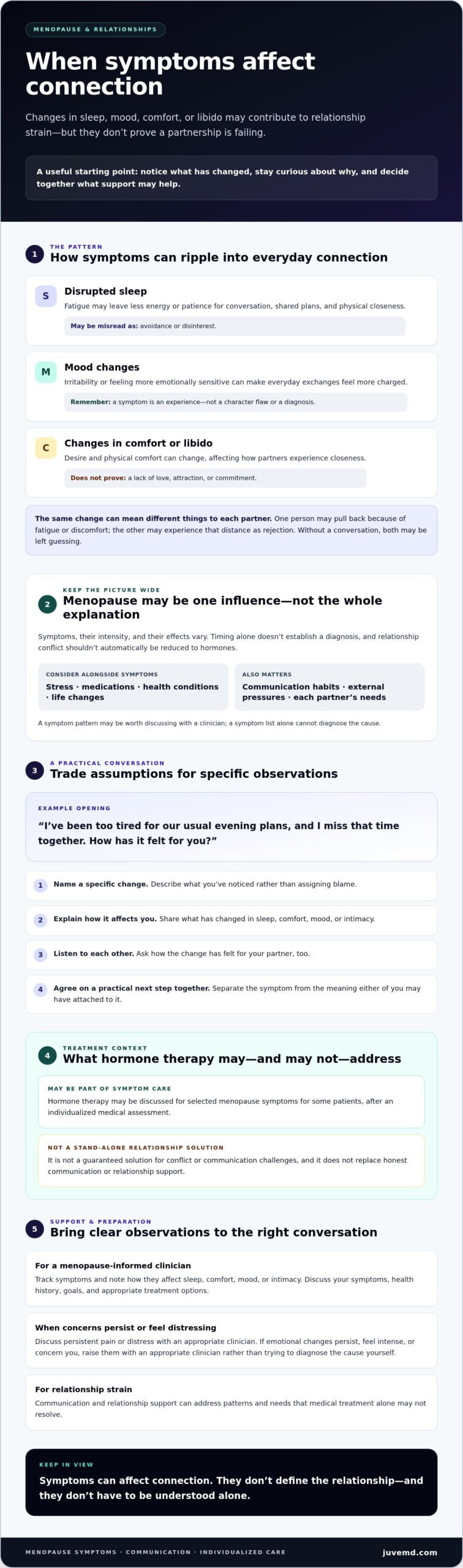
Disrupted sleep can leave someone with less energy or patience for conversation, shared plans, and physical closeness. A partner may see canceled plans or a quiet evening as avoidance, without realizing how depleted the other person feels.
Mood changes can also make everyday exchanges feel more charged. Irritability or feeling more emotionally sensitive is worth discussing as an experience, not labeling as a character flaw or diagnosing from the outside. Changes in sexual desire or comfort may affect intimacy, too. Discomfort, lower interest, stress, medication, and other health or life factors can all play a role, so it’s best not to assume a single cause.
Why can partners interpret the same change differently?
One person may withdraw to manage fatigue or discomfort. The other may interpret that distance as disinterest or rejection. Without a conversation about what’s happening, both partners can be left guessing, and assumptions may become another source of tension.
Try replacing blame with a specific observation and an open question. For example: “I’ve been too tired for our usual evening plans, and I miss that time together. How has it felt for you?” Listening to each other’s perspective can help separate the symptom from the meaning each partner has attached to it.
If you’re researching menopause hormone therapy Las Vegas, it may help to track symptoms and note how they affect sleep, comfort, mood, or intimacy. A clinician can help explore whether symptoms may be menopause-related; that medical conversation is one part of support, not a substitute for addressing relationship patterns together. Naming what’s changed can be a useful first step toward deciding what kind of support makes sense.
How Menopause, Mood, Sleep, and Intimacy Interact
A difficult night can affect the next day’s conversation. If sleep is interrupted, fatigue may make it harder to focus, stay patient, or respond as warmly as you’d like. Mood changes can add another layer, but they aren’t a character flaw, and a symptom alone can’t diagnose depression or anxiety. The National Institute on Aging offers helpful context on understanding the menopausal transition, including possible changes in sleep, mood, and physical comfort.
Menopause may be one influence, not the whole explanation. Stress, other health conditions, medications, and major life changes can also affect sleep, emotions, and intimacy. A pattern that begins during the menopausal transition may be worth discussing with a clinician, but timing by itself doesn’t establish a diagnosis. Relationship conflict also shouldn’t automatically be reduced to hormones; communication habits, external pressures, and each partner’s needs matter, too.
How sleep and mood changes can affect communication
Fatigue can narrow the bandwidth for everyday exchanges. One partner may want to resolve a concern late at night, while the other is too exhausted to engage. Irritability or difficulty concentrating may make that mismatch feel personal, even when low energy is part of the picture. If emotional changes persist, feel intense, or concern you, discuss them with an appropriate clinician rather than trying to diagnose the cause from a symptom list.
What changes in intimacy may mean, and what they do not prove
Desire and physical comfort can change, and those changes may affect how partners experience closeness. They don’t prove a lack of love, attraction, or commitment. Menopause may contribute for some people, but stress, medications, health concerns, and relationship circumstances can also influence intimacy. Persistent pain or distress deserves a conversation with an appropriate clinician, who can help consider possible causes and next steps.
Hormone therapy may be considered for selected menopause symptoms for some patients, based on an individual medical assessment. It isn’t a treatment for communication patterns or relationship distress, and it can’t establish that hormones are the cause of a particular conflict. If you’re exploring menopause hormone therapy Las Vegas, bring a clear account of what you’re experiencing, when it occurs, and how it affects daily life. A medical conversation can help assess symptom and treatment questions, while relationship concerns may call for separate support.
JuveMD, a Las Vegas clinic led by Dr. Andrea Dempsey, provides hormone education and personalized treatment planning. You can learn more about JuveMD’s hormone care as one possible starting point for discussing menopause-related concerns with a clinician.
Does Menopause Hormone Therapy Fix Relationship Problems?
No. Menopause hormone therapy isn’t a guaranteed treatment for conflict, communication difficulties, or relationship distress. It may be considered by a clinician for selected menopause symptoms in some patients, but symptom care and relationship support address different needs. Even if a symptom improves, that doesn’t automatically resolve longstanding misunderstandings, unmet expectations, or patterns of conflict.
That distinction can help couples choose support without assigning blame. Medical care can explore symptoms and possible treatment options. Counseling or other communication support can help partners understand each other’s perspectives and work through relationship patterns. Some people may benefit from one type of support, while others choose to explore both.
What hormone therapy may address, and what it cannot promise
Whether hormone therapy is an appropriate option depends on an individual discussion of symptoms, health history, goals, potential benefits, and risks. The menopause hormone therapy resource from the North American Menopause Society offers background for that conversation. No single formulation, including pellets, is right for everyone or universally superior. A treatment decision should be specific to the person, not based on the hope that a particular approach will repair a relationship.
If symptoms change, partners may find it easier to address daily challenges, but that possibility isn’t a promise of relationship improvement. If difficulties continue, it doesn’t mean treatment has failed or that either partner is at fault. The concerns may need a different kind of support.
When relationship support may be useful alongside medical care
Consider couples counseling if conversations repeatedly become arguments, or individual counseling if you want a private space to understand your own feelings and needs. These are options to explore, not signs that a relationship is beyond repair. A counselor can focus on communication and relationship concerns; a clinician can assess menopause symptoms and discuss medical options. Neither conversation needs to replace the other.
For menopause hormone therapy Las Vegas, bring questions about your symptoms, health history, treatment goals, and potential benefits and risks to a clinician. JuveMD, a Las Vegas clinic led by Dr. Andrea Dempsey, provides hormone education and personalized treatment planning. Its complete bioidentical hormone therapy guide can help you prepare for a discussion about treatment. Relationship support may need to come from a separate counseling provider.
What Couples Can Do When Menopause Affects Their Relationship
When symptoms and relationship tension overlap, it can be hard to know where to begin. A simple sequence can help: notice patterns, name what’s concerning you, listen to each other, and agree on one next step. The goal isn’t to prove that menopause caused a disagreement. It’s to understand what each person is experiencing and decide what support could help.
How to start a supportive conversation about menopause
Choose a calm moment, rather than raising a sensitive concern during an argument or when either of you is exhausted. Describe what you’ve noticed and how it affects you without assigning blame. For example: “I’ve been waking up tired and missing our time together. How has this change felt for you?”
Listen to the answer before proposing a solution. One partner may want more reassurance, while the other may need rest or a different kind of closeness. Agree on one practical change to try, such as setting aside a quieter time to talk, then check in later about whether it helped. Small, specific agreements can be easier to discuss than broad demands to “fix” the relationship.
What to bring up during a clinician appointment
Brief notes can help you describe your experience without trying to diagnose yourself. Record symptoms, when they occur, how they affect daily life, and questions you want to ask. Include relevant health history and medications, and mention concerns about mood, sleep, or intimacy if you feel comfortable.
You might ask:
- Could these symptoms be related to menopause, or should other factors be considered?
- Which treatment options fit my health history and goals, and what benefits and risks should we discuss?
- What follow-up would be appropriate if I choose to begin treatment?
Share severe or alarming symptoms with a healthcare professional promptly. A clinician can advise on appropriate next steps; don’t rely on symptom notes alone to decide what’s causing a change or whether testing is needed.
Medical care can help assess symptoms and treatment options; relationship support can help partners work on communication and connection. These forms of support may complement each other, especially when concerns extend beyond physical symptoms. If you’re exploring menopause hormone therapy Las Vegas, JuveMD offers hormone education and personalized treatment planning. Explore hormone care at JuveMD to learn more about discussing menopause-related questions with the clinic.
Finding Menopause Hormone Therapy Guidance in Las Vegas
A clinician conversation can help clarify whether symptoms may be related to menopause and what options are appropriate for your circumstances. It’s also a chance to discuss your priorities, whether that means addressing sleep disruption, changes in mood, physical discomfort, or questions about intimacy. A medical evaluation can inform decisions about symptoms; it isn’t relationship counseling and can’t promise to resolve conflict between partners.
Questions to ask a menopause clinician in Las Vegas
Come prepared to describe what you’ve noticed, when it happens, and how it affects daily life. Ask what might contribute to your symptoms and whether further evaluation is appropriate. Before choosing treatment, discuss potential benefits, risks, alternatives, and what follow-up may involve. Your medical history, preferences, and goals should be part of that conversation.
- How might my symptoms relate to menopause, and what else could be contributing?
- Which treatment options may fit my health history and goals?
- What benefits and risks should I weigh, and how would we review my progress?
- Are there alternatives I should consider?
These questions can help make a discussion about menopause hormone therapy Las Vegas more focused without assuming in advance that hormone treatment is the right choice.
How to choose the next support step
If symptoms affect your well-being or everyday activities, consider speaking with a clinician about assessment and treatment options. If communication remains difficult or conflict continues, couples or individual counseling may offer a separate kind of support. You don’t have to decide that one explains everything before seeking help with both health concerns and relationship needs.
JuveMD is a Las Vegas medical clinic led by Dr. Andrea Dempsey. The clinic provides hormone education and personalized treatment planning, including bioidentical pellet hormone therapy and injectable treatments. It is a resource for hormone-health questions, not relationship counseling. To learn more about the clinic’s approach, explore JuveMD’s hormone care and consider whether a conversation about your concerns feels like a useful next step.
Take a Thoughtful Next Step Toward Better Support
Menopause-related changes in sleep, mood, comfort, or desire can affect connection, but they don’t prove a relationship is failing or explain every disagreement. Start by sharing specific experiences, listening without blame, and agreeing on what support to explore. A clinician can assess symptoms and discuss whether menopause treatment options fit your health history and goals. Relationship counseling may help address communication patterns that medical treatment isn’t designed to resolve.
If you’re considering menopause hormone therapy Las Vegas, JuveMD is a local medical clinic led by Dr. Andrea Dempsey. The clinic offers hormone education and personalized hormone treatment planning, so you can raise questions about your symptoms and care options without assuming a particular treatment is right for you.
Explore JuveMD hormone care and discuss your questions. Seeking the right kind of support is a constructive step, and you can take it at your own pace.
Frequently Asked Questions
Can menopause cause relationship problems?
Menopause symptoms can contribute to relationship tension, but they don’t explain every difficulty. Disrupted sleep, mood changes, physical discomfort, or shifts in sexual desire may affect energy, patience, and closeness. Experiences differ from person to person. Try discussing specific changes with your partner without assigning blame. If conflict continues or communication feels stuck, relationship counseling may help alongside a separate medical conversation about symptoms.
Can hormone therapy improve relationships during menopause?
Hormone therapy may be considered for selected menopause symptoms after an individualized medical assessment, but it isn’t a treatment guaranteed to repair communication, trust, or conflict. A clinician can discuss whether an option fits your symptoms, health history, and goals, including potential benefits, risks, and alternatives. Couples may also choose direct conversations or counseling to address relationship concerns that medical treatment isn’t designed to resolve.
What menopause symptoms can affect intimacy?
Changes in desire, physical comfort, sleep, mood, or energy may influence intimacy, but there isn’t one explanation that applies to everyone. These changes don’t automatically mean a partner feels rejected or has lost interest. If pain or another concern persists or causes distress, discuss it with an appropriate clinician. A conversation can help explore possible contributing factors and suitable next steps without assuming a cause.
How do I talk to my partner about menopause-related changes?
Choose a calm time and describe what you’ve noticed, how it affects you, and what support might help. For example, you could say, “I’ve been sleeping poorly, and I have less energy in the evenings. Can we talk about how to make that time easier?” Ask how your partner is experiencing the changes, too. Focus on understanding rather than blame; consider relationship counseling if discussions repeatedly become difficult.
When should I see a doctor about menopause symptoms affecting my relationship?
Consider speaking with a clinician if symptoms persist, cause distress, affect daily life, or prompt questions about treatment. Before the visit, note what you experience, when it occurs, relevant health history, and medications. A clinician can assess possible contributing factors and discuss options. Seek urgent medical care for severe or alarming symptoms instead of waiting for a routine appointment or assuming they’re menopause-related.
Is menopause hormone therapy right for everyone?
No. Whether menopause hormone therapy is appropriate depends on your symptoms, health history, preferences, and a clinician’s assessment of potential benefits and risks. Treatment approaches and alternatives can be discussed as part of individualized care. If you’re considering menopause hormone therapy Las Vegas, ask how your circumstances shape the options and follow-up. Don’t start or change hormone treatment based only on an article.
Can a relationship improve without hormone therapy?
Yes. Choosing hormone therapy isn’t a requirement for working on a relationship. Partners can share their needs, make practical adjustments, and consider counseling if communication or conflict remains difficult. Medical evaluation may still help clarify symptoms and available care, but relationship support addresses different concerns. The next step can reflect both partners’ goals, health questions, and the type of support they want to explore.