
Reducing crow’s feet without surgery in Las Vegas can involve Botox, which temporarily relaxes the muscles that create expression lines around the eyes. Initial improvement is typically noticeable within 3-5 days, with full results appearing at approximately 2 weeks. Crow’s feet often start as creases when you smile or squint and may become visible when your face is at rest.
Wanting a softer look without losing the expressions that feel like you is understandable. If you’re considering reducing crow’s feet without surgery in Las Vegas, it helps to know what causes these lines, how Botox works, and what to discuss before treatment.
This article explains why crow’s feet develop, what to expect from Botox, and how a consultation can help tailor an approach to your facial movement and goals. It also outlines nonsurgical skin-treatment options available at JuveMD in Las Vegas.
Key Takeaways
- Crow’s feet often begin as expression lines around the outer eyes and can become visible even when your face is at rest.
- Botox temporarily relaxes the muscles that contribute to these lines; initial improvement is typically noticeable within 3-5 days, with full results at approximately 2 weeks.
- An appointment for crow’s feet injections typically takes 10-15 minutes, so understanding the treatment timeline can help you plan.
- Sun exposure, genetics, and everyday facial movements can influence how crow’s feet develop; broad-spectrum sunscreen is one part of a skin-protection routine.
- A personalized consultation can connect your goals and facial movement patterns to a treatment plan, including whether injectables are a suitable option.
What Are Crow’s Feet?
Crow’s feet are fine lines at the outer corners of the eyes, sometimes called laugh lines. Repeated expressions can make these creases more noticeable over time.
Crow’s Feet Formation and Contributing Factors
Crow’s feet form as repeated facial movement and changes in skin contribute to creases beside the eyes. The muscles around the eyes contract thousands of times every day during smiling, laughing, squinting, and blinking. Sun exposure, sunscreen use, diet, and genetics can also affect how these lines develop. Understanding these influences helps distinguish expression-related creases from other changes in the skin.
Dynamic and Static Crow’s Feet
Dynamic crow’s feet appear during expressions such as smiling or squinting; static lines remain visible when the face is relaxed. A crease that appears only with a smile reflects movement, while one visible at rest is more persistent. Noting how lines look both during expression and at rest helps clarify what a treatment may address.
Timing varies. People may first notice crow’s feet in their 30s, while skin-care routines and genetics can mean they appear in the 40s. Early lines often show when someone smiles or squints. With time, creases may remain visible after the expression ends. Age alone doesn’t determine when they form; sun exposure and individual skin characteristics also contribute.
For treatment in Las Vegas, choose a provider who assesses the eye area, facial movement, and your goals before discussing options. Ask for a clear explanation of the proposed approach, expected timing, and possible risks. An individualized assessment is more useful than choosing a treatment based on one line or a photograph alone.
Laser resurfacing and microneedling costs in Las Vegas depend on the treatment area, method, and number of sessions; the price depends on the case and is given after a quote request.
Retinoids such as retinol may support collagen and elastin production, while moisturizers help maintain skin hydration. Exfoliation removes dead cells from the skin’s surface and may soften the appearance of fine lines. Retinol can also cause itching, peeling, redness, puffiness, or scaly patches. Avoid direct sunlight after applying it and follow the product directions.
At home, use broad-spectrum sunscreen regularly and build a consistent skin-care routine. All sunscreens help protect against sunburn. According to the U.S. Food and Drug Administration, only broad-spectrum sunscreen with an SPF of at least 15 helps protect against UV rays that increase skin-cancer risk and early sun aging. Avoiding smoking, staying hydrated, eating well, and managing stress can also support skin health.
Injection procedure and appointment duration
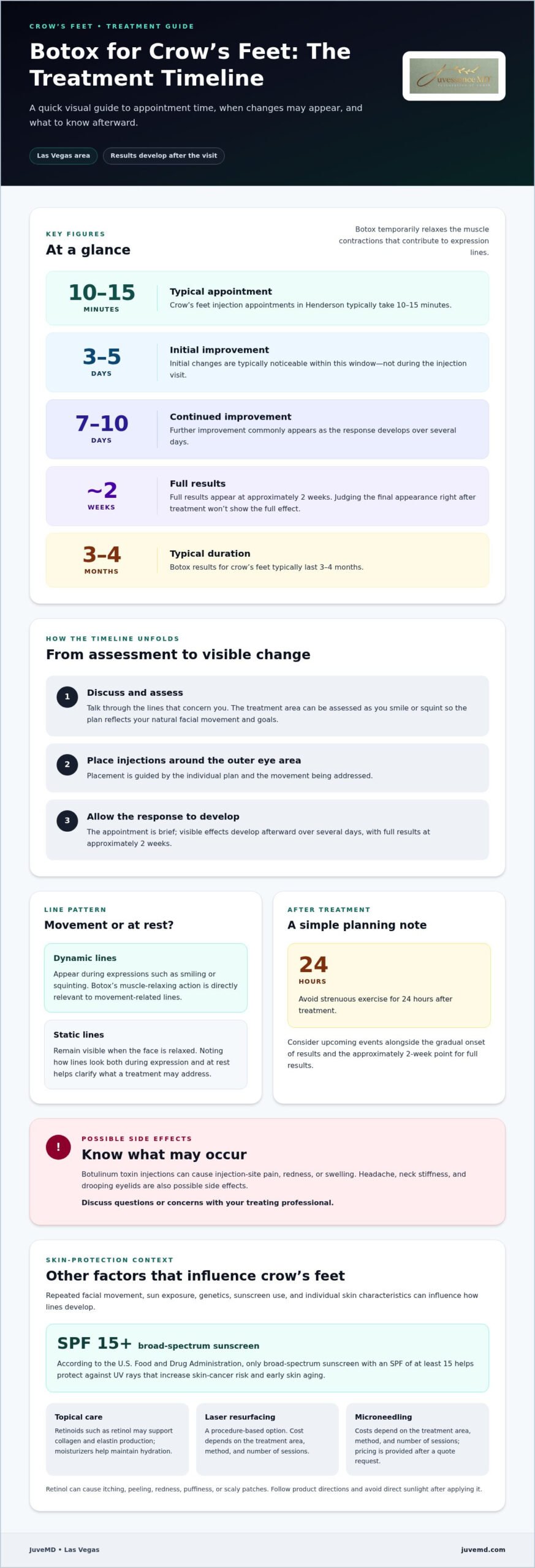
Botox injections for crow’s feet use a botulinum toxin neuromodulator to temporarily reduce the muscle contractions that create expression lines. The appointment is brief, but the visible effect develops afterward, not during the injection visit. In Henderson, appointments for crow’s feet typically take 10-15 minutes. The treatment area and the movement being addressed guide where injections are placed.
A typical visit begins with a discussion of the lines that concern you, including whether they appear during expression or remain visible at rest. The treatment area can then be assessed as you smile or squint, so the plan reflects your natural facial movement. Injections are placed around the outer eye area, with placement guided by the individual plan.
After treatment, the response unfolds over several days. Initial improvement is typically noticeable within 3-5 days. Continued improvement commonly appears within 7-10 days, with full results at approximately 2 weeks. Botox results for crow’s feet typically last 3-4 months. These milestones help explain why judging the final appearance immediately after an appointment won’t show the full effect.
Aftercare matters, too. Avoid strenuous exercise for 24 hours after treatment. Botulinum toxin injections can cause injection-site pain, redness, or swelling. Headache, neck stiffness, and drooping eyelids are also possible side effects. Knowing these potential effects beforehand helps you understand what to watch for after the visit and when to discuss a concern with your treating professional.
Botox, laser treatments, and topical products work in different ways. Botox targets the muscle activity behind expression lines; topical products such as retinol support skin care, while laser resurfacing is a procedure-based option. The useful comparison depends on whether your main concern is movement-related creasing, skin texture, or lines visible at rest.
For dynamic lines that appear with smiling, Botox’s muscle-relaxing action is directly relevant. Retinol may support collagen and elastin production, but it does not work like an injectable. Laser resurfacing is different from both: it is neither a topical routine nor a neuromodulator injection. Your skin condition and the type of lines you want to address help guide the choice.
A useful appointment plan accounts for the full timeline, not only the time spent in the treatment room. Consider upcoming events alongside the gradual onset of results and the approximately 2-week point for full results. A discussion of your goals, facial movement, and possible side effects can clarify whether Botox fits the concern you want to address.
Causes of wrinkles around the eyes
The skin beside each eye folds as the face makes expressions. Smiling, laughing, squinting, and blinking all engage the muscles around the eyes. Repeated movement can leave creases that become more visible over time. This helps explain why lines may first show during a smile rather than across the entire face.
Sun exposure is another influence on skin aging around the eyes. UV exposure can contribute to early sun-related aging, while regular sunscreen use helps protect skin. According to the U.S. Food and Drug Administration, all sunscreens help protect against sunburn, but only broad-spectrum sunscreens with an SPF of at least 15 help protect against UV rays that increase skin-cancer risk and early skin aging caused by the sun. Broad-spectrum coverage is the relevant label when considering both effects.
Genetics also helps explain why people notice crow’s feet at different times. Skin-care routine and inherited traits can affect when lines become apparent. Some people first notice them in their 30s; for others, they may not appear until their 40s. These ages are common patterns, not a timetable that predicts the same changes for every face.
Age and facial movement interact. A crease may appear when someone squints outdoors, then fade when the expression ends. Over time, crow’s feet can become visible even when the face is at rest. Looking at both a relaxed face and a smile gives a fuller picture of whether lines are mainly expression-related or more persistent.
Crow’s feet are reported to appear earlier and form deeper wrinkles in men than in women. This describes a general pattern, not every individual. Two people of the same age may have different line patterns because facial movement, genetics, and sun exposure vary.
Daily habits shape the overall picture, but no single factor explains every crease. Diet and skin-care routine are among the influences associated with crow’s feet. Sunscreen use matters because protecting skin from UV exposure addresses one contributor to early aging. Frequent squinting outdoors may make expression lines more noticeable, while another person’s lines may be more apparent at rest.
These causes offer practical clues for prevention. Broad-spectrum sunscreen with the relevant SPF protection can help limit UV-related skin aging. Notice where lines appear: only during a smile, or also when your face is relaxed. This helps identify whether movement or persistent creasing is the main concern, rather than relying on age alone.
Personalized consultations and treatment planning
A personalized consultation turns a general goal into a focused plan for the eye area. Start by describing what bothers you most, such as lines that appear with a smile or creases visible at rest. Explain whether you want softer lines, a change in skin texture, or both. If you’re considering reducing crow’s feet without surgery in Las Vegas, these priorities help keep the discussion focused on your concerns, not a one-size-fits-all approach.
An assessment can consider how your face moves during expressions and where the lines appear. For example, the pattern beside one eye may differ from the other. A useful discussion connects those observations with the change you hope to see. Mention treatments you have tried, such as sunscreen or retinol, and how your skin responded. That context can help shape the plan.
Botox may be discussed for lines connected to muscle movement. Other concerns may lead to a conversation about skin-focused approaches. The options aren’t interchangeable: each addresses a different part of the concern. A clear plan explains the intended target, what changes to watch for, and how the approach relates to your goals. This gives you a practical basis for deciding whether to proceed.
Ask how the treatment plan accounts for your natural expressions. Softening lines does not have to mean eliminating every crease when you smile. Share a specific preference, such as wanting lines to look less visible in photographs while keeping a natural expression. This helps keep the discussion centered on what you want to change.
Some plans may include complementary treatments. A provider may recommend fillers or microneedling alongside other care to enhance results and help them last longer. Whether those options fit depends on the concern being addressed and the intended treatment approach. The consultation should explain how each proposed treatment contributes, rather than treating additional procedures as automatic.
Use the conversation to clarify the plan before treatment. Consider these points:
- Target: Identify whether movement-related lines, skin texture, or both are your main concern.
- Approach: Ask how each proposed treatment relates to that target.
- Outcome: Describe the change you want, using an example from daily expressions or photographs.
- Follow-up: Understand how progress will be reviewed and what signs matter.
A consultation about reducing crow’s feet without surgery in Las Vegas can connect your goals, facial movement, and treatment options. Aim to leave with a clear understanding of each option’s purpose and how the proposed plan reflects your preferences.
Botox treatment in Henderson and the Las Vegas area
Throughout the Las Vegas area, Botox is a nonsurgical option for crow’s feet caused by muscle movement. This neuromodulator temporarily reduces the activity of muscles that contract around the eyes. It targets movement contributing to expression lines rather than directly changing the skin’s surface. That distinction explains why Botox and skin-focused treatments are not interchangeable.
Regional search results often focus on the injection itself, but treatment timing matters just as much. Improvement develops gradually, so an appointment close to an important event may not allow time to see the full effect. Initial changes typically appear within 3-5 days, with continued improvement within 7-10 days. Full results typically appear at approximately 2 weeks, and results commonly last 3-4 months.
These milestones can help with planning around a Las Vegas visit, work commitments, or a celebration. They also provide a sensible frame for assessing changes: the appearance immediately after treatment isn’t the final result. A typical crow’s feet appointment at JuveMD takes 10-15 minutes. Even with a brief visit, the treatment area and desired degree of softening deserve careful consideration.
Botox is not designed to erase every line or stop normal expression. The aim is to address muscle activity associated with crow’s feet while considering how your face moves. Lines visible at rest may involve factors beyond repeated movement, so distinguish those concerns before choosing an approach. A clear goal might be softer lines when smiling, rather than a motionless appearance.
After injections, avoid strenuous exercise for 24 hours. Possible effects include pain, redness, or swelling at injection sites, as well as headache, neck stiffness, or drooping eyelids. Knowing these potential effects helps you plan the hours after an appointment and recognize what treatment discussions should cover. The area around the eyes is delicate, so understanding the intended injection area and the aftercare guidance is part of informed planning.
Are there Nevada rules for who can administer Botox or cosmetic laser treatments? Botox injections and cosmetic laser treatments are distinct procedures, so don’t assume the same requirements apply to both. The relevant Nevada requirements depend on the procedure and the practitioner’s role; this section doesn’t state a specific rule or credential.
For a treatment discussion focused on reducing crows feet without surgery Las Vegas, explore injectable treatment options and consider how your goals, facial movement, and timing fit together. The practical takeaway is simple: plan around Botox’s gradual results, understand the potential side effects, and distinguish movement-related lines from concerns requiring a different approach.
JuveMD: Bioidentical Pellet Hormone Therapy
JuveMD offers Bioidentical Pellet Hormone Therapy, a separate service from care focused on crow’s feet. For lines around the eyes, JuveMD offers injectables and Skin Treatments. A discussion can focus on whether your main concern is expression-related lines, skin texture, or both, and which approach aligns with your goals. Hormone therapy should not be presented as a crow’s feet treatment.
To discuss concerns around your eyes and nonsurgical options in Las Vegas, contact JuveMD about injectables or Skin Treatments.
Choose a Next Step That Fits Your Goals
If you’re considering reducing crow’s feet without surgery in Las Vegas, start with a clear conversation about the look you want. Think about when the lines stand out, how you want your expressions to look, and what change would feel meaningful. Those priorities help focus the treatment discussion on your concerns rather than a one-size-fits-all idea of smoother skin.
A consultation is also a chance to ask questions and consider how an approach fits your facial movement and preferences. You do not need to arrive with every decision made. Start with what you have noticed and hope to change; the conversation can help clarify the options.
Contact JuveMD to discuss treatment and explore a personalized next step. A thoughtful plan can help you feel informed and comfortable moving forward.
Frequently Asked Questions
Is Botox Safe?
Botox is not risk-free, and possible effects should be part of the treatment discussion. Share your health history and ask how the injection plan relates to your eye area and goals. Possible effects include injection-site pain, redness or swelling, headache, neck stiffness, and drooping eyelids. This article is educational only, not medical advice. Consult your own healthcare provider before making health-related decisions; results may vary.
What Happens During Treatment?
During a Botox appointment, the treatment area and your facial movement are assessed before injections are placed around the outer eyes. The injections temporarily reduce muscle activity associated with crow’s feet. The appointment itself is brief, while changes in appearance develop gradually afterward. Before leaving, make sure you understand the aftercare instructions and know which changes or concerns to discuss with your healthcare provider.
What questions should I ask my doctor?
Ask what the proposed treatment is intended to change, how it fits your facial movement, and what alternatives address your specific concern. You can also ask about possible side effects, aftercare, and when to assess the result. If comparing Botox with skin treatments, ask how each targets your concern differently. Sharing your desired look makes the discussion more specific.
When Will I See Results?
Initial improvement after Botox is typically noticeable within 3-5 days. Changes continue over 7-10 days, and full results typically appear at approximately 2 weeks. Use that gradual timeline when planning around photographs or events, rather than expecting the final appearance immediately after treatment. Botox results for crow’s feet typically last 3-4 months, though the treatment plan and individual response matter.
What nonsurgical treatments reduce crow’s feet?
Botox addresses muscle movement associated with expression lines. Skin-care approaches such as retinol, exfoliation, and sunscreen focus on skin condition and protection rather than muscle activity. Chemical peels and microneedling are other options for skin concerns, while fillers may complement treatment in selected plans. These methods work differently, so compare the concern each targets rather than ranking one as “best.”
How effective are Botox and Dysport for crow’s feet, and how long do results last?
Botox temporarily relaxes muscles involved in crow’s feet, and results typically last 3-4 months. Dysport is described for lines between the eyebrows, so that information alone doesn’t establish its effect on crow’s feet. Its results may appear within 2-3 days, but onset timing isn’t the same as evidence of effectiveness for every treatment area. Discuss the specific area and goal with your healthcare provider.
What are the risks and side effects of Botox around the eyes?
Possible side effects include pain, redness, or swelling where injections were placed, headache, neck stiffness, and drooping eyelids. Before proceeding, make sure you understand the treatment plan and aftercare for the eye area. Ask what to expect and how to respond if a concern arises. Share relevant health information during your consultation so the discussion reflects your circumstances.
What should I expect before and after nonsurgical crow’s feet treatment?
Before treatment, describe the lines you want to address and the appearance you hope to maintain during expressions. After Botox, avoid strenuous exercise for 24 hours. The effect develops gradually, so allow time before evaluating the outcome or scheduling around an event. For topical retinol, follow product directions and avoid direct sunlight after applying it, as irritation or peeling can occur.