
The best hair-restoration option isn’t necessarily the one with the boldest promise. It’s the one that fits the cause and pattern of your hair loss. If you’re comparing non-surgical hair restoration options Las Vegas clinics may discuss, start by separating what a treatment is intended to do from what it can realistically address.
Hair thinning can have different causes, and an approach that may suit one person isn’t automatically right for another. A clinical evaluation can help clarify which details matter, including when the changes began, your health history, and what you hope to address.
This guide compares common categories of non-surgical care, explains what can affect suitability and expectations, and offers practical questions to bring to an evaluation. JuveMD, a Las Vegas medical clinic led by Dr. Andrea Dempsey, offers hair restoration and can be a local next step for discussing your concerns and goals.
Key Takeaways
- Non-surgical hair restoration includes different approaches. The right discussion depends on the type and pattern of hair loss.
- When comparing non-surgical hair restoration options Las Vegas clinics may discuss, look at suitability, rationale, risks, and follow-up, not just the treatment name.
- A clinical evaluation can help connect your concerns, health history, and goals to options worth discussing.
- Note when you first noticed hair changes, what you’ve tried, and what you hope to address before an appointment.
- JuveMD is a Las Vegas medical clinic led by Dr. Andrea Dempsey that offers hair restoration and personalized clinical care.
Non-surgical hair restoration in Las Vegas starts with understanding hair loss
A wider part, a thinning hairline, or increased shedding can raise questions about what to do next. “Non-surgical” describes a broad category, not one specific treatment. It may include clinician-guided medical care and in-office procedures. Comparing non-surgical hair restoration options Las Vegas clinics discuss is more useful once you understand what may be contributing to the change.
Hair loss has different causes and patterns, and appearance alone can’t establish the reason. An evaluation considers the timing of changes, relevant health history, and what you want to address. Suitability depends on those details, not simply on a treatment’s popularity.
What can contribute to thinning hair?
Pattern hair loss often develops gradually, while other forms may appear more suddenly or in distinct patches. Hormonal changes can be relevant for some people. Changes in health, medications, nutrition, or scalp condition may also be factors a clinician considers. These possibilities can overlap, so a particular pattern doesn’t prove a specific cause.
Sudden shedding, patchy loss, or thinning that continues to progress deserves clinical assessment rather than guesswork. The timing, distribution, and other symptoms can help guide what to evaluate. For a broader introduction to the different types and causes of hair loss, see this overview. An individual assessment is still needed to understand your situation.
Why the cause matters before comparing treatments
Cause, pattern, and duration can shape which options are relevant and what a reasonable goal might be. A clinician may discuss whether the priority is addressing a contributing factor, supporting hair growth, or improving the appearance of visible thinning. Those aims aren’t interchangeable. An approach directed at one type of hair loss may not address another, and a change in shedding may call for a different discussion than gradual pattern thinning.
Before an evaluation, note when you first noticed the change, whether it seems stable or is progressing, any recent health or medication changes, and what care you’ve already tried. Be specific about your goals, too. You may want to understand ongoing shedding, visible density, or which next step is appropriate.
Individualized hair-restoration planning means matching the discussion to your hair-loss pattern, health history, and goals instead of starting with a one-size-fits-all treatment. That cause-first conversation helps you compare approaches and set more grounded expectations before considering specific options.
Which non-surgical hair restoration options may be considered in Las Vegas?
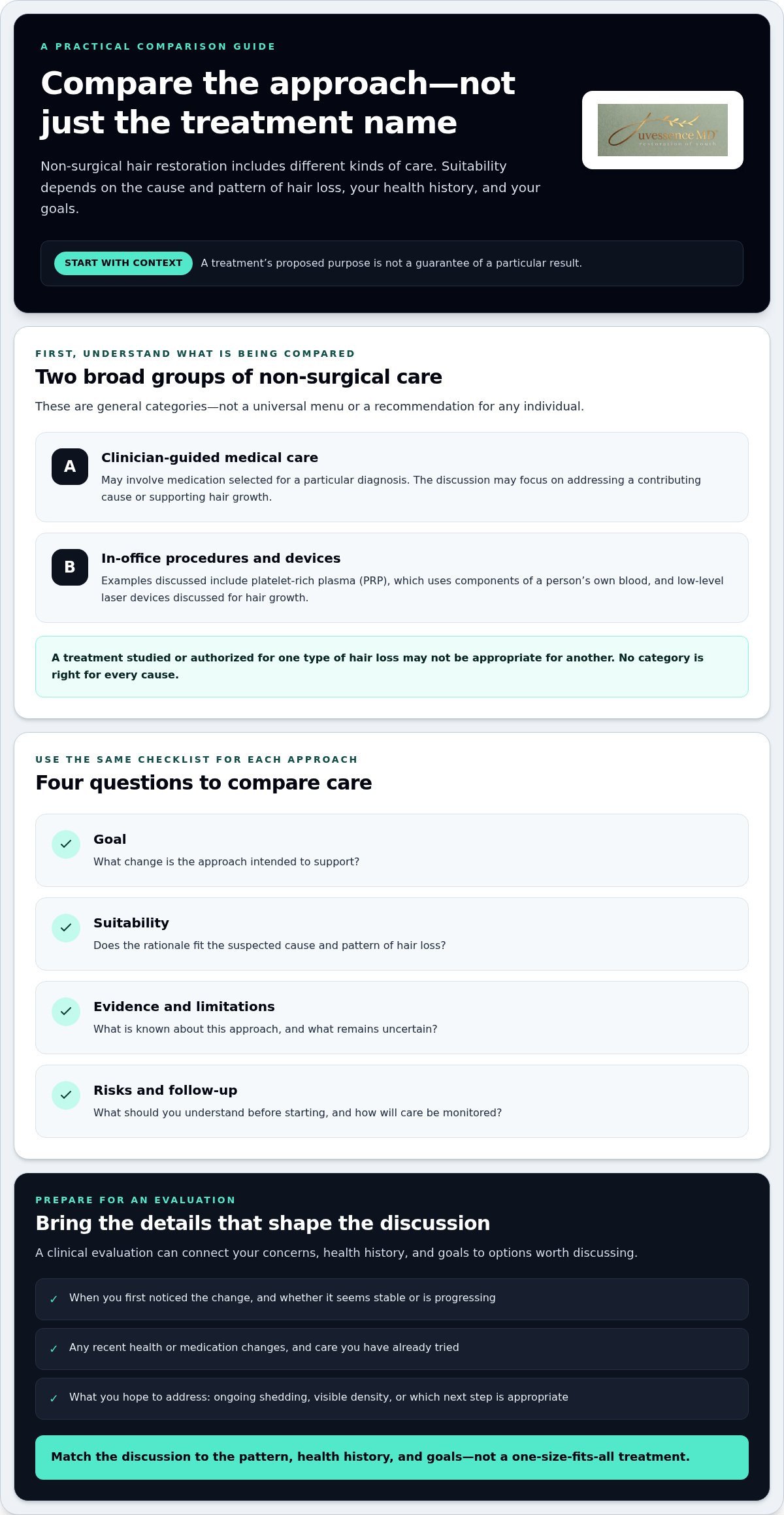
Non-surgical care generally falls into two broad groups: clinician-guided medical approaches and in-office procedures. Medical care may involve medication selected for a particular diagnosis. Procedures may include platelet-rich plasma (PRP), which uses components of a person’s own blood. Low-level laser devices are another category discussed for hair growth. These examples provide general context, not a universal menu or a recommendation for any individual.
Options differ in purpose, evidence, candidacy, potential risks, and follow-up. A treatment studied or authorized for one type of hair loss may not be appropriate for another. The American Academy of Dermatology’s overview of hair-loss treatments offers background, but an individualized assessment is needed to connect general information with your circumstances.
How to compare medical and in-office approaches
Use the same practical questions to compare each approach. Medical care may be intended to address a diagnosed cause or support hair growth, while an in-office procedure may aim to address thinning through a different mechanism. PRP is one procedure category, but its evidence, suitability, and risks should be discussed in relation to your pattern of loss rather than assumed. No category is right for every cause.
- Goal: What change is the approach intended to support?
- Suitability: Does the rationale fit the suspected cause and pattern of loss?
- Evidence and limitations: What is known about this approach, and what remains uncertain?
- Risks and follow-up: What should you understand before starting, and how will care be monitored?
These questions separate a treatment’s proposed purpose from broad claims about results. They also make it easier to compare medical care with an in-office procedure without assuming one is inherently better.
Questions to ask about suitability and expectations
Ask what benefits may be realistic for your situation, what limitations or risks apply, and what alternatives could be considered. Clarify how progress will be assessed, which signs will be tracked, and when the plan may be reviewed. These details matter because hair changes can take time to evaluate, and appropriate follow-up depends on the approach and your circumstances.
A treatment goal describes what care is intended to support; it isn’t a guarantee of a particular result. If you’re comparing non-surgical hair restoration options Las Vegas patients may explore, a personalized conversation can put the categories in context. For a local discussion of hair restoration, explore personalized care with JuveMD.
How to compare Las Vegas hair restoration providers and treatment plans
A polished presentation or confident promise can’t tell you whether a plan fits your situation. Compare the explanation instead. Does it connect your concerns and evaluation findings to the proposed approach? Does it make limitations clear? This framework can help you assess non-surgical hair restoration options Las Vegas clinics may discuss without assuming one approach is right for everyone.
| What to compare | What a clear plan should explain |
|---|---|
| Evaluation | What information or findings inform the recommendation, and what remains uncertain? |
| Rationale | How does the proposed care relate to the concern being addressed and the plan’s intended goal? |
| Risks and limitations | What potential risks, constraints, and alternatives should you understand before deciding? |
| Follow-up | What follow-up is expected, and when will the plan be reviewed? |
| Progress measures | How will changes be tracked, and what observations will inform next steps? |
What a clear clinical plan should explain
A clear plan links your concerns and evaluation findings to the care being proposed. It should explain the reasoning, describe relevant alternatives and limitations, and outline safety considerations and follow-up. The details depend on your evaluation. If a recommendation feels disconnected from your circumstances, ask for a clearer explanation before deciding.
Educational resources can help you prepare for that discussion. The American Hair Loss Association’s information on non-surgical treatments offers general context; it doesn’t replace an individualized clinical assessment.
How to interpret claims, reviews, and progress photos
Testimonials describe one person’s experience. They can offer perspective, but they aren’t a substitute for clinical evidence or a prediction of what someone else will experience. Hair changes and treatment timelines vary, so don’t read a review or before-and-after image as a guaranteed outcome.
Look for transparent explanations of the approach and how progress will be evaluated. If photos are used, consistent lighting, angles, distance, and hair styling can make comparisons more meaningful. Images alone, however, can’t establish why a change occurred. Be cautious of broad promises that don’t explain who a treatment may suit, what it can’t address, or how results will be monitored. A thoughtful comparison centers on clear explanations and individualized planning, not the most dramatic claim.
What to expect when exploring non-surgical hair restoration in Las Vegas
A hair-restoration consultation is a conversation, not a promise that a particular treatment will be recommended. The aim is to understand your concerns, consider relevant health information, discuss the assessment, and review options that may fit your situation. This gives you a chance to understand the reasoning before deciding what, if anything, to pursue.
- Describe your concerns. Share what changes you’ve noticed and what you’d most like to address.
- Review relevant history. Discuss health or medication changes and any previous hair-loss care.
- Discuss the assessment. Ask what the evaluation suggests and whether more information is needed.
- Consider options. Review possible approaches, limitations, risks, and follow-up before making a decision.
How to prepare for a hair-restoration consultation
A few notes can make the discussion more useful. Write down when you first noticed hair changes and how they’ve shifted over time. Bring relevant health history, a list of current concerns, and details of care you’ve already tried. You might also note what matters most to you, such as understanding the cause, addressing visible changes, or learning which next steps are reasonable.
Consider asking:
- What does the assessment suggest, and what remains uncertain?
- What factors affect whether an approach may suit me?
- What are the potential risks, limitations, and alternatives?
- How would progress be reviewed, and when might the plan be reassessed?
If you’re seeking information specific to women’s hair concerns, the clinic’s related article on hair-loss treatment for women may offer useful educational context alongside this guide.
How progress and follow-up can be discussed
Hair changes can be difficult to judge from memory alone. A clinician may discuss a consistent way to review progress, such as recording observations or comparing photographs taken under similar conditions. The right measures depend on the concern and care plan; no single tracking method fits every situation.
Follow-up timing also depends on the plan, so avoid treating a generic timeline or another person’s results as a prediction. Ask what changes will be monitored, how to share concerns between reviews, and what might prompt a reassessment. These details help set realistic expectations without implying a guaranteed outcome.
For a personalized conversation about hair restoration, schedule a consultation with JuveMD, a Las Vegas medical clinic led by Dr. Andrea Dempsey.
Explore personalized hair restoration care with JuveMD in Las Vegas
After comparing approaches, a focused clinical conversation can help you consider your own concerns. JuveMD is a Las Vegas medical clinic led by Dr. Andrea Dempsey that offers hair restoration. Use an individualized discussion to connect your questions and goals with the factors that may shape a plan, rather than treating a list of options as a one-size-fits-all menu.
A personalized starting point for hair restoration
Start by sharing what you’ve noticed, when the changes began, and what you hope to understand or address. Relevant health history and previous care can add context. The conversation can then explore what an evaluation suggests, whether an approach may suit your circumstances, and which expectations, limitations, risks, and follow-up considerations matter to you.
Take the time you need to understand the rationale before deciding on care. Ask how a proposed approach relates to your concerns, what alternatives may be relevant, and how progress would be reviewed. The details depend on individual evaluation, so a thoughtful discussion should clarify what is known about your situation and what still needs consideration.
For a deeper service overview, JuveMD’s hair-restoration treatment guide can help you continue learning about the care pathway. Use it alongside your own questions, not as a substitute for discussing your individual needs and goals with a clinician.
Take the next step with a Las Vegas clinic
Searching for non-surgical hair restoration options Las Vegas can bring up many approaches and strong claims. You don’t need to choose based on a headline or decide before understanding what may be appropriate for you. A personalized conversation can turn general information into questions and next steps that reflect your circumstances.
JuveMD offers hair restoration in Las Vegas. Explore the clinic’s hair-restoration care to learn more and consider whether a clinical discussion is the right next step. The aim is clarity: understand your concerns, discuss suitability and expectations, and decide how you’d like to proceed without assuming a particular treatment or outcome in advance.
Explore hair restoration care at JuveMD
Make your next step a well-informed one
The most useful way to compare non-surgical hair restoration options Las Vegas offers is to start with the cause and pattern of hair loss, then consider how each approach fits your health history and goals. Options differ in purpose, evidence, risks, and follow-up, so clear explanations matter more than broad promises. A personalized clinical evaluation can help turn uncertainty into an informed conversation about what may be appropriate for you.
JuveMD is a Las Vegas medical clinic led by Dr. Andrea Dempsey, with hair restoration among its services. If you’re ready to discuss your concerns and explore an individualized next step, explore personalized hair restoration care at JuveMD.
You don’t need every answer before you begin. A thoughtful conversation can help you move forward with greater clarity and confidence.
Frequently Asked Questions
Is non-surgical hair restoration effective for every type of hair loss?
No single approach is right for every person or every cause of hair loss. Suitability depends on factors such as the pattern of change, health history, and clinical assessment. An evaluation can help clarify which options may be relevant and what each is intended to address. Before deciding, discuss potential benefits alongside limitations, risks, and follow-up needs so expectations are grounded in your circumstances.
What non-surgical hair restoration options are available in Las Vegas?
Non-surgical hair restoration is a broad category that can include different medical approaches and in-office procedures. The options a clinician discusses depend on your concerns and evaluation findings. As you compare non-surgical hair restoration options Las Vegas clinics may discuss, consider each approach’s purpose, suitability, evidence, risks, and follow-up needs. A treatment’s popularity alone can’t show whether it’s appropriate for your hair-loss pattern or goals.
How do I choose a hair restoration treatment plan?
Start by discussing what may be contributing to your hair changes with a clinician. Ask how the assessment informs the proposed plan, what each approach is intended to address, and what alternatives may be relevant. Clarify potential limitations and risks, how progress will be assessed, and what follow-up may involve. A clear recommendation should connect the evaluation to the proposed care without promising a particular result.
Can hormonal changes contribute to hair thinning?
Yes, hormonal factors can be relevant to some hair-loss concerns, but they’re only one possible contributor. Hair changes can have different causes, and symptoms alone can’t establish a diagnosis or determine which care may be suitable. Share relevant health history and concerns during a clinical evaluation. A clinician can consider whether hormonal influences or other factors may be relevant to understanding your hair changes and discussing next steps.
How long does non-surgical hair restoration take to show results?
There isn’t one timeline that applies to every person or approach. Progress can depend on the cause of hair loss, the care plan, and how changes are assessed. Ask what signs to monitor, when follow-up may be appropriate, and when the plan could be reviewed. General timelines and testimonials describe other experiences, not a personal forecast or guarantee of results.
Is non-surgical hair restoration painful or risky?
Comfort and risk depend on the specific approach, your health, and the details of care. “Non-surgical” doesn’t mean risk-free. Before deciding, ask the clinician to explain potential discomfort, relevant risks, alternatives, and follow-up considerations. Share health concerns and previous care that could inform the discussion. Understanding these points can help you weigh potential benefits and limitations for your situation.
Can women in Las Vegas seek treatment for hair thinning?
Yes. Women in Las Vegas can seek clinical evaluation for hair thinning. The appropriate next step depends on the pattern of change, health history, and possible contributing factors. An individualized discussion can help clarify which concerns may call for different approaches. JuveMD offers hair restoration, but no particular treatment or outcome is appropriate for every woman.