
What if slower muscle gains call for a closer look at your health, not a shortcut? If you’re searching “improving muscle mass with testosterone Las Vegas,” you may be wondering whether hormone levels could be part of the picture. A plateau can be frustrating, and online claims can make testosterone sound like a fast track to strength. Clinically, it may be relevant when symptoms and testing point to a deficiency. It isn’t a muscle-building solution for everyone.
This article explains how testosterone relates to muscle health, what clinicians consider when assessing hormone levels, and why symptoms alone can’t establish a diagnosis. You’ll also learn how medical care compares with foundational habits such as resistance training, nutrition, and recovery, and what risks and ongoing monitoring may involve.
At JuveMD, personalized hormone care in Las Vegas starts with understanding the individual, not assuming that slower progress means low testosterone. A responsible evaluation can help connect your muscle goals with a clearer view of your hormone health and an informed, realistic next step.
Key Takeaways
- Understand how testosterone may relate to muscle health, and why it isn’t a shortcut or a substitute for consistent training.
- See how progressive resistance training, nutrition, sleep, and recovery work together to support muscle-building goals.
- Learn what to consider when comparing foundational training habits with clinician-assessed hormone care.
- For improving muscle mass with testosterone Las Vegas, understand why symptoms, health history, and clinical assessment matter before considering treatment.
- Explore how personalized hormone care at JuveMD can help connect your health context with an informed next step.
Can Testosterone Help Improve Muscle Mass in Las Vegas? Start with the Clinical Context
If you’re working to build strength or muscle, a plateau can prompt reasonable questions about whether something beyond your training deserves attention. A search for “improving muscle mass with testosterone Las Vegas” may bring up bold promises, but the clinical question is more specific: could a hormone issue be affecting your health, and would treatment be appropriate after an evaluation?
Testosterone is involved in several body functions, including reproductive health, bone maintenance, and muscle physiology. It contributes to processes related to muscle protein synthesis, the body’s building and repair of muscle proteins, and can influence body composition. For a general overview of testosterone’s relationship with muscle mass, distinguish these biological effects from what any individual may experience with treatment.
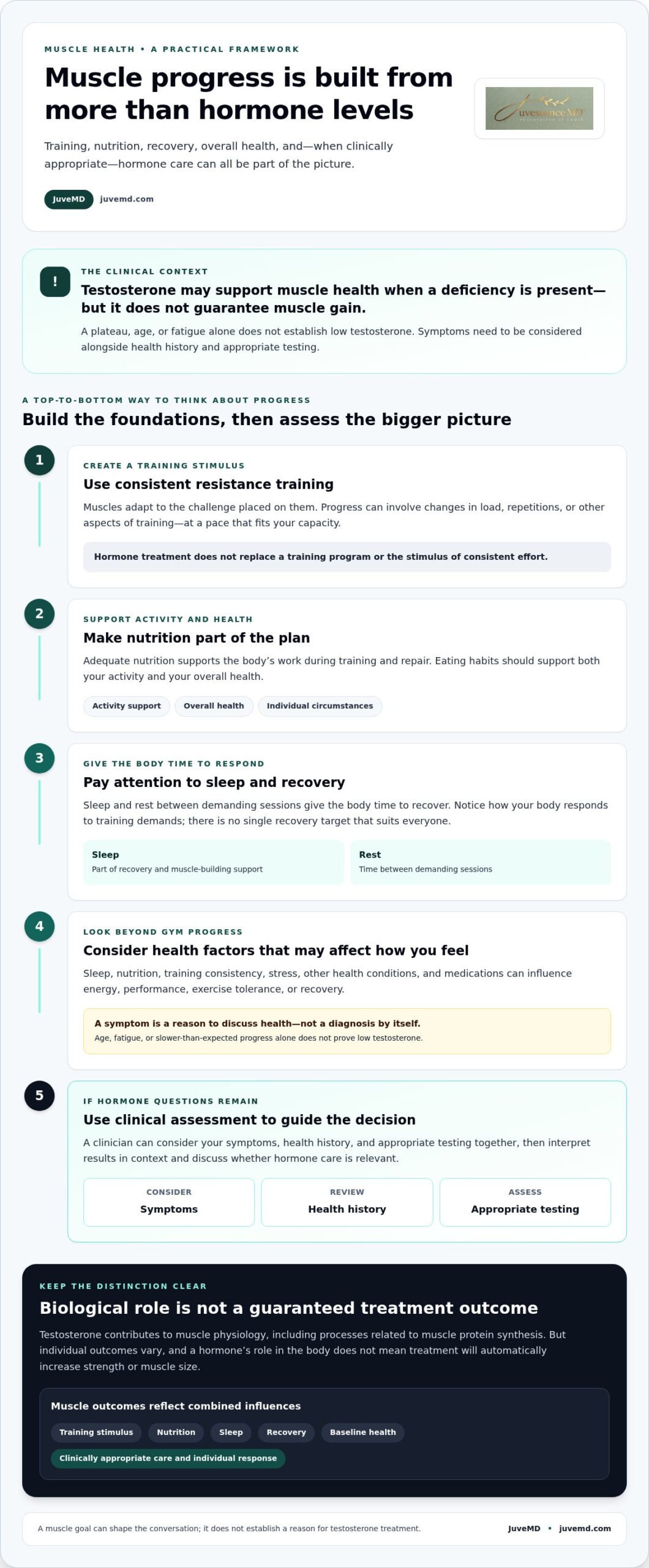
Testosterone may support muscle health when a deficiency is present, but it can’t guarantee muscle gain. A hormone’s role in muscle physiology doesn’t mean that taking testosterone will automatically increase strength or size. Results vary, and treatment is a medical decision for an appropriate clinical indication, not a general shortcut for improving gym performance.
What role does testosterone play in muscle health?
Testosterone is one part of the body’s complex system for maintaining and building lean tissue. Its effects depend on many factors, including a person’s overall health and the demands placed on their muscles. Testosterone alone doesn’t replace the stimulus of training or determine how quickly someone gains muscle. Biological function and treatment outcomes are related, but they aren’t interchangeable.
Age, fatigue, or slower-than-expected gym progress may be reasons to discuss health concerns, but none proves low testosterone on its own. Sleep, nutrition, training consistency, stress, other health conditions, and medications can also affect energy and performance. A clinician interprets symptoms alongside health history and appropriate testing rather than treating one sign as a diagnosis.
Why muscle goals need a Las Vegas-specific care conversation
People searching locally may be comparing hormone clinics and trying to separate practical medical guidance from claims that make treatment sound like a muscle-building guarantee. A useful conversation starts with your specific goal, then considers symptoms, medical history, and whether testing is clinically appropriate. If symptoms or results raise questions, a clinician can interpret them in context and discuss whether hormone care is relevant.
That context matters because a treatment decision should account for more than a desired change in body composition. It should consider your broader health and whether the purpose of care fits your circumstances. At JuveMD, personalized hormone optimization connects an individual’s goals with an assessment of hormone health, without assuming treatment is the answer for every plateau.
For readers considering one form of hormone care, the testosterone pellet therapy guide offers related information. Rather than assuming a particular treatment format, learn what an individualized clinical assessment can and cannot tell you about your muscle goals.
How Testosterone, Resistance Training, and Recovery Work Together
Muscle-building progress depends on more than a hormone level. Progressive resistance training gives muscles a reason to adapt: over time, the challenge can increase through changes in load, repetitions, or other aspects of training. Testosterone may be relevant to muscle physiology, but it doesn’t design a program, provide a training stimulus, or make consistent effort unnecessary.
Muscle outcomes reflect the combined influence of training stimulus, nutrition, sleep, recovery, baseline health, and, when clinically appropriate, hormone treatment and individual response. A general fitness goal and a medical decision call for different kinds of guidance. Wanting to gain muscle can shape a conversation, but it doesn’t establish a reason for testosterone treatment.
What should a muscle-building plan include besides hormone care?
Resistance training is a core foundation. Challenge muscles consistently and progress in a way that fits your capacity, rather than expecting hormone treatment to do the work of a training plan. A qualified fitness professional can help with exercise programming; this section isn’t a personalized exercise prescription.
Food and recovery matter, too. Adequate nutrition supports the body’s work during training and repair, while sleep and rest between demanding sessions give the body time to recover. There’s no single nutrition or recovery target that suits everyone, so individual circumstances matter.
- Training: Build a consistent resistance-training routine with an appropriate progression.
- Nutrition: Aim for eating habits that support your activity and overall health.
- Recovery: Pay attention to sleep, rest, and how your body responds to training demands.
Health conditions and medications can influence exercise tolerance, recovery, or energy. Include them in the conversation with your clinician, especially if they affect how you train or feel afterward. Harvard Health Publishing discusses testosterone’s role in muscle preservation, while also helping frame therapy as a medical question rather than a substitute for healthy habits.
Why individual outcomes cannot be guaranteed
Two people can follow similar routines and have different experiences because their starting health, training history, nutrition, sleep, and ability to recover may differ. If testosterone treatment is clinically appropriate, individual response can still vary. A general explanation of hormone function cannot predict a person’s results or establish that treatment will improve their strength or muscle mass.
A clinician should assess potential benefits and risks in light of your health and goals, rather than promise a particular outcome or timeline. Keep track of your training, recovery, and questions. These details can make a discussion about muscle goals more concrete without turning progress into a diagnosis.
If you’re considering whether hormone health belongs in that discussion, learn more about JuveMD’s personalized hormone-health care as one part of an informed approach to your goals.
Testosterone Treatment vs. Training Alone: How to Compare the Options
Training and hormone care address different questions. Resistance training and recovery are core parts of a muscle-building approach. Clinician-assessed testosterone treatment is a medical option considered when evaluation indicates it may be appropriate. The two aren’t interchangeable, and treatment isn’t a substitute for lifting or a shortcut to a particular physique.
Purpose
Training and recovery: Create a consistent stimulus for muscle adaptation and support the body’s ability to recover.
Hormone evaluation and possible treatment: Assess whether symptoms and clinical findings suggest a hormone issue that warrants medical care.
Who may benefit
Training and recovery: People pursuing strength or muscle goals, with an approach tailored to their abilities and health.
Hormone care: People whose symptoms and evaluation support a clinical indication, as determined with a clinician.
Oversight and limitations
Training and recovery: A fitness professional may help guide exercise, but training alone doesn’t diagnose a hormone condition.
Hormone care: Requires clinical assessment and individualized discussion. It doesn’t replace training, nutrition, sleep, or broader medical care, and it can’t guarantee muscle gains.
Treatment decisions depend on clinical assessment, not muscle goals alone. The American Urological Association’s testosterone deficiency guideline provides clinical context for evaluating testosterone deficiency. A physique or performance goal by itself isn’t evidence that testosterone treatment is medically suitable.
When is a hormone evaluation worth discussing?
Persistent symptoms or concerns about changes in well-being may be a reason to seek assessment, not a diagnosis. A clinician considers the pattern of symptoms alongside medical history, an examination when appropriate, and relevant laboratory results. Age, fatigue, or a training plateau on its own can’t confirm a hormone deficiency. The aim is to understand the broader health picture, not to pursue testosterone solely for athletic performance or appearance.
What testosterone treatment cannot replace
Even if treatment is clinically appropriate, it doesn’t create a training plan or replace consistent resistance exercise, adequate nutrition, restorative sleep, or attention to other health needs. Nor can it guarantee faster progress or prevent every change associated with aging. These foundations remain relevant whether or not hormone care is part of someone’s overall plan.
For broader context on hormone care, JuveMD’s bioidentical hormone replacement therapy guide discusses treatment as an individualized clinical consideration. If you’re researching improving muscle mass with testosterone Las Vegas, use that information to prepare questions, not to assume a particular therapy is the right next step.
What to Discuss Before Considering Testosterone for Muscle Goals
A productive clinical conversation connects your muscle or strength goal with your overall health. In Las Vegas, an in-person discussion can help you explain what you’re noticing, review relevant history, and understand whether further assessment is appropriate. The process should move from questions to clinical context, not from a desired physique straight to a treatment decision.
A practical sequence can keep the conversation focused:
- Clarify your goal. Describe the change you hope to make, such as improving strength or addressing a shift in training progress.
- Review symptoms and health history. Share concerns, relevant diagnoses, past treatments, and medications, including when changes began and whether they’ve persisted.
- Complete a clinical assessment. A clinician considers your symptoms and health context and determines whether examination or laboratory testing is appropriate.
- Discuss suitable options. Review what the assessment suggests, possible benefits and risks, and whether hormone care has a role alongside your broader health plan.
What information should you bring to a clinical conversation?
A few notes can help you describe the full picture clearly. Include symptoms and when they started, relevant health history, current medications, and your muscle or strength goals. Be candid about your training routine, nutrition, sleep, recovery, and changes you’ve noticed over time. This information supports discussion; it isn’t a basis for self-diagnosis.
Laboratory results also need clinical interpretation. A single value viewed without symptoms, health history, and appropriate context can’t determine on its own whether treatment is suitable. If you already have test results, bring them to the conversation rather than drawing conclusions from an isolated number.
How should risks, follow-up, and expectations be discussed?
Before deciding on treatment, discuss possible benefits, risks, alternatives, and the monitoring that may be appropriate for your circumstances and treatment plan. Testosterone can increase red blood cell production, which may raise hematocrit, so ask how relevant health markers will be assessed. Monitoring needs and follow-up should be determined with the treating clinician, not assumed from a general schedule.
Set realistic expectations together. Agree on health goals that can be reviewed over time, and clarify how you’ll discuss progress, side effects, or concerns at follow-up. Muscle changes alone may not capture the full picture of treatment or overall health. No particular gain or timeline should be treated as guaranteed.
If you’re researching improving muscle mass with testosterone Las Vegas, JuveMD’s personalized hormone-health care can connect your goals with a thoughtful clinical assessment. Explore JuveMD hormone care as a starting point for a conversation grounded in your individual health context.
Personalized Hormone Care for Muscle at JuveMD Las Vegas
Understanding the science is only part of making a sound decision. At JuveMD, hormone-health care in Las Vegas is personalized around clinical assessment, a person’s broader health context, and their goals. A muscle goal can be part of that conversation, but it doesn’t make hormone treatment inevitable. The purpose is to understand whether hormone health is relevant to your concerns and discuss an appropriate path forward.
JuveMD’s hormone-health services include bioidentical pellet hormone therapy and injectable treatments. These are clinic services, not a promise that a particular format is appropriate for testosterone care or that treatment will produce a specific change in muscle mass. Any discussion of options should follow an individualized assessment.
What an individualized hormone-care discussion should clarify
A useful conversation brings together the details that shape a clinical decision: symptoms, relevant health history, examination findings when appropriate, laboratory testing and its interpretation, personal goals, and potential risks. No single detail should be treated as the whole answer. The clinician considers how these factors fit together and explains what they may mean for your care.
It can also help to distinguish what you hope to change from what treatment can reasonably address. Discuss your strength or muscle goals alongside your training habits, nutrition, sleep, and recovery. These broader factors remain relevant whether hormone care is considered or not, and individual muscle outcomes can’t be promised.
- Assessment: What do symptoms and clinical findings suggest about hormone health?
- Options: What approaches, if any, fit the assessment and overall health context?
- Expectations: What benefits, risks, and follow-up considerations should be discussed?
A considered next step in Las Vegas
There’s no need to arrive with a diagnosis or a predetermined treatment in mind. If you’re considering improving muscle mass with testosterone Las Vegas, bring your questions and the changes you’ve noticed to a clinical conversation. A careful evaluation may help clarify whether hormone health deserves attention, while keeping the decision centered on your circumstances rather than a generalized promise about muscle gains.
JuveMD’s approach connects hormone-health care with personal goals and clinical context. If this information has raised questions about your health, take the next step when you feel ready to discuss them. Explore hormone-health care in Las Vegas and learn more about an individualized approach.
Take a Thoughtful Next Step Toward Your Goals
Your next move doesn’t have to be a treatment decision. It can be a clearer sense of what you want to improve, what changes you’ve noticed, and what questions would help you feel informed. That perspective keeps the focus on your health, not promises of a particular physique or a quick fix.
If you’re exploring improving muscle mass with testosterone Las Vegas, let your goals guide a conversation while clinical assessment guides any care decision. A measured approach makes room to consider what’s appropriate for you and how your broader wellness goals fit together. You deserve clear information and care that respects your individual circumstances.
Explore hormone-health care in Las Vegas and take the next step when you’re ready. A thoughtful conversation can help you move forward with greater clarity and confidence.
Frequently Asked Questions
Can testosterone therapy improve muscle mass if testosterone levels are normal?
Testosterone therapy isn’t generally recommended solely to build muscle when levels are normal. A search for “improving muscle mass with testosterone Las Vegas” shouldn’t be taken as evidence that treatment is appropriate: clinical care addresses an identified hormone problem, not a physique goal alone. If levels are normal, discuss other possible reasons for a plateau, such as training consistency, recovery, nutrition, or another health concern, with an appropriate clinician.
Is testosterone approved as a treatment for bodybuilding or athletic performance?
No. Testosterone’s established medical use is to treat hypogonadism associated with specific medical conditions, not bodybuilding or athletic performance enhancement. Using it to pursue a competitive advantage or a particular physique isn’t the same as treating a diagnosed hormone deficiency. Nonmedical use can carry health risks, so don’t use testosterone prescribed to someone else or obtain it outside medical care. A clinician can explain whether your concerns warrant evaluation.
Can women consider testosterone treatment for muscle-related concerns?
Women can discuss hormone-related concerns with a clinician, but testosterone shouldn’t be assumed to be a muscle-building treatment. Whether any hormone care is appropriate depends on the person’s symptoms, health context, clinical assessment, and relevant testing. JuveMD describes its hormone optimization approach as personalized for men and women. Avoid self-treating with testosterone products; a clinician can discuss potential risks and whether a different explanation or approach better fits your concern.
Does testosterone treatment affect fertility in men?
Yes. Testosterone taken from outside the body can suppress the signals that support sperm production, potentially reducing fertility. The effect can vary, and recovery after stopping treatment isn’t something to assume or predict without medical guidance. If you may want children now or in the future, raise this before starting therapy. Ask the clinician to explain how treatment could affect your reproductive plans and what options may be appropriate for your circumstances.
Can low testosterone be diagnosed from symptoms alone?
No. Symptoms can prompt an assessment, but they don’t establish low testosterone because similar concerns can have other causes. Diagnosis generally considers symptoms together with consistently low morning testosterone results on separate tests, interpreted by a clinician. Don’t diagnose yourself from fatigue, lower gym performance, or a single lab value. Share when symptoms began and how they affect daily life so the clinician can decide what evaluation is appropriate.
What should I ask at a testosterone consultation in Las Vegas?
Ask what your symptoms and test results indicate, whether additional testing is needed, and what other explanations may fit your concerns. You can also ask about potential benefits and risks, how follow-up would be handled, and how treatment decisions relate to fertility plans or other health priorities. Bring a medication list and any relevant test reports. These questions can help you leave with a clearer understanding, even if treatment isn’t recommended.
Can testosterone treatment be considered alongside other health conditions or medications?
Possibly, but a clinician needs to review your health conditions and medications before discussing treatment. Some health factors may change the balance of potential benefits and risks or affect what monitoring is appropriate. Share prescription medicines, over-the-counter products, supplements, and relevant medical history rather than stopping anything on your own. The clinician can explain whether testosterone should be considered, whether additional assessment is needed, or whether another plan better suits your health.