
Confidence after menopause rarely returns through one quick fix. If you feel less at ease in your body, second-guess yourself at work, or find that poor sleep and mood changes are affecting your relationships, it’s understandable to wonder how to regain confidence after menopause. These experiences can feel unsettling, but they don’t mean you’ve lost who you are.
Rebuilding confidence starts with understanding what’s affecting you, then choosing realistic steps that fit your needs. Small, individualized changes can support emotional and physical wellbeing. Persistent or disruptive symptoms deserve a thoughtful conversation with a qualified clinician. You don’t have to dismiss what you’re experiencing or figure it out alone.
This guide explores how menopause-related changes may influence confidence, how to identify the situations and symptoms weighing on you, and practical ways to feel more supported. You’ll also learn how to prepare for a clinical discussion and when professional guidance may help you consider appropriate options. The goal isn’t to return to an earlier version of yourself, but to build trust in yourself as you are now.
Key Takeaways
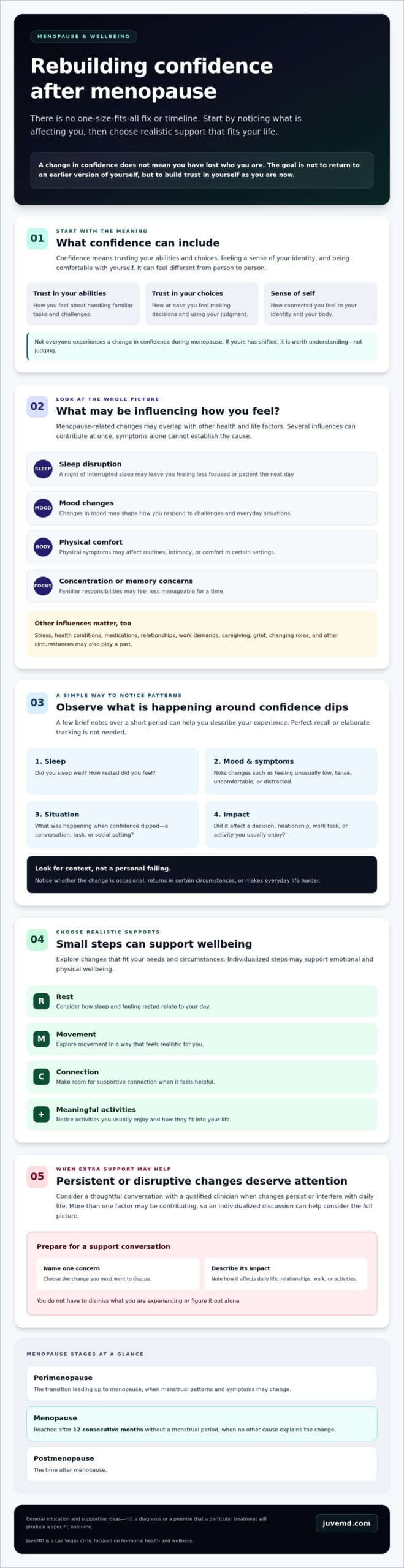
- Confidence means trusting your abilities, choices, and sense of self. Changes can feel different for each person.
- Notice when confidence dips and whether sleep, mood, physical symptoms, or concentration concerns may be part of the picture.
- Explore how to regain confidence after menopause through small, realistic steps that support rest, movement, connection, and meaningful activities.
- Consider professional support when changes persist or interfere with daily life, since more than one factor may be contributing.
- Prepare for a support conversation by identifying one concern and noting how it affects you. JuveMD is a Las Vegas clinic focused on hormonal health and wellness.
How menopause can affect confidence, and why your experience is personal
A shift in confidence can feel unsettling, especially if you’re used to trusting your judgment or feeling at ease in your body. Menopause doesn’t affect everyone in the same way, and not everyone experiences a change in confidence. Here, confidence means trust in your abilities and choices, a sense of your identity, and comfort with yourself. If those feelings have changed, that experience is worth understanding, not judging.
The menopause transition can overlap with changes in sleep, mood, and physical comfort. A night of interrupted sleep, for example, may leave you feeling less focused or patient the next day. Physical symptoms may affect how comfortable you feel in certain settings. These experiences can influence daily life, but they don’t automatically explain every emotional or cognitive concern. Stress, health conditions, medications, and other circumstances may also play a part.
What can change during the menopause transition?
Perimenopause is the transition leading up to menopause, when menstrual patterns and symptoms may change. Menopause is reached after 12 consecutive months without a menstrual period, when no other cause explains the change. Postmenopause refers to the time afterward. The Menopause overview describes these stages and the range of experiences associated with them.
Changes can be uneven. Sleep disruption, shifts in mood, or symptoms that affect physical comfort may make familiar routines feel harder for a time. If concentration or memory feels different, avoid assuming hormones are the only explanation. Consider the full picture, including sleep quality, stress, health, and changes in your daily responsibilities. This guide offers general education and supportive ideas, not a diagnosis or a promise that a particular treatment will produce a specific outcome.
Why confidence does not follow one menopause timeline
There’s no single pattern or timetable for confidence. Symptoms, overall health, relationships, work demands, and access to support all vary. So do the circumstances surrounding midlife. Ageing, caregiving, stress, grief, or changing roles can influence how you see yourself, whether or not they coincide with menopause.
That’s why the question of how to regain confidence after menopause has no universal answer. Paying attention to when confidence shifts and what else is happening in your life can help clarify what support may be useful. A change that feels connected to menopause may also have other contributors, so an individualized approach leaves room to consider them.
Confidence changes can have multiple possible influences; your experience deserves individualized attention.
Understand what may be affecting your confidence after menopause
To understand a change in self-assurance, look for its context rather than treating it as a personal failing. Does it appear after a poor night’s sleep, during a physical symptom, or before a particular work or social situation? Does it pass, return in certain circumstances, or make everyday tasks feel harder? These observations can help you describe what’s happening more clearly.
Several factors may overlap. Interrupted sleep can affect how rested or focused you feel. Mood changes may shape how you respond to challenges, while physical discomfort can influence daily routines or intimacy. Concentration concerns may make familiar responsibilities feel less manageable. The Menopause Society’s overview of menopause and mental health offers additional context, but symptoms alone can’t establish what’s causing a change. Health conditions, stress, medication, and life circumstances may also contribute.
Notice patterns in mood, sleep, and everyday functioning
Try a brief journal for a short period. You don’t need elaborate tracking or perfect recall. A few notes can help you see whether concerns are occasional or interfering with relationships, work, or activities you usually enjoy.
- Sleep: Note whether you slept well and how rested you felt.
- Mood and symptoms: Record changes you noticed, such as feeling unusually low, tense, uncomfortable, or distracted.
- Situation: Describe what was happening when your confidence dipped, including conversations, tasks, or social settings.
- Impact: Note whether the concern affected a decision, relationship, work task, or usual activity.
Patterns can give you and a clinician a useful starting point for discussion. They don’t diagnose a cause, and a checklist shouldn’t be used to label yourself or rule out other explanations.
Separate body image and life changes from personal worth
Changes in appearance, energy, or sexual comfort can affect how you feel about your body and intimacy. You may also be adjusting to new responsibilities, caregiving demands, relationship changes, or a different role at work. There’s no required way to feel about these shifts. Notice which expectations are yours and which may come from outside pressure.
Your body or circumstances may change; your worth as a person does not depend on either. If the question of how to regain confidence after menopause feels difficult to answer, use your notes to identify what matters most and what you’d like help exploring. For a conversation about hormonal health and wellness, learn more about JuveMD’s approach to hormonal health.
Practical ways to rebuild confidence after menopause
Confidence is often strengthened through repeated experiences of trusting yourself, not by waiting until you feel completely ready. Treat the ideas below as experiments. Try one, notice how it fits, and adjust without treating a particular result or timeline as a test of success. The aim is to make room for choices that support your wellbeing and reflect what matters to you.
Start with small actions that reinforce self-trust
Choose one manageable action connected to an interest or value. You might take a short walk, return to a creative hobby, ask a question in a meeting, or make time for a friend. Keep the step realistic for your energy and circumstances. Following through can remind you that you can make choices and respond to your needs.
Set boundaries that help make the action possible. That could mean declining an optional commitment, asking for help with a task, or protecting time to rest. At the end of the day, notice what you did rather than judging yourself by what remains undone. If an activity feels too demanding, scale it down or choose another. This is not a test of willpower.
Self-talk can also shape how a setback feels. Try replacing a harsh judgment with a specific, balanced observation. Instead of “I can’t do anything right,” consider, “I lost my focus in that conversation, and I can follow up when I’m ready.” This doesn’t dismiss a difficult moment. It keeps one moment from defining your abilities or worth.
Build support around emotional and physical wellbeing
Supportive routines don’t need to be elaborate. Gentle movement that suits your body, a regular wind-down routine, and time for meaningful activities may help you care for your overall wellbeing. These habits aren’t guaranteed treatments for menopause symptoms or confidence changes. Treat them as options to explore, and adapt them to your health, preferences, and clinician’s guidance when relevant.
Connection matters, too. You might tell someone you trust, “I’ve been feeling less like myself lately,” without sharing anything you’d rather keep private. Peer support can offer a sense of understanding, while counseling or menopause-informed mental health support may help you explore self-image, stress, or persistent mood concerns. You don’t have to wait until things feel unmanageable to ask for support.
If self-guided steps aren’t enough, or changes are affecting your daily life, a qualified clinician can help assess possible contributors and discuss appropriate next steps. Asking for an evaluation doesn’t commit you to a particular treatment. A thoughtful plan can consider your symptoms, health history, and preferences rather than assuming one strategy works for everyone.
When confidence changes deserve professional support
Consider speaking with a qualified clinician if changes in mood, sleep, physical comfort, or confidence persist, worsen, or interfere with relationships, work, or activities you usually manage. You don’t need to wait until symptoms feel severe. Menopause may be one part of the picture, but health conditions, medications, stress, and other life changes can overlap. An individualized assessment can help explore possible causes rather than assume one explanation.
What to discuss with a menopause-informed clinician
Before an appointment, gather a few notes to make the conversation easier. Include when changes began, how often they occur, what seems to affect them, and how they influence your daily life. Bring relevant health history and a list of medications or supplements, and note questions you want answered.
- What possible factors could be contributing to these changes?
- What evaluation, if any, would help clarify the picture?
- What are the potential benefits, risks, and alternatives to each option?
- What should I do if symptoms continue or change?
You can ask for explanations in plain language and take time to consider your options. The goal is a useful discussion, not a quick assumption about what you should do.
How to think about hormone therapy and other options
Hormone therapy may be one option to discuss for some menopause-related symptoms, but decisions depend on individual symptoms, health history, and preferences. It isn’t appropriate for everyone, and it shouldn’t be presented as a direct way to restore confidence or as a solution for every concern. A clinician can help explain whether it may be relevant to your situation and discuss other approaches. For more background, explore an overview of bioidentical hormone replacement therapy in Las Vegas.
As you consider how to regain confidence after menopause, remember that seeking care doesn’t commit you to a particular treatment. It can help you understand what may be affecting you and decide on a next step that fits your needs. JuveMD is a Las Vegas clinic focused on hormonal health and wellness. To learn more about its approach, explore JuveMD’s hormonal health care.
If you’re thinking about harming yourself or feel in immediate danger, seek help now. In the United States, call or text 988 for the Suicide & Crisis Lifeline. If there’s immediate danger, call 911 or go to an emergency department.
Create a personalized next step with menopause care in Las Vegas
You don’t need to solve everything at once. Choose one concern that matters most right now, note how it affects your daily life, and decide who could help you explore it. For example, you might write down that disrupted sleep is making work harder, or that changes in physical comfort are affecting intimacy. A clear starting point can make a support conversation feel more manageable.
What an individualized conversation can help clarify
Bring your priorities, questions, relevant health history, and any symptom notes you’ve kept. You don’t need to arrive with a treatment already in mind. You can ask what assessment may be appropriate, what options could fit your situation, and how potential benefits, risks, alternatives, monitoring, and follow-up would be considered. Take time to ask for clarification and make decisions with your clinician.
JuveMD is a Las Vegas clinic focused on hormonal health and wellness. It offers bioidentical pellet hormone therapy, but that doesn’t mean pellet therapy is suitable for every person or every concern. An individualized clinical evaluation is needed to consider whether it may be appropriate in light of your symptoms, health history, and preferences. Confidence changes can have influences beyond hormones, so discuss the full picture rather than expecting one approach to address everything.
Explore women’s hormone care in Las Vegas
If you’re gathering information, JuveMD’s educational article on hormone pellet therapy for women in Las Vegas may offer a more focused overview. Use it as background for questions, not as a substitute for individualized advice. A clinician can help you understand what the approach involves and whether it belongs among the options you want to consider.
A practical next step is to identify your main concern, describe its impact, and choose a qualified professional for the conversation. If you’d like to learn more about JuveMD’s hormonal health and wellness focus, contact the clinic to ask about discussing your concerns. The goal is an informed decision that reflects your needs, not pressure to pursue a particular treatment.
Take one supportive step toward feeling more like yourself
Confidence after menopause isn’t rebuilt through one perfect solution. Start by noticing what affects your wellbeing, then choose a small, realistic step that supports your needs. Sleep, mood, physical comfort, relationships, and life changes can all shape how you feel. Persistent or disruptive concerns deserve an individualized conversation with a qualified clinician.
Learning how to regain confidence after menopause can begin with asking questions, tracking what’s changed, and exploring support without assuming a particular treatment is right for you. JuveMD is a Las Vegas clinic specializing in hormonal health and wellness, led by Dr. Andrea Dempsey. The clinic offers bioidentical pellet hormone therapy and individualized wellness plans; whether any option is suitable depends on your circumstances and clinical evaluation.
If you’d like to learn more about the clinic’s approach, explore JuveMD’s hormone health services. Contact the clinic to ask about discussing your concerns and learning what support may fit your needs. You deserve thoughtful support, and each step toward understanding your needs can help you move forward with greater clarity and self-trust.
Frequently Asked Questions
Is it normal to lose confidence after menopause?
Confidence can change during or after menopause, but it doesn’t happen to everyone, and there’s no single expected experience. Changes in sleep, mood, physical comfort, or daily circumstances may affect how capable or at ease you feel. If this shift persists or disrupts work, relationships, or activities you value, consider discussing it with a qualified clinician rather than assuming it’s simply something you must accept.
How can I feel like myself again after menopause?
Start by identifying what feels different and what matters most to you. Notice patterns, then try one manageable step, such as returning to an enjoyable activity, setting a realistic boundary, or making time for connection. Learning how to regain confidence after menopause isn’t about following a fixed timeline. If changes continue to affect daily life, a clinician can help explore possible contributors and suitable support.
Can menopause cause low self-esteem?
Menopause may coincide with experiences that affect self-esteem, such as changes in mood, sleep, body comfort, or sexual wellbeing. These changes don’t automatically explain how you feel, and low self-esteem can have other contributors, including stress, health concerns, relationships, or life transitions. Notice when these feelings arise and how they affect you. Persistent or distressing concerns are worth discussing with a qualified professional.
What can I do about menopause-related mood changes?
Begin by noting mood changes alongside sleep, physical symptoms, stressful situations, and their impact on your routine. Supportive habits, time with trusted people, and activities that feel meaningful may help overall wellbeing, though they aren’t guaranteed treatments. If mood changes persist, feel difficult to manage, or interfere with daily life, speak with a clinician. Seek urgent help if you’re thinking about harming yourself or feel in immediate danger.
Does hormone therapy improve confidence after menopause?
Hormone therapy isn’t a guaranteed or direct treatment for confidence, and it isn’t suitable for everyone. A clinician may discuss it in relation to specific menopause symptoms after considering your health history, preferences, and individual circumstances. Ask about potential benefits, risks, alternatives, and follow-up. For people in Las Vegas, JuveMD offers bioidentical pellet hormone therapy, but an individualized clinical evaluation is needed to consider whether it may be appropriate.
When should I talk to a doctor about confidence changes after menopause?
Consider an appointment if changes in confidence, mood, sleep, or physical wellbeing persist, worsen, or disrupt work, relationships, or usual activities. Beforehand, note when concerns began, how often they occur, their impact, relevant health history, and medications or supplements. These details can support a more focused discussion, but they can’t identify a cause on their own. For thoughts of self-harm or immediate danger, seek urgent help now.
Can counseling help rebuild confidence after menopause?
Counseling may help you work through self-doubt, stress, mood concerns, changing roles, or body image, whether or not menopause is the only factor. You can look for a counselor whose experience fits your needs, including menopause-informed mental health support if that matters to you. Counseling is an option, not a requirement, and it can complement a clinical assessment when physical symptoms or sleep changes are also affecting your wellbeing.