
Your body isn’t failing your diet; your hormones are vetoing your efforts. If you have ever felt like you’re doing everything right yet still struggle with unexplained weight gain in your midsection, you aren’t alone. It’s incredibly frustrating to follow generic, one-size-fits-all plans only to be met with extreme fatigue and persistent brain fog. Learning how to balance hormones to lose weight is often the missing piece of the puzzle. When your endocrine system is out of sync, your body is biologically programmed to store fat regardless of your caloric intake.
We believe that sustainable weight loss requires more than just willpower. It requires clinical precision. This guide provides the medical framework used to identify specific hormonal roadblocks that stall your progress. You’ll discover which precise lab tests are necessary to uncover the truth about your metabolism. We will also outline a professional plan to fix these metabolic issues, including how bioidentical hormone pellet therapy can help restore your energy and stabilize your system. By the end, you’ll have a clear path toward a revitalized body and lasting results.
Key Takeaways
- Understand how hormones act as the internal software that directs your metabolism to either store fat or burn energy.
- Discover the clinical framework for how to balance hormones to lose weight by identifying the specific biological drivers that dictate your metabolic rate.
- Learn why bioidentical pellet hormone therapy provides a more stable and effective solution for rebalancing your system than generic diet plans.
- Follow a clear, data-driven diagnostic roadmap to identify your unique biological roadblocks through precise medical testing rather than guesswork.
- Explore how a comprehensive medical weight loss program shifts the focus from temporary fixes to sustainable, long-term metabolic health and energy.
The Link Between Hormonal Imbalance and Weight Gain
Think of your hormones as the sophisticated software that directs your metabolism’s hardware. While most people focus on the “fuel” they consume, your hormones actually determine whether that fuel is burned for energy or archived as fat. Understanding how to balance hormones to lose weight begins with recognizing that your body isn’t working against you; it’s simply following a set of biological instructions. When your system senses stress, nutritional gaps, or age-related shifts, it triggers hormonal weight gain as a protective defense mechanism.
This is why so many people hit a wall. You’ve likely experienced that frustrating plateau where traditional diet and exercise simply stop working. No matter how much you restrict calories, the scale refuses to budge. At this stage, your body has entered a state of metabolic resistance. Rebalancing your hormonal system is the clinical key to unlocking those stubborn fat stores and signaling to your body that it’s safe to release them.
The Feedback Loop: Why Fat is an Endocrine Organ
It’s a common misconception that fat is just passive storage. In reality, adipose tissue functions as an active endocrine organ. It produces its own hormones, such as estrogen and leptin, which can interfere with your brain’s satiety signals. This creates a self-perpetuating cycle where the more fat cells you have, the more hormones they produce to protect that fat. This complex pathophysiology of obesity means that simple willpower is often powerless against a biological feedback loop. You aren’t failing; your chemistry is overriding your intentions.
Signs Your Weight Gain is Hormonal, Not Behavioral
Distinguishing between lifestyle-driven weight and metabolic resistance requires a look at specific physical patterns. Hormonal imbalances often leave distinct signatures. For instance, excess cortisol or insulin resistance typically leads to fat accumulation specifically in the midsection, while behavioral weight gain usually presents more evenly across the body. If you’re also dealing with night sweats, low libido, or chronic fatigue, your body is likely sending a distress signal. Learning how to balance hormones to lose weight requires moving beyond generic advice and looking at these clinical indicators to create a targeted medical plan for restoration.
The “Big Four” Hormones That Dictate Your Weight
While many factors influence your scale weight, four primary hormones act as the master controllers of your metabolic rate and fat storage capacity. These messengers don’t work in isolation; they function as a complex network where a shift in one inevitably impacts the others. To understand how to balance hormones to lose weight, we must look beyond standard lab ranges that merely indicate the absence of disease. Our goal is optimization, ensuring your levels are tuned for peak performance rather than just being “normal.”
Insulin resistance occurs when your cells become desensitized to insulin, forcing the pancreas to overproduce the hormone, which effectively locks fat cells and prevents them from releasing stored energy.
Insulin and Cortisol: The Fat Storage Duo
Insulin is your body’s primary gatekeeper. It decides whether the sugar in your bloodstream is burned for immediate energy or archived as fat. When insulin is chronically high, fat burning becomes biologically impossible. Cortisol, the stress hormone, complicates this by triggering visceral fat accumulation around your internal organs. Chronic stress creates a “double hit” where high cortisol raises blood sugar, which in turn spikes insulin. This cycle makes weight loss nearly impossible without clinical intervention.
Estrogen and Testosterone: The Body Composition Architects
These sex hormones are the primary architects of your body composition. Estrogen dominance or deficiency can both lead to weight gain, particularly in the hips and thighs for women. Conversely, testosterone is the fuel for your “metabolic fire.” It helps maintain lean muscle mass, which burns more calories at rest than fat tissue. As we age, the decline during perimenopause or andropause shifts the body toward fat storage. Optimizing these levels is a cornerstone of a medical weight loss program that prioritizes long-term health.
Thyroid: The Metabolic Thermostat
Your thyroid acts as the thermostat for every cell in your body. It produces T4, which must be converted into the active T3 hormone to drive metabolism. Many patients receive “normal” TSH results while still suffering from a sluggish metabolism because their bodies aren’t converting hormones efficiently. The Endocrine Changes in Obesity often reveal that thyroid health is deeply intertwined with insulin and cortisol levels. Understanding how to balance hormones to lose weight requires a deep dive into these synergistic relationships to ensure every part of your metabolic engine is firing correctly.
How to Balance Hormones to Lose Weight: Medical vs. Lifestyle
When you’re researching how to balance hormones to lose weight, it’s helpful to view intervention as a hierarchy. Think of lifestyle changes as the foundation, or the floor, while medical optimization serves as the ceiling. For many, diet and exercise provide a baseline of health, but they aren’t always enough to overcome significant metabolic resistance. If your internal chemistry is fundamentally skewed, you can’t simply “out-diet” the problem. You need a strategy that addresses both the behavioral and the biological drivers of your weight.
Generic “hormone diets” often promise rapid results by cutting out specific food groups. While these can help reduce inflammation, they often fall short for individuals with a clinical Hormonal Imbalance. This is where bioidentical pellet hormone therapy offers a distinct clinical advantage. Unlike self-guided plans, medical therapy provides the precise biological signaling your body needs to resume normal metabolic function. It bridges the gap between what you can achieve through habits and what your body requires for true restoration.
The Limitations of Lifestyle-Only Approaches
The standard advice to “eat less and move more” can actually be counterproductive for someone with high cortisol or thyroid issues. Severe caloric restriction is a major physiological stressor. If your body is already in a state of hormonal defense, cutting calories further can trigger “metabolic adaptation.” This is a survival mechanism where your resting energy expenditure drops to preserve fat stores. Your body effectively fights back against your efforts to lose weight. When you reach this point of diminishing returns, it’s time to transition from a solo gym routine to a structured medical weight loss program that can diagnose and correct these underlying failures.
The Clinical Advantage: Bioidentical Pellet Therapy
Bioidentical hormone replacement therapy (BHRT) pellets are small, custom-compounded cylinders placed just under the skin. They represent a significant advancement over traditional delivery methods like creams or oral pills. Pellets provide a steady, 24/7 release of hormones that mimics the body’s natural secretion patterns. This prevents the “rollercoaster” effect of peak-and-trough levels often associated with other treatments. For those focused on how to balance hormones to lose weight, pellets offer specific metabolic benefits. They help restore the energy needed for high-quality exercise and improve sleep quality, both of which are critical for fat oxidation and hormonal recovery. When combined with advanced tools like Semaglutide or Tirzepatide, this integrated approach can be transformative; learn how these options work together in our comprehensive clinical reference on medical weight loss injections.
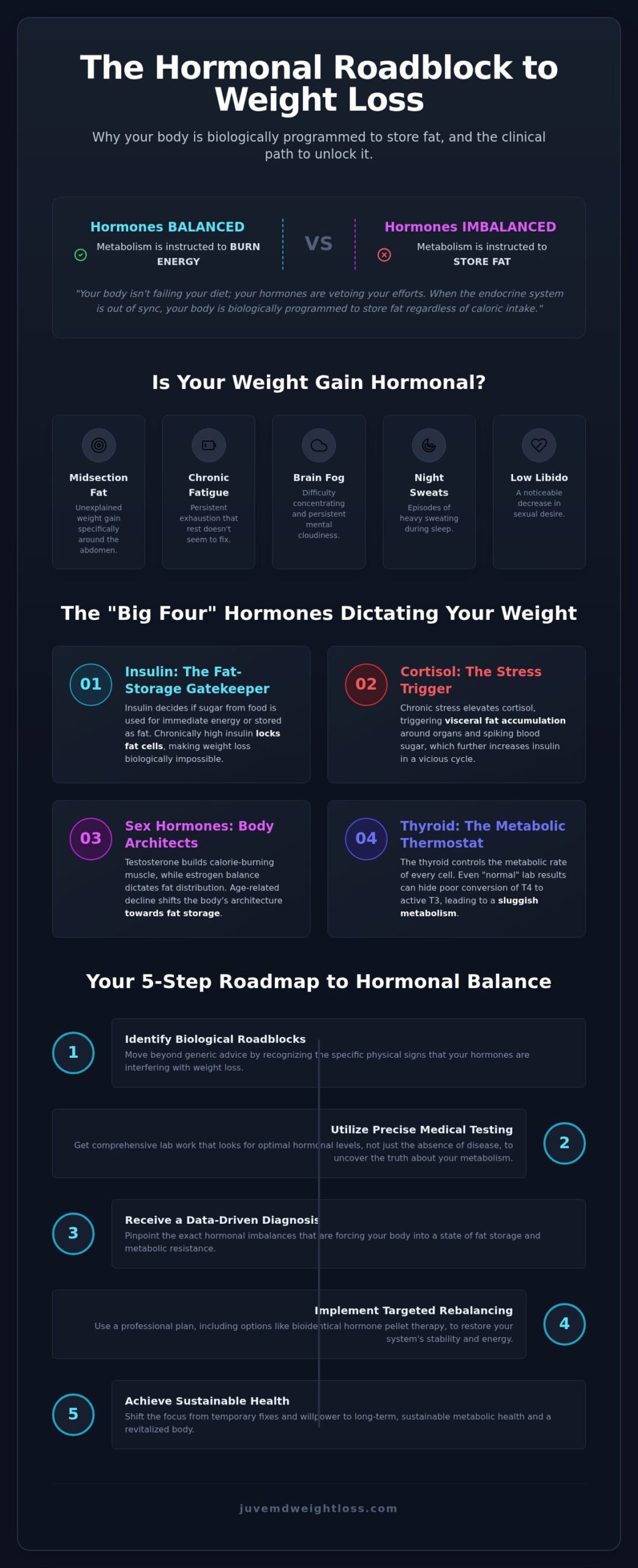
Your 5-Step Diagnostic Roadmap to Hormonal Balance
Discovering how to balance hormones to lose weight requires a departure from guesswork and a commitment to clinical data. Many people spend years trying different supplements or restrictive diets without ever understanding their unique biological blueprint. A data-driven approach removes the frustration of trial and error by identifying exactly where your system is stalling. Comprehensive blood work is the blueprint for your treatment, providing the objective evidence needed to build a strategy that actually works for your body.
Step 1: Comprehensive Hormone Level Testing
The foundation of any successful medical plan is a deep dive into your chemistry. We look at essential markers including Free and Total Testosterone, Estradiol, Progesterone, a Full Thyroid Panel, and Fasting Insulin. It’s vital to test “Free” hormone levels, as these represent the hormones actually available for your cells to use, rather than those bound to proteins. For menstruating women, timing is critical; testing typically occurs during the mid-luteal phase, around days 19 to 21 of the cycle, to capture accurate progesterone and estrogen ratios.
Step 2: Expert Clinical Consultation
Raw data requires expert interpretation to be useful. During a consultation with Dr. Andrea Dempsey, we move beyond standard “reference ranges” that only flag extreme disease states. Instead, we focus on your “optimal range,” which is the level where you actually feel your best and your metabolism functions at its peak. We pair these lab results with your medical history and specific symptoms like brain fog or midsection weight gain to create a complete picture of your health. Working with a qualified non-surgical weight loss Las Vegas specialist ensures that your lab data is interpreted through the lens of metabolic optimization, not just disease prevention.
Step 3: Personalized Treatment Planning
Once we identify your roadblocks, we weave together a custom plan. This isn’t a one-size pill; it’s a sophisticated integration of bioidentical hormone pellet therapy, medical weight loss injections, and targeted nutrition. We customize every dosage based on your specific lab data to ensure safety and efficacy. You’ll receive a realistic timeline for stabilization, as your body needs time to adjust to its new, optimized environment. To start this process, you can schedule a medical weight loss consultation to review your unique metabolic needs.
Step 4 & 5: Implementation and Ongoing Optimization
The final steps of the roadmap involve the supervised implementation of your plan followed by long-term monitoring. Hormonal balance isn’t a static destination; it’s a dynamic state that requires periodic adjustments. We monitor your progress through follow-up labs and symptom checks, ensuring that as you lose weight and your activity levels increase, your treatment evolves with you. This proactive management prevents future plateaus and ensures your results are as sustainable as they are significant. If you’re considering a weight loss consultation in Las Vegas that incorporates the latest injection therapies alongside hormonal optimization, our clinical team can guide you through every step of this process.
Sustaining Results: The JuveMD Approach to Weight Management
Achieving your goal weight is a significant milestone, but the clinical focus at JuveMD extends far beyond the initial loss. Real success lies in transitioning from an active intervention phase to a sustainable, vibrant lifestyle. Many patients come to us with a deep-seated fear that once they stop a specific protocol, the weight will inevitably return. This “rebound” effect is usually the result of failing to address the underlying biological drivers that caused the gain in the first place. By learning how to balance hormones to lose weight through a structured medical weight loss program, you’re doing more than just suppressing appetite. You’re recalibrating your body’s metabolic set point for long-term stability and health.
Monitoring and Adjusting for Long-Term Success
Hormonal health isn’t a static destination; it’s a dynamic journey that shifts as you age and as your body composition improves. As you lose adipose tissue, the amount of fat-produced hormones like estrogen and leptin in your system naturally decreases. This shift is a positive sign of progress, but it often requires precise adjustments to your treatment dosages to ensure your levels remain optimized. Regular follow-up labs allow us to track these changes with clinical accuracy, ensuring your medical support stays perfectly aligned with your body’s evolving needs. We function as your long-term wellness partner, providing the professional oversight necessary to prevent future plateaus and maintain your metabolic fire.
Beyond the Scale: The Total Wellness Transformation
While weight loss is often the primary motivator, the most profound markers of a balanced system usually appear in your daily quality of life. Patients frequently report significant improvements in sleep quality, a total reversal of brain fog, and a restored libido as their hormones stabilize. These victories are evidence that your metabolic engine is finally running efficiently and your body is no longer in a state of chronic stress. To complement your internal transformation, we offer sophisticated aesthetic services, including injectables and skin treatments, to help your outward appearance match your revitalized internal health. If you’re ready to move beyond generic advice and embrace a professional, data-driven path to health, schedule your personalized hormone consultation today and take the first step toward lasting results.
Reclaim Your Metabolic Health
Weight loss is rarely just a matter of willpower; it’s a matter of biological permission. By identifying the specific hormonal roadblocks in your system, you can move past the frustration of failed diets and chronic fatigue. Understanding how to balance hormones to lose weight requires a shift from generic advice to clinical precision. Science-backed medical weight loss plans and specialized Bioidentical Pellet Therapy provide the steady-release support your body needs to stabilize and thrive.
Through personalized care from Dr. Andrea Dempsey, you can uncover your unique metabolic blueprint and implement a plan designed for lasting results. This journey isn’t just about the scale; it’s about restoring your energy, mental clarity, and overall confidence. You don’t have to navigate these complex physiological shifts alone. Professional guidance ensures that every adjustment is based on data rather than guesswork.
Begin Your Hormonal Optimization Journey with JuveMD and discover the difference that expert, individualized care can make for your future. Your path to a revitalized life starts with a single, data-driven step. We are here to support you in achieving the sustainable transformation you deserve.
Frequently Asked Questions
How long does it take to balance hormones for weight loss?
Most patients begin to notice improvements in energy and sleep within the first few weeks of starting therapy. However, it typically takes 3 to 6 months of consistent clinical management for your system to fully stabilize. This timeline allows your metabolism to adjust to new hormonal signals and begin the process of fat oxidation. Patience is vital because your body needs time to reverse years of metabolic adaptation and chronic stress.
Can I balance my hormones naturally, or do I need medical help?
While nutrition and sleep are essential foundations, they often aren’t enough to correct a deep-seated clinical imbalance. If you’re struggling with how to balance hormones to lose weight and lifestyle changes have failed, medical intervention is likely necessary. Clinical treatments like bioidentical pellets provide the precise biological signals that diet alone cannot replicate. We recommend starting with a medical consultation to determine if your issues are behavioral or biological.
Will hormone replacement therapy make me gain weight?
Optimized hormone therapy is designed to improve body composition, not cause weight gain. While some outdated synthetic treatments were associated with water retention, modern bioidentical pellet therapy focuses on metabolic optimization. By restoring testosterone and balancing estrogen, you can actually increase lean muscle mass and improve your resting metabolic rate. This shift makes it easier for your body to burn fat rather than store it, especially when paired with a clinical weight loss plan.
What is the most important hormone for weight loss in women?
Insulin is often considered the master hormone for fat storage, but for women, the ratio of estrogen to progesterone is equally critical. If these are out of sync, your body may prioritize storing fat in the midsection and hips regardless of your caloric intake. Thyroid function also plays a massive role in setting your overall metabolic pace. Because these hormones work in a tight network, optimizing the entire system is more effective than focusing on just one.
Are bioidentical hormone pellets safer than traditional HRT?
Bioidentical hormones are chemically indistinguishable from the hormones your body produces naturally. Unlike traditional synthetic HRT, which often uses non-human sources, bioidentical pellets offer a more natural physiological match. The pellet delivery system also provides a steady, 24/7 release of hormones into the bloodstream. This avoids the high peaks and low troughs associated with oral pills or creams, which can reduce the risk of side effects and provide more consistent results.
Do I need to change my diet while on hormone therapy?
Yes, your nutritional choices act as the supporting environment for your hormone therapy to succeed. While pellets and injectables provide the biological software for weight loss, your diet provides the necessary raw materials and fuel. Focusing on anti-inflammatory foods and stable blood sugar levels will maximize your results. We integrate personalized nutrition plans into our medical weight loss programs to ensure your lifestyle and clinical treatments work in perfect harmony.
Can hormone pellets help with menopause-related belly fat?
Menopause-related weight gain is often driven by a sharp decline in estrogen and testosterone, which shifts fat storage to the abdomen. Pellet therapy specifically targets this hormonal shift by restoring these levels to an optimal range. This helps redistribute fat and boosts the metabolic fire needed to burn visceral adipose tissue. Many women find that once their hormones are balanced, the stubborn “menopause middle” finally begins to respond to exercise and healthy eating again.
How do I know if my weight gain is thyroid-related or estrogen-related?
It’s impossible to distinguish between the two based on symptoms alone, as both can cause fatigue and weight gain. Thyroid issues often present with cold intolerance and thinning hair, while estrogen imbalances might involve mood swings or night sweats. The only definitive way to know is through comprehensive lab testing. At JuveMD, we use detailed blood panels to identify the exact source of your metabolic resistance so we can create a targeted treatment plan.