
Pellets provide a steady release, but there is an important trade-off: once inserted, a pellet cannot readily be removed or reduced if side effects develop. Bioidentical hormone pellets are small implants placed under the skin that release hormones gradually over several months. In women, possible side effects include acne, breast tenderness, headaches, mood changes, and temporary soreness, bruising, or swelling near the insertion site.
It is reasonable to weigh the convenience of a pellet against how long its effects may continue. Knowing which symptoms can occur, what to expect at the insertion site, and which changes need medical attention can help clarify the decision.
This article explains how pellets work, covers possible insertion-site and hormone-related effects, and describes how a provider selects a dose based on your health history and symptoms. It also explains why dose planning matters when an inserted pellet cannot simply be removed if the dose does not suit you.
Key Takeaways
- Hormone-related effects can include acne, breast tenderness, headaches, and mood changes; knowing what to watch for helps you recognize changes after insertion.
- Bruising, soreness, swelling, or redness may occur around the insertion site. Learn which changes can be part of healing and which symptoms may need medical attention.
- Compounded bioidentical hormones are not FDA-approved or tested for safety or effectiveness, according to the U.S. Food and Drug Administration.
- Dose selection considers your symptoms and health history, while a pellet’s dose can’t be readily reduced or stopped after insertion.
- Understand how potential benefits, possible side effects, and personal health considerations fit together before deciding whether pellet therapy suits your needs.
WHAT ARE THE MOST COMMON SIDE EFFECTS WHEN THE PELLETS ARE FIRST INSERTED?
Early effects may come from the incision or from changing hormone levels. Knowing the difference can help you interpret symptoms during menopause therapy.
Estrogen and Testosterone Effects in Women
Estrogen and testosterone pellets deliver different hormones, so their effects depend partly on which hormone is used. Estrogen therapy may be considered for menopause symptoms, while reported testosterone-related effects include acne and increased facial hair. This distinction matters when weighing possible symptom relief against changes you may notice in your skin, hair, or breasts.
Hot flashes are a common menopause concern: about 70-80% of women experience them. Hormone replacement therapy may also cause breast tenderness, bloating, spotting, headaches, or mood swings. A symptom diary can help you describe when a change began and how it affects daily life.
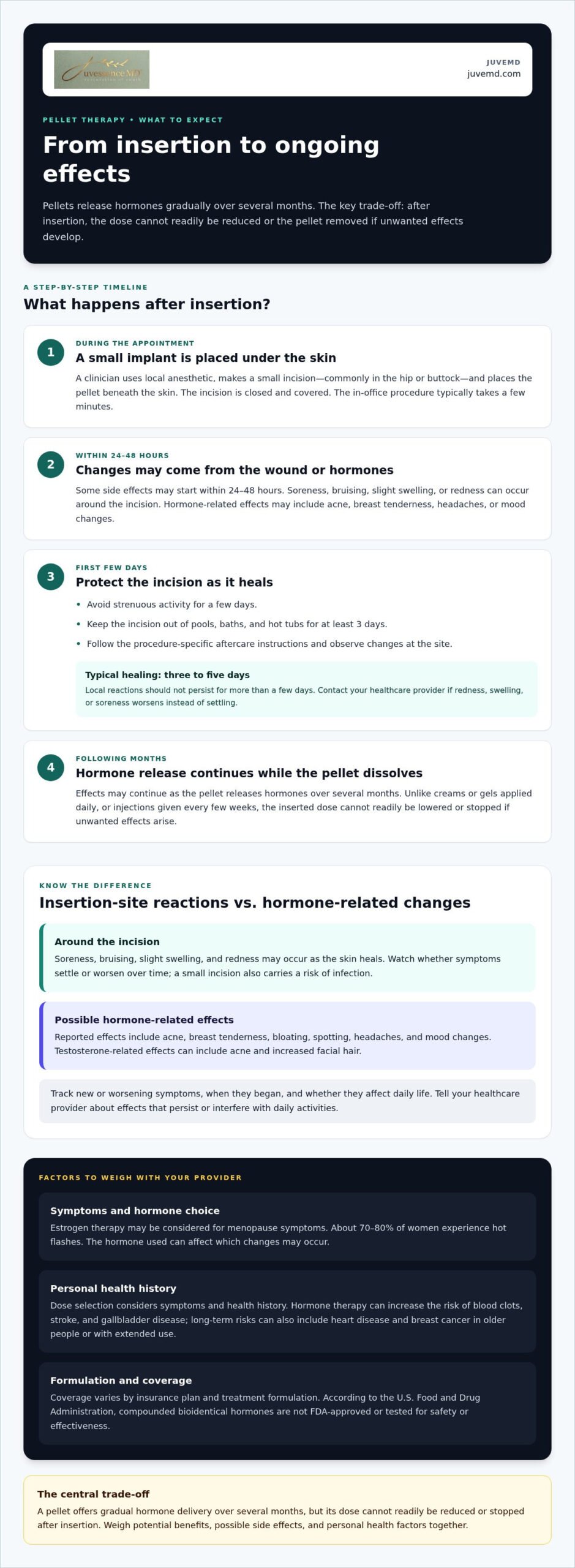
Pellets release hormones gradually over several months. Unlike creams and gels that require daily application, or injections given every few weeks, an implanted pellet provides longer-lasting delivery. The trade-off is that the inserted dose cannot readily be reduced if unwanted effects arise.
Coverage for hormone therapy varies by insurance plan and treatment formulation. Compounded bioidentical hormones are not FDA-approved or tested for safety or effectiveness, according to the U.S. Food and Drug Administration. Ask your insurer how it handles the specific treatment and formulation under consideration.
Pellet therapy is sometimes presented as a convenient alternative, but convenience alone does not mean it is safer. Hormone therapy can increase the risk of blood clots, stroke, and gallbladder disease. Potential benefits and risks depend on a person’s health history and treatment context.
Long-term risks can include blood clots and stroke. Hormone therapy may also increase the risk of heart disease and breast cancer in older people or with extended use. These risks make it important to review personal health factors before treatment.
Side Effect Duration and Pellet Removal
Side effects may start within 24-48 hours after insertion, while others continue as the pellet releases hormones over several months. The duration depends on the symptom and the body’s response. Pellets generally can’t be removed once inserted, so unwanted hormone-related effects can’t usually be addressed by stopping treatment or lowering the dose.
Bruising or soreness near the incision differs from a hormone-related change such as acne or moodiness. Track new or worsening symptoms, and tell your healthcare provider about effects that persist or interfere with daily activities.
Insertion-site irritation, infection, bruising, swelling, and redness
Pellet insertion creates a small wound, so temporary skin reactions are possible. Knowing what the procedure involves and the typical recovery timeline can help you monitor the site.
Common Insertion-Site Reactions
Common reactions include soreness, bruising, slight swelling, and redness around the incision. These changes can occur as the skin heals, but should not persist for more than a few days. Tracking changes each day can help distinguish a reaction that is settling from symptoms that are worsening or lingering. A small incision also carries a risk of infection.
During insertion, a clinician uses local anesthetic and makes a small incision, commonly in the hip or buttock. The pellet is placed under the skin, and the incision is closed and covered. The in-office procedure typically takes a few minutes. Because the site is a wound, care matters after the appointment too.
The pellet releases hormones gradually as it dissolves over several months. This is separate from the incision’s healing: local soreness or swelling concerns the skin, while changes such as acne may relate to hormone exposure. Testosterone pellets use the same general insertion approach, so site care remains relevant regardless of the hormone used.
For recovery, follow the specific aftercare instructions provided for your procedure. Common precautions include:
- Avoid strenuous activity for a few days to allow the insertion site to heal.
- Keep the incision out of pools, baths, and hot tubs for at least 3 days.
- Observe the area for changes in redness, swelling, soreness, or bruising.
Wound healing after pellet insertion typically takes three to five days. These precautions help protect the incision during this early period.
Insertion Complications
Insertion complications are problems that arise during the procedure or while the wound heals, including infection at the incision. This matters because the pellet remains beneath the skin as the site recovers. If redness, swelling, or soreness worsens instead of settling after a few days, contact your healthcare provider for guidance.
Healing can vary, so compare the site’s appearance over time rather than judging one moment alone. For example, note whether bruising is fading or redness is spreading. Avoid strenuous exercise and water submersion during the recommended recovery window, since both can affect the healing incision. If you’re considering pellet hormone therapy, understanding insertion and aftercare can help you discuss what recovery involves.
Compounding, potency, and purity concerns
“Bioidentical” describes hormones designed to be chemically identical to hormones the body produces. The label alone does not establish how a pellet was made, tested, or approved. For women considering hormone pellet therapy, the distinction between an FDA-approved product and a compounded preparation matters when weighing evidence about safety and effectiveness.
According to the U.S. Food and Drug Administration, compounded bioidentical hormones are not FDA-approved or tested for safety or effectiveness. Compounding means preparing a medication to meet a prescription. It is not the same as FDA approval, and an individualized formulation should not be assumed to have the same review or evidence as an approved product.
Custom compounding may sound like a precise match for a person’s symptoms or hormone levels. But customization alone does not show that a preparation’s potency or purity has been established through FDA testing. A “custom” label also does not prove that a dose will prevent an imbalance, weight gain, or other unwanted effects.
Hormone pellets are small implants, about the size of a grain of rice. They can deliver estrogen or testosterone gradually as they dissolve. The hormone ingredient and amount determine what the pellet delivers, so the preparation’s contents matter more than the words “bioidentical” or “custom” on their own.
Compounded preparations may be considered when a prescriber writes an individualized prescription. Still, customization is not proof of superior results or greater safety. Ask what hormone the pellet contains and how the formulation relates to the treatment plan. Those details help clarify what “compounded” means in your case.
Potency means the amount of active hormone in a preparation; purity concerns what else is present. The FDA’s statement means compounded bioidentical hormones have not been tested by the agency for safety or effectiveness. It does not establish that every pellet has the same contents, nor does it prove that a specific pellet caused a symptom.
This distinction is useful if you notice acne, breast tenderness, or weight gain after treatment. A symptom alone cannot identify a pellet’s potency or purity. Record when the change began, the hormone named in your treatment, and any dose details available to you. This gives your healthcare provider clearer information to review possible causes.
Cancer concerns also deserve careful discussion. The available facts about compounded hormones do not establish a cancer risk for an individual pellet or patient. Separate the question of FDA testing from your personal health history and the risks of hormone therapy. These are related considerations, but they are not interchangeable conclusions.
Before choosing hormone pellet therapy, clarify three things: whether the preparation is compounded, which hormone it contains, and what evidence supports its intended use. These questions cannot predict every outcome, but they help distinguish a product’s label from what is known about its testing and formulation.
How does my healthcare provider select my dose?
Dose selection starts with your symptoms, health history, and treatment goals. For women, hormone levels alone are not a reliable dosing target: the FDA recommends against using hormone levels to guide hormone therapy dosing in women. A lab result should not replace a careful review of how you feel and your health risks.
Discuss the symptoms you want to address, such as menopause-related hot flashes, and any changes you have noticed since treatment began. The dose may be adjusted as your hormone needs change. Keep a clear record of symptom relief, new symptoms, and when each change started. This gives your provider practical information to evaluate your response.
Your health history also affects whether hormone therapy may be appropriate. Bioidentical hormone therapy may not be safe for people with blood clotting disorders, heart or cardiovascular disease, breast cancer, or a history of stroke. Share these conditions before treatment, including details about a past diagnosis or event, so they can be considered alongside your current symptoms.
Bring an up-to-date list of prescription medicines, over-the-counter products, and supplements to your appointment. A complete list helps your provider review your overall treatment context rather than considering estrogen or another hormone in isolation. Mention any previous hormone therapy, including creams, and describe what you used and how you responded.
What tests and follow-up monitoring are recommended for women using hormone pellets? Follow-up should assess symptom response, unwanted effects, and relevant health conditions. The FDA recommends against using hormone levels to guide a woman’s hormone therapy dose, so monitoring should not rely on hormone-level results alone.
After insertion, note changes such as breast tenderness, acne, mood shifts, or spotting, along with when they occur and how they affect daily life. Contact your healthcare provider about negative effects, especially symptoms that do not go away or cannot be managed. This information can support decisions about future care, even though an inserted pellet’s dose cannot simply be lowered.
Medication review is also part of thoughtful dose planning. Tell your provider about changes to prescriptions or supplements, and do not assume an earlier assessment covers a new health condition. For example, a new diagnosis involving the heart or blood clotting may change the safety discussion before another pellet is considered.
A useful follow-up conversation connects three details: the symptoms you hoped to improve, the changes you actually experience, and your current health history. Bring notes and medication lists to make that review more specific. Dose decisions should reflect those clinical details, not a hormone number viewed on its own.
Potential side effects, including acne, hair changes, and mood changes
Hormone pellets may affect more than menopause symptoms. Acne, increased facial hair, mood swings, and breast tenderness are reported effects, so pay attention to changes after the procedure. A side effect can be associated with hormone therapy without being normal or harmless in every situation.
Skin changes can be particularly noticeable. Acne, for example, may appear or worsen, while increased facial hair may change how you manage grooming. Track where acne develops, when it began, and whether facial-hair growth is new. These details give a clearer picture than simply recording “skin changes.”
Mood shifts, including moodiness or mood swings, can also occur. Note the change, its timing, and its effect on daily routines. Headaches, tiredness, blurred vision, weight gain, bloating, cramping, or spotting are also reported with bioidentical hormones. Document spotting, especially if it differs from your usual pattern.
Dose matters because pellets continue releasing hormones after insertion. Unlike a daily method such as applying a cream, a pellet dose cannot readily be adjusted once it is in place. Keeping a clear symptom record can help distinguish the treatment timeline from changes that began earlier.
Try this simple tracking method:
- Write down the symptom, such as acne, breast tenderness, or mood changes.
- Record when it started and whether it changes over time.
- Note its effect on sleep, work, exercise, or other daily activities.
- Include other changes, such as spotting, bloating, or weight gain.
This record does not diagnose the cause, but it gives your healthcare provider specific examples to review. Contact your healthcare provider about a symptom that persists or cannot be managed. Describe its severity and timing rather than relying on a general label like “hormone imbalance.”
Keep the procedure in perspective: some people may notice pellet effects within 24-48 hours, while other changes may emerge later. That timing doesn’t prove a symptom’s cause. Comparing your notes with your baseline before treatment can help show what changed and when.
For a focused conversation about symptoms and hormone treatment, schedule a hormone health discussion.
JuveMD: Bioidentical Pellet Hormone Therapy
JuveMD offers Bioidentical Pellet Hormone Therapy for people considering pellet-based hormone treatment. If menopause symptoms or possible side effects have raised questions, a focused conversation can help you discuss your goals, health history, and concerns about dose selection.
Before deciding, consider what matters to you: symptom relief, the method of hormone delivery, and the fact that an inserted pellet cannot readily be adjusted. Bring notes about symptoms or changes you have experienced, along with questions about potential risks and follow-up. These details can make a treatment discussion more specific to your needs.
Pellet therapy may not suit every person or health situation. Contact JuveMD in Las Vegas to discuss Bioidentical Pellet Hormone Therapy and whether it aligns with your treatment goals.
Make Your Next Hormone-Health Decision With Clarity
Choosing a hormone treatment is a personal decision, and your priorities should guide the conversation. Consider what you hope to change, which trade-offs matter to you, and what questions still need answers. Keeping those priorities in view can help you take an informed next step rather than focusing only on the possibility of symptom relief.
If you are weighing the side effects of bioidentical hormone pellets in women, JuveMD in Las Vegas offers Bioidentical Pellet Hormone Therapy. The practice also offers Injectables and Skin Treatments. A discussion focused on your goals and concerns can help you explore whether pellet therapy fits what you are seeking.
Bring your questions, including concerns about side effects or dose selection, and share what matters most to you. Contact JuveMD with your questions to begin the conversation. Clear information can help you approach your decision with greater confidence and a plan that reflects your needs.
Frequently Asked Questions
WHAT ARE PELLETS?
Hormone pellets are small implants placed beneath the skin to deliver hormones gradually. They are generally about the size of a grain of rice and may contain estrogen or testosterone. For example, a pellet differs from a tablet because it is implanted rather than swallowed. Its gradual release means treatment continues over time, so the inserted dose cannot be treated like a daily medication you simply skip.
What are bioidentical hormones?
Bioidentical hormones are preparations described as chemically identical to hormones the body produces. The term describes the hormone, not necessarily how a medication is made or evaluated. According to the U.S. Food and Drug Administration, compounded bioidentical hormones are not FDA-approved or tested for safety or effectiveness. This distinction can help you ask about both the hormone and the preparation used.
Can BioTE pellets cause blood clots?
Hormone therapy can increase the risk of blood clots, but that general risk does not establish that a particular BioTE pellet caused a clot. The risk discussion should account for your medical history, including any blood-clotting disorder. Before treatment, describe any personal history of clots and ask how it affects your options. Sudden or severe symptoms require prompt medical attention rather than an online assessment.
HOW SOON WILL I FEEL THE EFFECTS OF THE PELLETS?
Some patients notice effects within 24-48 hours after insertion, while others may need a week or two to notice a difference. Full effects of bioidentical hormone therapy may take about three months. The timing of a change doesn’t prove the pellet caused it. For a useful comparison, note your symptoms before insertion, then record what changes and when.
How Does Hormone Pellet Therapy Work?
Hormone pellet therapy places an implant beneath the skin, where it releases hormone gradually as it dissolves over several months. Pellets can deliver estrogen or testosterone. Unlike a medication taken on a schedule, an implanted pellet continues releasing after insertion, and its dose cannot readily be adjusted afterward. That delivery method is an important consideration when discussing treatment preferences and possible side effects.
WHAT ARE THE POTENTIAL COMPLICATIONS OF INSERTING HORMONE PELLETS?
Insertion can cause bruising, soreness, swelling, or redness around the small incision, and the incision carries a small risk of infection. In Las Vegas, as elsewhere, follow the aftercare instructions for your procedure and track changes at the site. If symptoms worsen, persist, or concern you, contact your healthcare provider rather than trying to diagnose an infection yourself.
What are the common side effects of bioidentical hormone pellets in women?
Reported effects include acne, increased facial hair, mood changes, breast tenderness, headache, tiredness, weight gain, bloating, cramping, and spotting. For example, note whether acne began after insertion or whether spotting differs from your usual pattern. A brief symptom record, including timing and impact on daily activities, can make a follow-up discussion more specific than trying to recall every change later.
What serious risks and complications can hormone pellets cause?
Hormone therapy can increase the risk of blood clots, stroke, and gallbladder disease. It may also increase the risk of heart disease and breast cancer in older people or with extended use. These are hormone-therapy risks, not proof that a particular pellet caused harm. Discuss your health history and treatment duration when weighing potential benefits against risks, especially before starting or continuing therapy.