
What if an “am I a candidate for BHRT quiz” could point you toward a useful conversation without giving you a yes-or-no answer? Fatigue, sleep changes, hot flashes, or shifts in mood can be associated with hormonal changes, but they can also have other causes. It makes sense to look for clarity, especially when an online quiz seems to offer a quick conclusion.
A checklist can help you notice symptom patterns and decide what you want to discuss. It can’t diagnose a hormone disorder, confirm that you’re a candidate for bioidentical hormone replacement therapy (BHRT), or account for your full health history and individual risks.
This guide offers a practical self-check, explains what quiz results can and can’t tell you, and outlines why an individualized clinical assessment matters. If your responses raise questions, you’ll have a clearer sense of what to discuss with a hormone-health clinician in Las Vegas, including at JuveMD. The goal isn’t to decide on treatment from a score, but to approach the conversation with useful context.
Key Takeaways
- Use the symptom checklist to organize observations about energy, sleep, mood, sexual health, and temperature changes.
- An am I a candidate for BHRT quiz can help you prepare questions, but it can’t diagnose a condition or confirm treatment suitability.
- Age and life stage are only part of the picture; personal health history can also affect whether BHRT is appropriate.
- Record when symptoms occur and gather relevant health and medication information before discussing your concerns with a clinician.
- At JuveMD in Las Vegas, a self-check can help frame an individualized hormone-health conversation, while a clinician determines appropriate next steps.
Am I a candidate for BHRT? Start with this symptom-pattern checklist
Persistent or changing symptoms can raise questions about hormone health. Fatigue, disrupted sleep, hot flashes, or mood shifts may be part of the picture, but they don’t point to one cause on their own. A useful first step is to note what has changed and how those changes affect your everyday life.
Symptoms worth noting before a hormone-health conversation
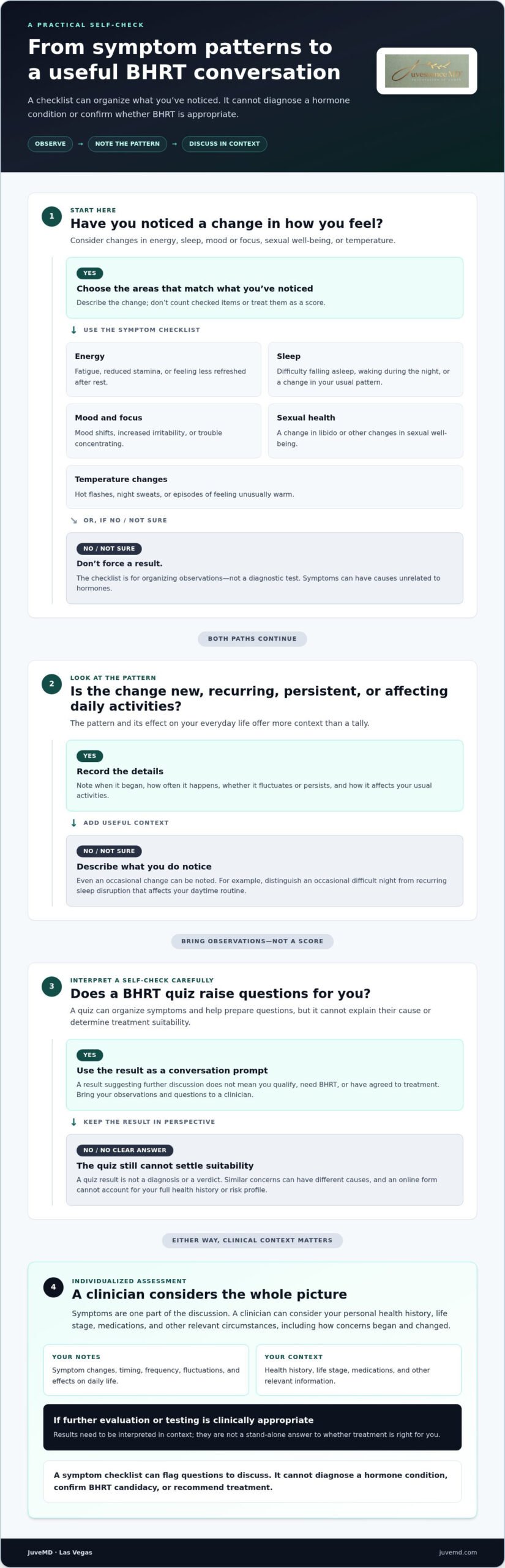
Use this checklist to organize observations, not to count symptoms or reach a conclusion. Note whether a change is new, recurring, persistent, or affecting activities that usually feel manageable.
- Energy: Fatigue, reduced stamina, or feeling less refreshed after rest.
- Sleep: Difficulty falling asleep, waking during the night, or changes in your usual sleep pattern.
- Mood and focus: Mood shifts, increased irritability, or trouble concentrating.
- Sexual health: A change in libido or other changes in sexual well-being.
- Temperature changes: Hot flashes, night sweats, or episodes of feeling unusually warm.
For each observation, note when it began, how often it happens, and whether it fluctuates or persists. For example, distinguish an occasional difficult night from recurring sleep disruption that affects your daytime routine. This context is more useful in a discussion than a tally of checked items.
How to use the checklist without self-diagnosing
Think of each checked item as a prompt to describe, not a result that points to treatment. If you’re searching for an am I a candidate for BHRT quiz, remember that a checklist can help you frame questions, but symptoms alone can’t establish eligibility. A single concern is also less informative without its broader health context.
Fatigue, changes in sleep, mood, libido, or focus can have many possible explanations, including factors unrelated to hormones. A clinician considers the pattern alongside your health history and other relevant information. The term BHRT is also used in discussions of different hormone preparations; for general background, see Bioidentical hormone replacement therapy (BHRT) on Wikipedia.
A symptom checklist can flag questions to discuss, but it cannot diagnose a hormone condition. There’s no score here that confirms candidacy or recommends treatment. Use your notes to explain what has changed and what concerns you most. This makes a hormone-health conversation more specific while leaving assessment and next steps to a clinician.
What an ‘am I a candidate for BHRT’ quiz can, and cannot, tell you
A BHRT quiz is an educational self-check. It organizes your reported symptoms and concerns into questions to bring to a clinician. It can help you decide whether you want to discuss hormone health, but it can’t explain why a symptom is happening or determine whether hormone therapy is suitable for you.
A quiz result is a starting point, not a medical verdict
An am I a candidate for BHRT quiz may flag patterns worth discussing, but matching symptoms to a set of questions doesn’t establish their cause. Similar concerns can occur for different reasons, and a quiz can’t account for every detail of your health or assess your full risk profile. A result shouldn’t be read as “you qualify” or “you need BHRT.”
A result suggesting further discussion doesn’t mean you’ve agreed to treatment. An evaluation can give you an opportunity to ask questions, understand potential options, and consider whether any next step fits your needs. You remain part of the decision. For broader treatment context, see JuveMD’s complete BHRT guide for Las Vegas.
Why clinical context matters when considering BHRT
A clinician interprets symptoms alongside your personal health history, life stage, and other relevant factors. They can ask how concerns began, whether they’ve changed, and how they affect daily life, then determine whether further evaluation or testing is clinically appropriate. If testing is appropriate, the results need interpretation in context; they aren’t a stand-alone answer to whether treatment is right for you.
This is why quiz feedback can’t replace an individualized assessment. The same response may mean something different depending on a person’s health background, medications, and overall circumstances. An online form can’t ask follow-up questions in the depth needed to make those distinctions or prescribe a treatment plan.
A quiz can guide a conversation, but only an individualized clinical assessment can address treatment suitability. If your answers raise questions, bring them to a clinician rather than treating a score as a diagnosis or recommendation. A hormone-health discussion can help clarify what your symptoms may warrant and what options, if any, are appropriate to consider.
For readers in Las Vegas, JuveMD is a medical clinic focused on hormonal health and wellness. Your quiz responses can help organize a conversation with the clinic, while a clinician considers your individual circumstances and determines appropriate next steps. Learn more about hormone-health care at JuveMD.
Which personal factors can change whether BHRT is appropriate?
Symptoms are one part of a hormone-health discussion, not the whole picture. Their timing, your life stage, health history, medications, and current circumstances may all help a clinician understand what could be contributing. If you’re wondering whether to take an am I a candidate for BHRT quiz, use it to gather observations, not to screen yourself in or out.
| Area to consider | What to observe or discuss |
|---|---|
| Symptom pattern | What changed, when it began, whether it comes and goes, and how it affects daily life. |
| Life-stage context | Any recent transition or health change that may help explain when symptoms started. |
| Health history | Relevant past or current health conditions, medications, and other changes in well-being. |
Consider symptom timing and life-stage context
Try to connect symptoms to a timeline. Did a change begin gradually or suddenly? Has it stayed consistent, or does it fluctuate? Note whether it coincided with a life-stage transition, while remembering that timing alone doesn’t identify a cause.
Menopause, aging, or any single age doesn’t automatically establish that BHRT is suitable. Life stage can inform the conversation, but an individual assessment is needed to weigh it alongside symptoms and personal circumstances. For questions about women’s care, JuveMD’s information on hormone pellet therapy for women in Las Vegas provides related context.
Include health history and possible alternative explanations
Before a clinical conversation, make a simple record of relevant health changes and the medications or supplements you currently use. Include changes in sleep, stress, energy, mood, or weight, and note when they began. These observations don’t point to one diagnosis; they give a clinician useful context for considering possible explanations.
Similar symptoms can arise for different reasons. Fatigue, for example, may relate to sleep disruption, stress, a health condition, medication effects, or hormonal changes. Weight or mood changes can also have multiple possible contributors. This overlap is why one symptom or a quiz result shouldn’t determine a treatment decision.
Health history matters, too. A clinician may need to understand prior diagnoses, current concerns, and other factors that could influence the risks and benefits of hormone therapy. You don’t need to interpret that information on your own. If something feels relevant or you’re unsure whether to include it, mention it as a question rather than making an assumption about what it means.
These details help make the conversation more individualized, but they don’t guarantee a particular recommendation. Your age, symptom pattern, or a single health-history detail isn’t a verdict on candidacy. Share what you’ve noticed and let a clinician consider the full context before discussing whether any next step is appropriate.
What should you do after completing a BHRT self-check?
A self-check is most useful when it helps turn broad concerns into clear notes and questions. You don’t need to interpret your answers or decide whether BHRT is right for you before speaking with a clinician. Focus on describing what you’ve noticed and what you hope to understand.
Build a concise symptom and question summary
Save your checklist responses, then make a brief summary to refer to during a hormone-health discussion. Include your main concerns, when they began, whether they come and go, and how they affect routines such as work, exercise, or sleep. Note relevant health changes and current medications or supplements, too.
Write down what you want clarity about. You might want to understand possible reasons for a change, whether further evaluation is appropriate, or what benefits and limitations hormone therapy may involve. Questions about individual risks are also worth raising. Preparing them doesn’t mean you’ve decided that BHRT is the answer.
- Symptoms: What concerns you most, when each change started, and how often it occurs.
- Context: Relevant health changes, conditions, medications, and supplements.
- Questions: What you hope to learn about possible causes, benefits, limitations, and personal risks.
Know what the first discussion is for
The purpose of a clinical conversation is to understand your concerns and discuss reasonable next steps. A clinician can consider your symptom summary and health context, then discuss whether further evaluation or treatment options are appropriate. Any evaluation is individualized; the self-check alone doesn’t determine which steps make sense for you.
You can ask questions, take time to consider the information, and discuss options without committing to treatment. If you’re unsure how to explain a symptom or what to prioritize, bring your notes as they are. They don’t need to be complete or medically interpreted to help you describe your experience.
Before the discussion, consider what would help you feel informed. You may want to understand how a potential option is considered, what its limitations are, or how personal health factors shape the decision. There’s no need to arrive with a preferred treatment. The aim is to leave with a clearer understanding of what may be relevant to your situation and what, if anything, to consider next.
If you’re ready to discuss your questions in Las Vegas, explore JuveMD’s hormone-health care. A clinician can help put your observations in context and discuss appropriate next steps without treating a quiz result as a verdict.
Considering BHRT in Las Vegas? Discuss your results with JuveMD
A self-check can help you put concerns into words, but your answers aren’t a treatment decision. For people in Las Vegas considering what to do next, JuveMD offers a local setting for a hormone-health discussion. The clinic focuses on hormonal health and wellness, and its care includes bioidentical pellet hormone therapy and comprehensive hormone education.
How JuveMD fits into an individualized hormone-health conversation
Led by Dr. Andrea Dempsey, JuveMD approaches hormone health with attention to the individual, rather than treating a checklist as a diagnosis. Your notes can help explain what prompted your questions, while a clinician considers your circumstances and determines appropriate next steps. Learning about pellet therapy is part of an informed conversation, not an indication that every person completing a self-check is a candidate.
That distinction matters. A quiz response can’t account for the details a clinician may need to discuss or establish whether a particular therapy is appropriate. JuveMD’s hormone education can help you understand the topic and prepare questions, while decisions about evaluation or treatment remain individualized. You don’t need to arrive with a conclusion about what your symptoms mean.
Make an informed next step in Las Vegas
Bring your symptom notes and questions to a clinical discussion. You might start with the change that affects you most, explain when you first noticed it, and share relevant health context or medication information. If you’re not sure what’s connected, say so. Clear observations are useful even when you don’t have an explanation.
It may also help to identify what you want from the conversation. Perhaps you want to understand possible contributors to your symptoms, learn about the benefits and limitations of BHRT, or ask how personal health factors may shape the decision. These questions invite a more meaningful discussion than a quiz score can provide.
The clinician’s role is to consider your individual situation and discuss reasonable next steps. That may include further evaluation or a conversation about treatment options, depending on what is appropriate. A self-check doesn’t decide which path to take, and exploring the subject doesn’t obligate you to begin therapy. You can ask questions, consider the information, and make decisions at your own pace.
If your search for an am I a candidate for BHRT quiz has helped you recognize questions you want answered, you can bring those questions to JuveMD in Las Vegas. The goal is a clearer, individualized understanding, not a promise of eligibility or a particular outcome. Explore hormone-health care at JuveMD as a next step toward an informed conversation. Learning more leaves the decision in your hands.
Turn your questions into a thoughtful next step
If you’re still asking, “am I a candidate for BHRT quiz,” let that question open a conversation rather than force a verdict. You don’t need to arrive with a diagnosis or a decision. Your questions and personal priorities can help shape a discussion about what matters to you and what options may be appropriate to consider.
JuveMD is a Las Vegas medical clinic focused on hormonal health and wellness, led by Dr. Andrea Dempsey. The practice offers bioidentical pellet hormone therapy, with treatment suitability determined through individualized clinical consideration, not a quiz score. Learning more is a way to explore your questions, not a commitment to a particular therapy.
When you feel ready to take that step, explore hormone-health care at JuveMD. You can move forward at your own pace, with your questions guiding the conversation and your choices remaining yours.
Frequently Asked Questions
Can an online BHRT quiz tell me if I am a candidate?
No. An am I a candidate for BHRT quiz can help you organize concerns and decide whether to raise hormone health with a clinician, but it can’t diagnose a condition or determine whether treatment is suitable. A result is a conversation starter, not a medical verdict. Use it to identify questions you want answered, then discuss your symptoms and circumstances in an individualized evaluation.
What symptoms should I include in a BHRT self-check?
Document changes in energy, sleep, mood, hot flashes, libido, or focus. Include details that make each observation clearer, such as whether sleep trouble involves difficulty falling asleep or waking during the night. These symptoms can have different causes, so record when each began and how it affects your routines rather than treating it as proof of hormone imbalance. A short dated note can help you describe patterns accurately.
Do I need hormone testing before considering BHRT?
Whether testing is useful depends on your concerns and clinical context. A quiz can’t identify which tests, if any, are appropriate, and results need to be interpreted alongside your overall health picture. In a conversation, you can ask what an evaluation is intended to clarify and how any proposed testing relates to your symptoms. A clinician can explain the reasoning without assuming a particular testing pathway.
Can men and women both take a BHRT quiz?
People of different sexes may have questions about hormone health, but symptoms and clinical considerations can differ. A general checklist may help organize observations, but it isn’t a one-size-fits-all assessment. Don’t use a friend’s quiz result as a guide to your own next step. Describe your symptoms, health background, and concerns in a clinician conversation so they can be considered in your individual context.
Does a positive BHRT quiz result mean I should start treatment?
No. A positive or high-scoring self-check only reflects the answers entered; it doesn’t establish a diagnosis or mean you should begin BHRT. Use the result to identify concerns you want to discuss. A clinician can consider your circumstances and explain which options may be appropriate, along with their limitations and risks. You can ask questions and weigh that information before making any treatment decision.
Can symptoms like fatigue or brain fog be caused by something other than hormones?
Yes. Fatigue, disrupted sleep, mood changes, and difficulty concentrating can have multiple possible explanations, and a checklist can’t identify the cause. For instance, note whether concentration feels worse after a poor night’s sleep or whether it occurs independently. Share when the changes began, how they affect daily activities, and relevant health context with a clinician. This gives the discussion more detail without asking you to diagnose yourself.
What should I bring to a BHRT consultation in Las Vegas?
Bring a concise timeline of symptoms, notes on how they affect your routines, current medication information, relevant health-history details, and questions about possible next steps. You might include when a concern is most noticeable or whether it has changed over time. These notes are preparation, not a requirement or a substitute for clinical judgment. They can help make a hormone-health discussion in Las Vegas more focused and useful.