
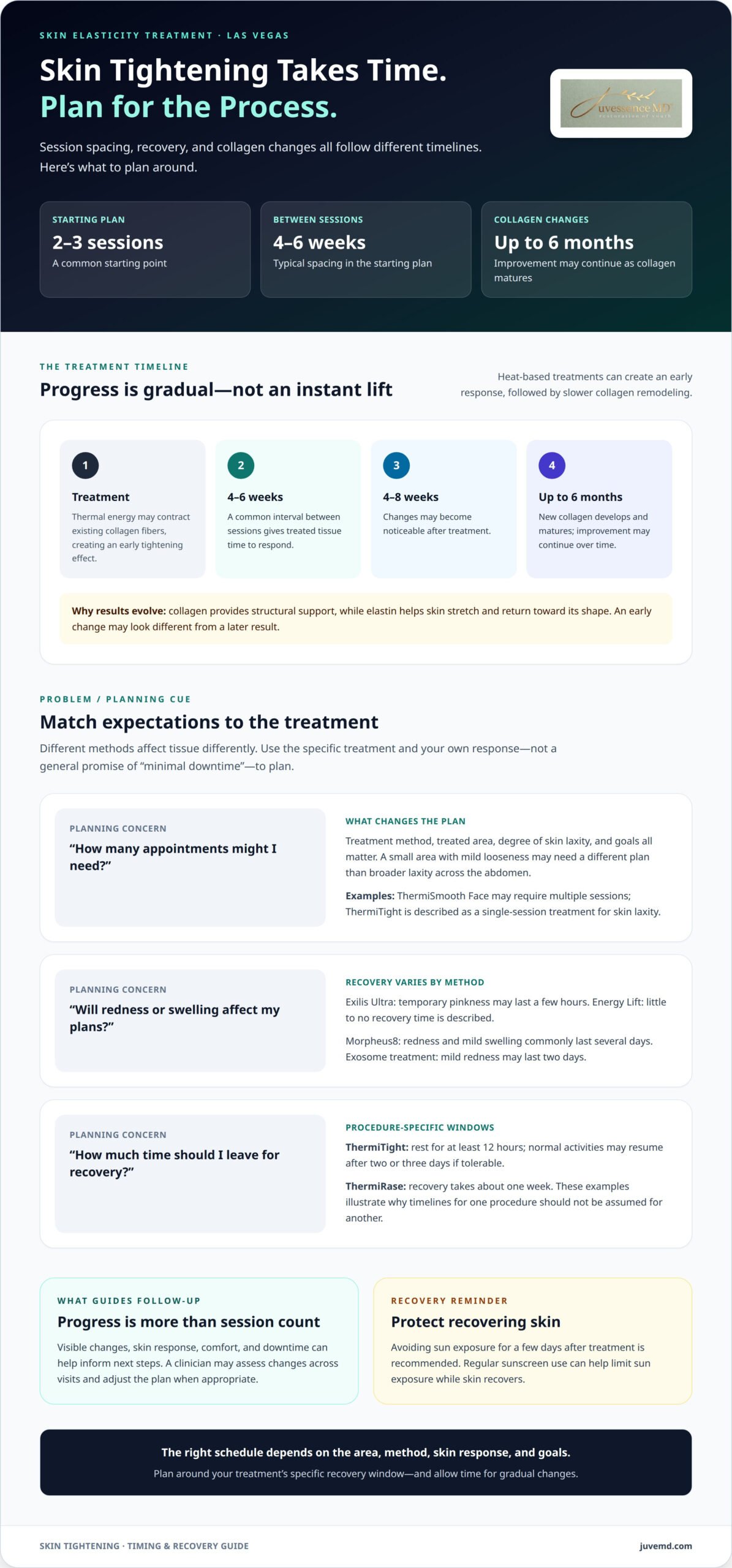
Skin tightening is gradual, not an instant lift. For skin elasticity treatment in Las Vegas, a common starting plan is two to three sessions spaced four to six weeks apart. Changes may become noticeable four to eight weeks after treatment and continue to improve for up to six months as collagen matures.
It’s natural to want firmer-looking skin and to understand what the process involves. The right approach depends on your skin and goals, and results develop over time rather than appearing all at once.
This article explains common treatment benefits, how session plans are determined, and when anesthesia may be used. You’ll also learn what temporary redness can look like, how recovery varies by treatment, and when results may begin to show.
Key Takeaways
- Skin-tightening treatments support firmness by encouraging collagen activity, but the best approach depends on the area treated and the degree of skin laxity.
- Your treatment plan may involve a series of sessions; the method and your goals help determine the spacing and total number.
- Anesthesia needs vary by procedure, and some non-invasive treatments may use local anesthesia to reduce discomfort.
- Temporary redness or swelling can occur, while recovery time depends on the treatment selected.
- Results develop gradually, so understanding the expected timeline can help you plan treatment and assess changes realistically.
How many skin tightening sessions will I need to see results?
A common starting plan is two to three skin-tightening sessions, spaced four to six weeks apart. This gives treated tissue time to respond between appointments. The number of sessions depends on the treatment method, area, degree of skin laxity, and your goals. For example, a small area with mild looseness may call for a different plan than broader laxity across the abdomen.
Heat-based treatments work through an immediate response and a slower repair process. During treatment, thermal energy can cause existing collagen fibers to contract, creating an early tightening effect. Controlled heat also aims to stimulate collagen and elastin production. Collagen provides structural support, while elastin helps skin stretch and return toward its shape.
New collagen develops gradually over the following months, rather than appearing immediately after a session. As it forms and matures, the skin’s supporting structure can remodel. This helps explain why an early change may look different from the later result. Non-surgical skin-tightening changes may become noticeable four to eight weeks after treatment and continue to improve for up to six months.
Radiofrequency, ultrasound, laser, and microneedling use different approaches to target tissue and encourage collagen activity. For example, Exilis Ultra combines radiofrequency and ultrasound, while microneedling creates controlled micro-injuries. The appropriate method depends on the treatment area and your goals. Comfort and downtime also vary by technique.
Session count isn’t the only measure of progress. A treatment plan also considers the area’s size, degree of laxity, and how your skin responds after each appointment. A clinician can assess changes across visits and adjust the plan when appropriate. Regular sunscreen use after treatment helps limit sun exposure while skin recovers.
Cost depends on the treatment area, method, and number of sessions, and is provided after a quote request. Skin-tightening treatments are generally elective cosmetic care, so insurance coverage depends on the plan and whether the treatment is medically indicated.
For example, a two-session plan may start with an initial treatment, followed by a review before the next appointment. Your provider considers visible changes, skin response, comfort, and downtime when discussing next steps. Since collagen remodeling continues after treatment, judging results too soon may mean missing changes that develop over the following months.
Downtime and temporary skin redness
Recovery depends on how a treatment delivers energy and how deeply it affects tissue. Non-invasive skin tightening generally involves less downtime than invasive or surgical procedures, but “minimal downtime” doesn’t mean everyone reacts the same way. The treatment area, method, and individual skin response all shape the first few days. Before treatment, a personalized plan should explain expected redness, swelling, and when you can return to usual activities.
Exilis Ultra is described as having no downtime. Temporary pinkness may last a few hours, so some patients schedule treatment around work or other commitments. Energy Lift is also described as requiring little to no recovery time. These examples show why the treatment name matters: recovery expectations for one non-surgical method don’t automatically apply to another.
- Exilis Ultra: temporary pinkness may last a few hours.
- Morpheus8: redness and mild swelling commonly last several days.
- Exosome treatment: mild redness may last two days.
Other procedures have different recovery windows. After ThermiTight, patients should rest for at least 12 hours. They may resume normal activities after two or three days if tolerable. Recovery after ThermiRase takes about one week. These timelines help illustrate how a treatment affecting tissue differently can require a different pause from usual routines.
After non-invasive skin tightening, redness, swelling, or numbness may fade over the next few days. These temporary effects vary by treatment and area. For example, someone treating the face may notice visible redness, while another person’s response may be less apparent. The specific method is key to setting realistic downtime expectations.
Plan around the likely recovery window rather than assuming rejuvenation means an immediate return to every activity. A clinician can explain procedure-specific aftercare and how to respond to expected temporary effects. Avoiding sun exposure for a few days after treatment is recommended. Regular sunscreen application can also help protect treated skin from sun exposure.
Before an appointment, patients can discuss work, social plans, and any concerns about visible redness. That helps the provider explain whether the timing suits the treatment’s recovery period. The distinction is practical: Exilis Ultra’s pinkness may last only a few hours, while Morpheus8 redness and mild swelling may continue for several days. Knowing the difference can make scheduling more comfortable.
Follow the personalized post-treatment instructions for the specific procedure, since recovery guidance differs by method. If redness, swelling, or numbness changes instead of fading over the expected period, contact the treating professional for guidance. Knowing the expected pattern can help distinguish routine short-term effects from a change that deserves attention.
Treatment sessions and possible anesthesia
Session plans depend on the treatment method, target area, degree of skin laxity, and aesthetic goals. ThermiSmooth Face may require multiple sessions to reach a desired cosmetic outcome. ThermiTight, by contrast, is described as a single-session treatment for skin laxity. These examples show why a treatment name alone doesn’t establish one schedule for everyone.
Appointment length also varies by procedure. A ThermiTight procedure takes one to two hours. That timeframe can help with planning, but it shouldn’t be applied to other treatments. The session plan should account for the area being treated and the method’s specific steps, rather than assuming every advanced skin-tightening appointment follows the same format.
Anesthesia isn’t automatically required for every non-invasive procedure. A professional may use local anesthesia at the start to minimize pain or discomfort. Whether it’s considered depends on the procedure and your comfort needs. Before treatment, the professional can explain the planned approach and what you may experience during the session.
To understand a proposed plan, discuss these points during the treatment consultation:
- Method: Ask whether the recommendation involves ThermiSmooth Face, ThermiTight, or another approach.
- Schedule: Clarify whether the plan involves one appointment or multiple sessions.
- Comfort: Discuss whether local anesthesia may be used for the procedure.
- Maintenance: Ask how future appointments fit the treatment plan.
Maintenance may be part of a longer-term plan. Maintenance sessions are scheduled annually or as a provider recommends to help sustain skin-tightening outcomes. This is a guideline, not a promise that everyone will follow the same timetable. Skin response, treatment method, and desired degree of firmness inform the follow-up plan.
Collagen and elastin activity continues after treatment, so the appointment day doesn’t show the full aesthetic outcome. A youthful-looking change may develop over time as the skin responds. That’s one reason a professional may consider your progress and goals before discussing maintenance, rather than setting appointments by a fixed calendar alone.
To avoid surprises, discuss the session format, expected appointment duration, and anesthesia plan before the procedure. For example, someone considering ThermiTight can plan around its one-to-two-hour procedure time, while someone considering ThermiSmooth Face should understand that multiple sessions may be needed. Clear expectations make it easier to plan for treatment and recovery.
Treatment timelines and results
A common starting plan is two to three sessions, with results lasting months to years with proper skincare and maintenance. The timing of visible changes depends on the treatment: some effects appear within weeks, while collagen remodeling continues longer.
Radiofrequency and other energy-based treatments stimulate a gradual tissue response, so the appointment date isn’t the same as the result date. Skin-tightening changes may first become noticeable four to eight weeks after treatment. Improvement can continue for up to six months as new collagen matures, providing a longer window to assess firmness and tightening.
Different methods have their own timelines. Morpheus8 results typically develop over one to three months. ThermiSmooth Face improvements may develop over three to six months after treatment. These timeframes reflect gradual changes, not an instant lift, and help set expectations for when to evaluate the effect.
Exosome treatment follows a shorter early timeline. Patients may see improvements in skin tone and texture within the first week, especially when treatment is combined with microneedling. Enhancement may continue over four to six weeks. This differs from collagen-focused tightening, where visible effects can keep developing for months.
Results may last months to years with proper skincare and maintenance. Longevity varies with the treatment approach and ongoing skincare, so maintenance belongs in the overall plan rather than as an afterthought. Annual maintenance sessions, or a schedule recommended by a provider, can help sustain skin-tightening outcomes.
Several factors affect how a result looks over time:
- Treatment method: Radiofrequency, microneedling, and other energy approaches have different response timelines.
- Target area: The face, neck, abdomen, arms, and thighs may need distinct treatment plans.
- Skin concern: Mild laxity and more pronounced looseness can call for different goals.
- Maintenance: Ongoing skincare and follow-up treatments support lasting results.
For a clear progress check, note the treatment date and compare changes at consistent intervals. An early review can capture initial tightening, while later assessment reflects collagen development. For example, a Morpheus8 result is typically assessed across its one-to-three-month development period, not solely in the first days.
Non-surgical tightening can enhance firmness without surgery, but it doesn’t produce the same change as a surgical lift. Gradual improvement may suit someone seeking a measured change, while the treatment approach should match the concern and desired outcome. Knowing the expected timeline helps you plan follow-up and assess results at an appropriate stage.
What treatments improve skin elasticity in Las Vegas?
Skin-tightening treatments use different energy sources and techniques to address laxity, firmness, and texture. The best fit depends on the treatment area, concern, and degree of looseness. Non-invasive options are generally suited to people with mild to moderate skin laxity who want to avoid surgery. They can target loose skin on the face, neck, and body, with plans tailored to each area.
Exilis Ultra combines monopolar radiofrequency and ultrasound energy. It is used to smooth areas such as the abdomen, upper arms, inner and outer thighs, and jawline. The device delivers heat to encourage collagen production, while providers monitor skin temperature during treatment. This option may suit someone focused on firmness across a body area or along the jawline, rather than surface texture alone.
Microneedling and radiofrequency microneedling work differently. Microneedling creates tiny, controlled micro-injuries that activate the skin’s healing response and support collagen and elastin production. RF microneedling adds radiofrequency heat beneath the skin’s surface to stimulate collagen and tighten tissue. Morpheus8 is one example; it can reach subdermal tissue at depths of up to 8 millimeters. These methods may address laxity alongside concerns such as pronounced wrinkles, acne scarring, and uneven tone.
- Energy Lift: A non-surgical approach described as improving firmness, elasticity, facial contour, and jawline definition.
- Skin resurfacing: Targets rough texture, uneven tone, fine lines, and acne scars by supporting skin repair.
- ThermiSmooth Face: May require multiple sessions, with improvements developing over three to six months.
- ThermiTight: A single-session treatment described for skin laxity, with a one-to-two-hour procedure time.
These options aren’t interchangeable. Resurfacing, for example, focuses on the skin’s surface, while RF microneedling delivers heat below it. Energy Lift is described as addressing facial contour and under-eye puffiness or sagging. The treated area and primary concern help determine which approach makes sense to discuss.
A professional assessment can account for skin laxity, desired changes, and whether the concern involves texture or contour. Someone with mild looseness across the neck may have different priorities from someone targeting abdominal skin. For advanced sagging or excess skin, non-surgical treatments may not provide the degree of change sought. A skincare treatment expert can discuss appropriate options.
To explore options suited to your skin concerns and goals, discuss skin treatment options.
JuveMD: Skin Treatments
JuveMD offers Skin Treatments for people considering professional care for skin firmness, texture, or elasticity in Las Vegas. If you’re weighing treatment methods, session needs, or recovery expectations, a conversation about your concerns and goals can help clarify the next step. The right approach depends on the area you want to address and the changes you’re seeking, rather than a one-size-fits-all plan.
Turn to JuveMD when you’re ready to discuss skin treatment options or want help understanding how professional care may fit your goals. Bring questions about timing, comfort, and recovery so they can be part of the conversation.
Contact JuveMD to discuss your skin treatment goals.
Choose a next step that fits your goals
The most useful next step is a focused conversation about the skin change you want to address. Bring your priorities, treatment questions, and any concerns about recovery into that discussion. This gives the care team a clearer starting point for considering an approach that aligns with your needs.
JuveMD offers Skin Treatments, Injectables, and Bioidentical Pellet Hormone Therapy. For skin elasticity treatment in Las Vegas, the relevant conversation is about your aesthetic goals and which skin treatment may suit you. A personalized discussion can help you move from general research toward a considered care plan.
Contact JuveMD to discuss treatment and take a thoughtful next step toward skin care that reflects your goals.
Frequently Asked Questions
Common treatment benefits?
Depending on the method, skin treatments can support firmer-looking skin, smoother texture, and improved facial contour. For example, Energy Lift is described as enhancing firmness and jawline definition, while resurfacing treatments target rough texture, uneven tone, fine lines, and acne scars. Focus on the benefit that matches your concern: improving surface texture differs from treating laxity beneath the skin.
Is there downtime associated with non-surgical skin tightening?
Downtime varies by procedure, and some non-surgical treatments cause temporary visible effects. Exilis Ultra is described as having no downtime, although temporary pinkness can last a few hours. Morpheus8 can cause redness and mild swelling for several days. If you have an event or work commitment, plan around the specific treatment’s recovery expectations rather than assuming every non-surgical option has the same downtime.
Are skin tightening treatments safe for darker skin tones?
Some skin-tightening treatments are described as suitable for all skin types, but that doesn’t mean every device or technique is identical. The treatment area, skin concern, and method all matter when choosing an approach. During a consultation, discuss your skin tone, history of skin reactions, and treatment goals. This helps guide a personalized discussion of appropriate options and aftercare.
Can skin tightening treatments be combined with injectables like Botox or fillers?
Skin treatments and injectables address different aesthetic concerns, and a care plan can consider both. Whether treatments are appropriate together or should be scheduled separately depends on the procedures and areas involved. Share which injectables you’re considering and any recent treatments during the consultation. This helps the clinician discuss sequencing instead of assuming every combination or schedule suits everyone.
How Long Until I See the Results?
Timing depends on the treatment. Morpheus8 results typically develop over one to three months, while ThermiSmooth Face improvements may develop over three to six months. Exosome treatment can produce early changes in tone and texture within the first week, with further enhancement over four to six weeks. These examples show why it helps to assess progress against the selected treatment’s timeline.
How Many Appointments Will I Need?
Appointment needs vary by method and goal. ThermiTight is described as a single-session treatment, while ThermiSmooth Face may require multiple sessions. A common starting plan for skin tightening is two to three sessions spaced four to six weeks apart. The treatment area and degree of laxity help shape the plan, so ask for a schedule tied to the specific procedure being considered.
Who is a good candidate for non-surgical skin tightening?
Non-surgical tightening is generally suited to people with mild to moderate skin laxity who want to avoid surgery. It can address loose skin on the face, neck, or body. The concern matters: someone seeking subtle jawline definition has different goals from someone with excess sagging skin. More advanced laxity calls for a discussion about what non-surgical treatment can realistically address.
What are the risks and side effects of skin elasticity treatments?
Temporary redness, swelling, or numbness can occur after some non-invasive treatments. The type and duration of effects vary; Morpheus8, for example, commonly causes redness and mild swelling for several days. Treatment-specific aftercare helps you understand what to expect. Tell the clinician about your skin history and concerns before treatment, and follow the instructions provided for your selected procedure.