
Hormone therapy may improve depression linked to the menopause transition, but it is not a universal treatment for depression. For some people, the answer to whether hormone therapy can help with depression is yes, particularly when mood symptoms occur alongside other menopause-related changes.
It is also understandable to wonder whether hormone therapy could affect mental health in the opposite way. Mood can change during treatment, and hormone formulations differ, so a shift in mood deserves attention. Hormone therapy is not FDA-approved to treat depression; antidepressants remain a first-line option for perimenopausal depression.
This article explains how hormone therapy may affect mood, why timing and menopause stage matter, and what risks to consider. It also compares hormone therapy with antidepressants, including when they may be used together. The aim is to help you understand the options and prepare for a considered discussion about menopause-related mood symptoms.
Key Takeaways
- Estradiol may help with depression during perimenopause, while antidepressants remain a first-line treatment; the right approach depends on symptoms and treatment goals.
- Hormone therapy can affect mood in different ways, so understanding how estrogen and progesterone may contribute can help you recognize changes during treatment.
- Mood changes and sleep problems may emerge before hot flashes, making it useful to consider the broader menopause transition.
- Age, time since menopause, symptoms, and health history all matter when weighing the potential benefits and risks of hormone therapy.
- Learn how JuveMD’s Bioidentical Pellet Hormone Therapy may fit into a personalized conversation about hormonal health.
Should I take antidepressants or HRT for menopause-related depression?
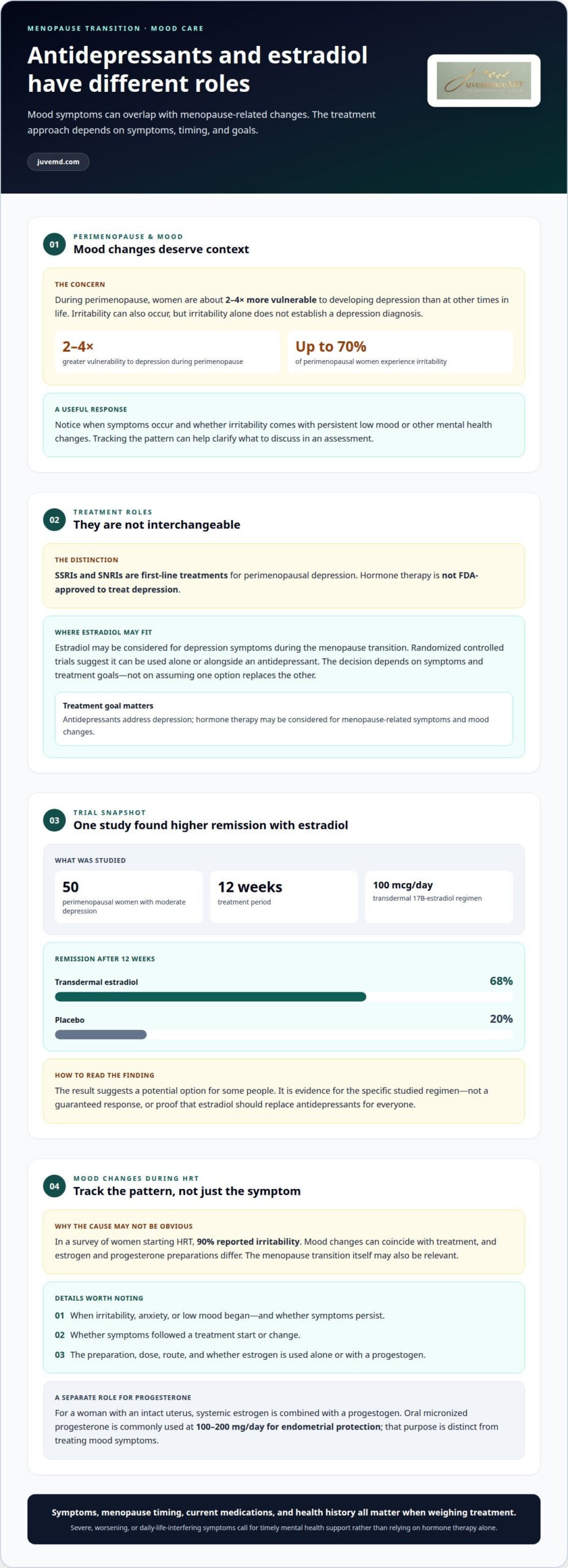
Antidepressants and hormone therapy can both be part of care for menopause-related depression, but they are not interchangeable. SSRIs and SNRIs are first-line treatments for perimenopausal depression, while estradiol may be considered when symptoms occur during the menopause transition.
Estradiol for perimenopausal depression
Estradiol is an estrogen hormone that has been studied as a treatment for depression during perimenopause. In a randomized trial involving 50 perimenopausal women with moderate depression, 68% receiving transdermal estradiol reached remission after 12 weeks, compared with 20% receiving placebo. The studied regimen was transdermal 17B-estradiol at 100 mcg/day. These results suggest a potential option, not a guaranteed response for every person.
Depression risk during perimenopause
Perimenopause is the transition before menopause. Women are about two to four times more vulnerable to developing depression during this period than at other times in life. This elevated risk makes it worth assessing mood changes alongside other symptoms. The trial described above found no association between menopause stage and increased depression risk; younger age and high school education or less correlated with increased risk.
HRT and perimenopausal irritability
Irritability is a mood symptom that may occur during perimenopause, but it doesn’t by itself establish a diagnosis of depression. Up to 70% of perimenopausal women experience irritability. When irritability appears with persistent low mood or other changes in mental health, tracking when it occurs can help clarify whether symptoms may relate to the transition or need a broader assessment.
So, can hormone therapy help with depression? Estradiol may help some people with perimenopausal depression, and several randomized controlled trials suggest it can be used alone or alongside an antidepressant. However, hormone therapy is not FDA-approved to treat depression, and antidepressants remain a first-line option. Treatment decisions should consider the symptoms and whether menopause-related concerns are also present.
For example, a person experiencing depression alongside hot flashes may discuss both symptom groups as part of treatment planning. Someone already taking an SSRI or SNRI may also discuss whether hormone therapy could have a role, rather than stopping or changing medication independently. The 12-week estradiol trial provides evidence for a specific treatment approach, but it doesn’t establish that estradiol should replace antidepressants for everyone.
The practical distinction is the treatment goal: antidepressants address depression, while hormone therapy may be considered for menopause-related symptoms and mood changes. A clinician can review mood symptoms, menopause timing, current medications, and relevant health history when weighing these approaches. If symptoms are severe, worsening, or interfering with daily life, seek timely mental health support rather than relying on hormone therapy alone.
Can HRT cause mental health issues?
Hormone therapy can coincide with mood changes, including irritability, and estrogen or progesterone preparations differ. Depression studies have examined transdermal estradiol; women with a uterus typically need a progestogen alongside systemic estrogen.
Hormones and mood
Estrogen and progesterone are reproductive hormones that can influence mood during menopause treatment. Their role matters because a mood change after starting therapy can have several possible explanations, including the treatment regimen and the menopause transition itself. In a survey of women starting HRT, 90% reported irritability. That finding makes it important to distinguish a new symptom from depression or anxiety.
Pay attention to the timing and pattern of mood and anxiety symptoms. Note whether irritability began after a treatment change, whether it persists, and whether low mood or anxiety is also present. These details can help frame a discussion about the regimen, rather than assuming every emotional change has the same cause.
Estrogen and progesterone preparations
Estrogen therapy is available in different preparations, including transdermal estradiol and oral estrogen. Depression research has examined transdermal estradiol, while broader hormone therapy regimens may pair estrogen with a progestogen. The route and combination matter because a treatment studied for mood is not automatically equivalent to every hormone preparation.
For a woman with an intact uterus, estrogen therapy is combined with a progestogen, typically oral micronized progesterone. Oral micronized progesterone is commonly used at 100-200 mg/day for endometrial protection. That purpose is distinct from treating mood symptoms, so the presence of progesterone in a regimen doesn’t mean it was selected as an antidepressant.
Progesterone-related mood effects can be difficult to distinguish from other changes during treatment. If irritability or anxiety begins after starting or changing hormone therapy, record the symptom and when it began, then discuss the pattern with the prescribing clinician. The specific preparation, dose, and whether estrogen is used alone or with a progestogen are relevant details.
Studies have also examined whether adding a progestin changes hormone therapy’s effect on depression. In the reported findings, adding progestin did not significantly affect overall effectiveness. This does not show that every formulation affects mood identically; it means the addition did not significantly alter the overall effect in those findings.
Hormone therapy is not a substitute for assessing persistent depression or anxiety. A treatment plan can account for mood symptoms, the estrogen route, and the need for progestogen when the uterus is intact. Because preparations differ, mental health changes during treatment are useful information for reviewing the regimen, not a reason to adjust hormones without clinical guidance.
Preventing depressive symptoms during the menopause transition
Depressive symptoms can emerge during the menopause transition, sometimes before hot flashes or other vasomotor symptoms. Understanding how the transition is defined and how mood changes relate to it can help clarify treatment choices.
Hormone therapy for menopause-related depression
Menopausal hormone therapy uses hormones to address menopause-related symptoms, and research has examined its possible effects on mood. Can hormone therapy improve depression symptoms? It may help some people, and one trial found transdermal estradiol plus progesterone halved new-onset depressive symptoms over 12 months among initially euthymic peri- and early postmenopausal women, compared with placebo.
HRT is not FDA-approved to treat depression, although doctors may prescribe it off-label. Menopause means 12 consecutive months without a menstrual period; perimenopause can last five to seven years or longer, and mood symptoms may begin several years before vasomotor symptoms.
Prevention also involves noticing symptoms early and seeking an assessment when they persist or disrupt daily life. In one study, women who experienced natural menopause had significant improvements in depressive symptoms, while those with surgical or chemotherapy-based iatrogenic menopause did not. These findings describe groups, not individual outcomes.
Evidence and clinical guidance
Evidence about hormone therapy and mood includes trials of estradiol and prevention studies involving progesterone. These findings support considering the menopause-related context, but they do not establish hormone therapy as a standard depression treatment. Hormone therapy is not FDA-approved for depression, and potential benefits should be weighed separately from its use for other menopausal symptoms.
What evidence and clinical guidelines support hormone therapy for depression? Research includes randomized trials, but the facts summarized here do not establish a specific clinical guideline recommending hormone therapy as a depression treatment. An assessment can consider mood symptoms, menopause timing, and whether depression needs treatment beyond hormone therapy.
How is hormone-related depression diagnosed and treated in the United States? An assessment considers the pattern of mood symptoms, menopause timing, and health history. Treatment may address depression directly, menopause-related symptoms, or both, depending on the person’s situation.
Other hormone treatments for depression
Testosterone and thyroid hormones relate to different health questions than menopausal estrogen therapy. Can testosterone therapy improve depression in men with low testosterone? The evidence summarized here does not establish that it treats depression; low testosterone and mood symptoms need to be assessed as distinct concerns.
Does thyroid hormone treatment help depression caused by hypothyroidism? Treatment addresses the thyroid condition, while depressive symptoms may also need direct evaluation. A clinician considers whether thyroid dysfunction explains the symptoms or whether another cause may contribute.
Who should avoid hormone therapy, and what conditions require caution? Hormone therapy is not suitable for everyone; a person’s health history and the specific regimen affect whether its risks are acceptable. For example, a history of a hormone-sensitive condition can call for particular caution before systemic treatment.
Age and timing considerations for hormone therapy
Age and time since menopause help frame the potential benefits and risks of menopausal hormone therapy. For most healthy, symptomatic women younger than 60 and within 10 years of menopause onset, benefits outweigh risks when treatment is individualized and periodically reassessed.
Menopause typically occurs between ages 45 and 55, and the median age in the United States is around 51. These figures offer context, not a personal deadline. A person considering treatment at 52 may be within 10 years of menopause, while someone the same age may not be, depending on when menopause began.
The timing window matters because the benefit-risk balance can change with age and years since menopause. For women under 60 and within 10 years of menopause, hormone therapy is described as a reasonable option when symptoms warrant consideration. Providers weigh the timing alongside the symptoms being treated, such as hot flashes, and relevant health history.
Mood changes can enter that discussion, but age alone doesn’t show whether hormone therapy is appropriate for depression. Consider a practical example: someone experiencing mood changes and hot flashes soon after menopause may discuss both concerns together. Someone whose menopause began more than 10 years earlier falls outside the timing window described for that reasonable-option group.
Reaching age 60 or 65 doesn’t automatically require stopping menopausal hormone therapy. Routine discontinuation at ages 60-65 is not required. Continuing beyond 65 may be considered for persistent vasomotor symptoms, quality-of-life concerns, or osteoporosis prevention, after individualized counseling.
These age thresholds describe decisions, not a schedule that applies identically to everyone. A useful review considers the person’s current age, when menopause began, which symptoms remain, and what the treatment is intended to address. For example, persistent hot flashes may carry different weight than mood changes alone when discussing continued therapy.
Periodic reassessment helps providers revisit whether the original treatment goals still fit. A review can consider whether symptoms have changed, whether benefits remain meaningful, and whether health factors have shifted since treatment began. For a person approaching age 60, that conversation can address continued use without assuming that an age milestone automatically settles the decision.
In short, age and timing are considered together: younger than 60 and within 10 years of menopause is a commonly described window for weighing therapy. Beyond that window, persistent symptoms, quality of life, osteoporosis prevention, and individualized counseling remain relevant considerations, including after age 65.
Hormone replacement therapy and depression
Hormone replacement therapy (HRT) may improve depression symptoms associated with the menopause transition, but it is not an established depression treatment for everyone. Its clearest role is as a potential option for some people with menopause-related mood symptoms, either alone or alongside antidepressants.
Evidence includes a study of 170 women at a menopause clinic in Ontario, Canada. In that group, 62% scored as “depressed.” This finding describes the participants, not the share of all menopausal women with depression. It also shows why mood symptoms deserve attention during menopause care, rather than being treated as a minor side effect.
A separate observational study surveyed 978 perimenopausal and postmenopausal women starting HRT. After three months of treatment, participants reported improvement in mood-related symptoms. Because this was observational, it shows an association after treatment began, not proof that HRT caused every improvement. Researchers concluded hormone therapy may improve menopause-related depressive symptoms alone or with antidepressants.
The combined approach has also attracted interest. In the survey findings, hormone therapy and antidepressants showed a synergistic effect on mood symptoms. That does not mean combining treatments is appropriate for everyone. It does show that HRT and antidepressants need not always be treated as competing choices; a treatment plan can address both menopause symptoms and depression.
Timing and treatment goals matter. Someone seeking help for persistent depression needs an assessment of depressive symptoms, while someone also managing menopause-related symptoms may discuss whether hormone treatment is appropriate. Studies report mood relief on average within three months of starting HRT, though the timing varies. Tracking mood changes during treatment can help show whether the intended benefit is occurring.
The practical takeaway: HRT can be considered for menopause-related mood symptoms, but it is not FDA-approved to treat depression. Antidepressants remain an important option, and some people may use them alongside hormone therapy. The right approach depends on symptoms, treatment history, and health factors, not on a single study result.
If you’re weighing hormonal care for mood symptoms, explore hormone health support as part of a broader treatment discussion. A clear conversation can distinguish depression care from menopause symptom management and identify whether hormone therapy belongs in the plan.
JuveMD: Bioidentical Pellet Hormone Therapy
JuveMD offers Bioidentical Pellet Hormone Therapy for people exploring hormonal health options. If mood symptoms occur alongside menopause-related concerns, a conversation about hormone therapy can help clarify whether this approach fits your goals and health history.
Hormone therapy is not FDA-approved to treat depression, and pellet therapy should not be assumed to replace depression care. Share your mood concerns and any current treatment when discussing your options. This helps keep the focus on your overall needs and the role hormonal care may play.
If you would like to discuss Bioidentical Pellet Hormone Therapy and your hormonal health, contact JuveMD in Las Vegas.
Take a thoughtful next step for your mood
Understanding whether hormone therapy can help with depression starts with considering mood symptoms in the broader context of your health. Before discussing options, note when symptoms began, how they affect daily life, and whether they changed alongside menopause symptoms or a treatment adjustment. Bring information about your current medications and hormone therapy history to the conversation.
This information can help clarify whether the priority is depression care, menopause-related symptom management, or both. Hormone therapy is not a replacement for appropriate mental health care, and treatment choices should reflect your symptoms and goals. JuveMD offers Bioidentical Pellet Hormone Therapy, along with injectables and skin treatments, for different wellness needs.
If you’re ready to discuss your hormonal health and possible next steps, contact JuveMD to discuss your options. A clear, informed conversation can help you move forward with greater confidence.
Frequently Asked Questions
Do doctors prescribe hormone replacement therapy for depression?
Doctors may prescribe HRT off-label for menopause-related depressive symptoms, but it is not FDA-approved to treat depression. The distinction matters: a prescription may target menopause symptoms and associated mood changes rather than replace depression treatment. If you are already taking an antidepressant, do not stop or change it based on information about HRT alone. Discuss how each treatment fits your symptoms and existing care plan.
How can HRT help with mental health during menopause?
HRT may ease menopause-related mood symptoms for some people, particularly when they occur alongside other changes during the transition. For example, tracking mood alongside changes in sleep or hot flashes can help someone describe how symptoms affect daily routines. That context helps clarify the treatment goal: addressing menopause symptoms, depression, or both. HRT does not replace an assessment of persistent or worsening mental health symptoms.
How long does it take for HRT to improve mood swings?
Mood relief is reported on average within three months after starting HRT, although timing varies. To assess changes, note when treatment begins and record mood patterns over time, including whether symptoms improve, worsen, or shift. Bring that timeline to a treatment review. A change in mood after starting HRT deserves discussion, rather than an assumption that the treatment is working or failing.
Personalized Approaches: Who Can Benefit from HRT?
HRT may be considered for people whose mood symptoms occur during menopause, especially when they also have menopause-related symptoms. Suitability depends on the treatment goal, menopause timing, and health history. Someone seeking help for depression alone, for instance, may need a different plan from someone addressing depression alongside hot flashes. A personalized discussion can clarify whether HRT belongs alongside other care, rather than treating it as a default choice.
Why is HRT making me depressed?
A mood change during HRT does not establish that the treatment caused depression. Hormone therapy can coincide with irritability, and menopause itself can involve mood symptoms. Note when the change began and whether it followed starting or changing a preparation. Share that timeline, the specific regimen, and any other symptoms with the prescribing clinician. Do not stop prescribed medication or adjust hormone treatment without discussing the change.
Can estrogen therapy help depression during perimenopause or menopause?
Estrogen, particularly transdermal estradiol, may help some people with depression during perimenopause. In a randomized trial of 50 perimenopausal women with moderate depression, remission after 12 weeks occurred in 68% receiving estradiol and 20% receiving placebo. That finding concerns a specific study and treatment regimen. It doesn’t show that every estrogen preparation treats depression or that estrogen should replace an individualized depression plan.
How does hormone therapy compare with antidepressants and psychotherapy?
Antidepressants and HRT have different roles: SSRIs and SNRIs are first-line treatments for perimenopausal depression, while HRT may be considered for menopause-related symptoms and mood changes. Some research suggests estradiol can be used alone or with an antidepressant. Psychotherapy is another treatment approach, but the evidence summarized here does not compare it directly with HRT. A treatment plan can address symptoms and goals without assuming one option suits everyone.
What are the risks and side effects of hormone therapy?
Risks depend on the hormone regimen and personal health history. Women with an intact uterus generally need a progestogen alongside systemic estrogen to protect the endometrium. Estrogen-alone products carry an endometrial cancer warning for women with an intact uterus. Earlier research also raised concerns about venous thromboembolism, stroke, and breast cancer with specific oral estrogen-progestin regimens. Review the exact preparation and relevant health factors before making treatment decisions.