
The option that requires the least frequent upkeep may also be the hardest to adjust. When comparing hormone pellets vs creams vs patches, focus on dose control: pellets release hormones over several months, while creams and patches follow routines that a clinician can adjust more readily.
Convenience matters, especially when daily application or regular patch changes feel like extra work. But it is only one part of the decision. Consider how each method delivers hormones, how readily the dose can be changed, and whether a topical product could transfer through skin contact.
This guide explains how pellets, creams, and patches work, then compares dose flexibility and transfer considerations. It also outlines what to discuss when considering a switch from pellets to patches. A pellet cannot be adjusted once it is placed, and its effects may take months to wear off. Use these trade-offs to prepare for a treatment conversation that reflects your needs.
Key Takeaways
- Compare how pellets, creams, and patches deliver hormones to identify which routine may fit your preferences.
- Understand why pellet doses are less flexible and what to consider before changing treatment.
- Learn how to reduce the chance of topical hormones transferring through skin contact.
- Recognize symptoms that may be discussed when evaluating hormone therapy and its potential benefits.
- Explore how patch, cream, and gel application differ, including practical considerations such as skin irritation and absorption.
Can you switch from hormone pellets to patches?
Switching from pellets to patches may be possible, but timing matters. Pellets continue releasing hormones for months, while patches deliver estradiol through the skin on a replaceable schedule. Neither method guarantees better symptom relief for every patient.
Risks differ by method. Pellet insertion can cause infection, bleeding, scarring, extrusion, or a hematoma, while patches may irritate the skin. Creams and gels can transfer through skin contact before absorption, so follow application and contact precautions.
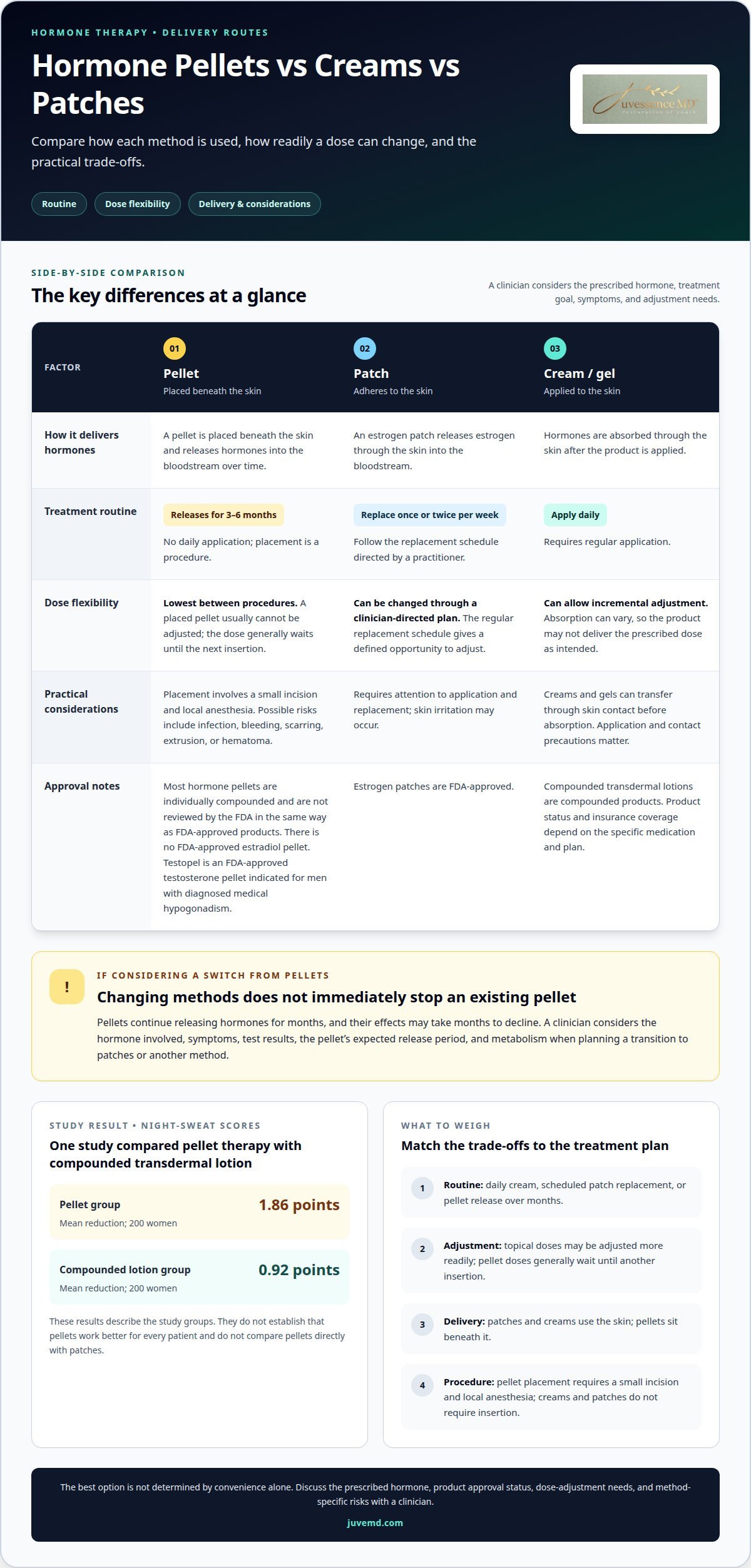
A pellet usually cannot be removed or adjusted after insertion, so elevated hormone levels may take months to decline. Switching to a patch does not immediately stop hormone release from an existing pellet. A clinician considers the hormone involved, symptoms, test results, and the pellet’s expected release period when planning a transition. Metabolism also affects how long its effects may continue.
FDA approval depends on the specific product and hormone. Estrogen patches are FDA-approved; most hormone pellets are individually compounded and are not reviewed by the FDA in the same way. Testopel, an FDA-approved testosterone pellet, is indicated for men with diagnosed medical hypogonadism. There is no FDA-approved estradiol pellet.
| Option | FDA status | Dose adjustment | Key consideration |
|---|---|---|---|
| Compounded pellet | Compounded pellets are not FDA-approved | Usually waits until the next insertion | Effects can persist for months |
| Estradiol patch | FDA-approved | Can be changed through a clinician-directed plan | May irritate skin |
| Compounded transdermal lotion | Compounded | Can allow incremental adjustments | Application and absorption can vary |
One comparison studied 200 women receiving pellet therapy and 200 receiving compounded transdermal lotion. The pellet group had a greater mean reduction in night-sweat scores, 1.86 points versus 0.92 points. These results compare those study groups; they do not establish that pellets work better for every patient or compare pellets directly with patches.
Compounded products also warrant careful discussion. The Drug Quality and Security Act gave the FDA additional powers to regulate compounding pharmacies in 2014. In 2020, the FDA listed estradiol and testosterone pellets on its Difficult to Compound List. The 2020 National Academies review found insufficient evidence that compounded bioidentical hormones are safe and effective, recommending their use only in specific cases. The Menopause Society does not recommend compounded hormone therapy over FDA-approved options.
The American College of Obstetricians and Gynecologists recommends routes other than pellets for testosterone, citing limited safety data and the inability to remove a placed pellet. Weigh the treatment goal, product approval status, dose-adjustment needs, and insertion risks when considering options.
How pellets, creams, and patches deliver hormones
These methods differ in how hormones enter the bloodstream, how often treatment is applied, and how readily a dose can be adjusted. A useful comparison of hormone pellets vs creams vs patches starts with the delivery route, then considers the treatment routine and prescribed hormone.
Estrogen Patch Delivery
An estrogen patch adheres to the skin and releases estrogen through it into the bloodstream. Patches are typically replaced once or twice per week, as directed by a practitioner. Unlike a pellet, a patch can be removed and replaced on a regular schedule, giving a clinician a defined opportunity to adjust the plan. The patch still requires attention to application and replacement.
Subcutaneous Pellet Delivery
A hormone pellet is placed beneath the skin through a procedure involving a small incision and local anesthesia. It releases hormones into the bloodstream over three to six months. Unlike creams and patches, which require repeated use, a pellet delivers hormones over a longer interval without daily application. Its dose usually cannot be adjusted until the next scheduled insertion, so extended release also means less flexibility between procedures.
Creams are applied to the skin daily, allowing hormones to be absorbed through it. This differs from patch delivery, which uses an adhesive product replaced on a schedule, and pellet delivery, which places hormones beneath the skin. Clinicians can adjust cream and gel doses incrementally. Absorption can vary, however, so topical products may not deliver the prescribed dose as intended.
Insurance coverage depends on the specific plan, prescribed medication, and delivery method. A policy may treat FDA-approved estrogen patches differently from compounded creams or pellets. Coverage for one product does not establish coverage for another. The exact medication, its route, and the plan’s coverage process all matter when comparing hormone pellets vs creams vs patches.
Compare the practical factors before choosing a method:
- Routine: Daily creams require regular application; patches need scheduled replacement; pellets release hormones for months.
- Adjustment: Cream doses can be adjusted incrementally, while pellet doses generally remain unchanged until another insertion.
- Delivery: Patches and creams deliver hormones through the skin; pellets sit beneath it.
- Procedure: Pellet placement requires a small incision and local anesthesia; patches and creams do not require insertion.
Someone who prefers fewer application steps may value a pellet’s extended release, while someone prioritizing dose flexibility may prefer a topical method. The treatment goal, prescribed hormone, routine, and adjustment needs all help guide the choice. Insurance coverage is another practical consideration because plan decisions can differ by medication and delivery method.
Symptoms that may improve with hormone therapy
Hormone therapy may be considered for symptoms linked to changing hormone levels, including hot flashes, night sweats, vaginal dryness, and low libido. Which symptoms matter most helps shape the treatment discussion, along with the hormone involved and the patient’s health history.
Study findings offer one view of symptom changes, not a guarantee for an individual. In a comparison of pellet therapy and compounded lotion, women receiving pellets had a greater mean reduction in hot-flash scores: 2.08 points versus 1.03 points. Vaginal-dryness scores fell by 1.88 points with pellets and 0.81 points with lotion. The groups also differed in night-sweat and libido scores, but those results don’t establish that one delivery method is best for every patient.
To prepare for a practical discussion, note which symptoms affect daily life, when they occur, and whether they changed after treatment began. Someone whose main concern is vaginal dryness may have different options to discuss than someone focused on hot flashes. Estradiol is used in some hormone therapy plans; testosterone treatment involves different considerations and is not interchangeable with estrogen.
Hormone therapy costs and insurance coverage depend on the prescribed medication, delivery method, and individual plan. Coverage for an FDA-approved product may differ from coverage for a compounded preparation. Review the specific medication and route as part of treatment planning rather than assuming coverage transfers between patches, creams, and pellets. Out-of-pocket costs also depend on plan benefits and prescribed treatment.
People with a uterus need progesterone as part of hormone replacement therapy for uterine protection. A levonorgestrel IUD is a progestin-based option to discuss within that plan; its role depends on the patient’s treatment needs. Vaginal estrogen used alone does not require progestin or progesterone for uterine protection.
Pellet therapy may appeal to patients who prefer treatment delivered over months rather than regular topical applications. Some health histories call for caution. People with a history of blood clots, stroke, or heart attack, active liver disease, or unexplained vaginal bleeding should generally avoid pellets. Unexplained bleeding needs evaluation before treatment.
Evidence-based choices consider the symptom goal, hormone level, medical history, and product. FDA-approved estradiol patches are one option; creams and gels allow incremental dose changes, while pellets are less adjustable after insertion. The Menopause Society does not recommend compounded hormone therapy over FDA-approved options. Discussing these factors with a clinician can help patients make a more informed choice.
Cream and gel dosing flexibility and transfer risk
Creams and gels allow more incremental adjustments than pellets, while patches follow a replacement schedule. Pellets continue releasing hormones for months, so their dose usually cannot be changed between insertions. Creams and patches can be stopped or changed more readily, but treatment effects and timing still depend on the prescribed hormone and individual response.
Daily application gives topical creams and gels flexibility during menopause treatment. A clinician can adjust the prescribed dose in increments, then assess symptoms and hormone levels over time. This may address changing treatment needs without waiting for another pellet insertion. However, topical absorption can vary, so applying more product without medical guidance may not produce predictable effects.
Transfer risk is a practical consideration with transdermal creams and gels. Before absorption, skin contact can transfer hormone to a partner or child. Follow the product’s application and drying instructions, and avoid direct contact with the treated area until absorption. For example, if you apply cream to your arm, covering the area or avoiding contact with it can help limit unintended exposure.
The schedule also affects convenience. Hormone creams and gels are applied daily, while estrogen patches are typically replaced once or twice per week, as directed by a practitioner. Pellets release hormones over three to six months. Daily use may offer more frequent opportunities for clinician-directed dose adjustment, patches require fewer application days, and pellets require less frequent administration.
Stopping treatment differs by delivery method. You can stop applying a cream or remove a patch, but neither action means symptoms or hormone effects will change immediately. A pellet cannot routinely be removed after placement, and its release continues over time. Someone experiencing unwanted effects after insertion may therefore have fewer immediate ways to change hormone exposure than someone using a topical product.
Personalized dosing depends on the treatment goal, symptoms, hormone measurements, and health history. For example, if menopause symptoms change during follow-up, a clinician may reassess a topical dose. A pellet dose usually remains in place until the next scheduled insertion, typically every three to six months, making advance dose planning especially relevant.
- For more dose flexibility: Creams and gels allow incremental clinician-directed adjustments.
- For fewer routine applications: Patches need replacement once or twice weekly; pellets release hormones for months.
- For topical transfer precautions: Avoid direct skin contact with treated areas until cream or gel absorbs.
- For a pellet concern: Discuss symptoms promptly, since the pellet cannot usually be removed or adjusted after insertion.
Estradiol patches, gels, and creams
For menopause treatment, estradiol is available in patches and topical preparations such as creams and gels. The hormone pellets vs creams vs patches comparison also depends on the specific hormone and product formulation, not only the delivery method.
These options differ in application routine, dose flexibility, and product status. A bioidentical label describes a hormone’s molecular structure; it does not establish whether the product is FDA-approved.
Estradiol Patches
An estradiol patch adheres to the skin and releases estrogen through it into the bloodstream. Patches are typically replaced once or twice per week, as directed by a practitioner. This differs from daily cream or gel application and from pellets placed under the skin. Skin irritation is possible, so the application site is a practical consideration.
Estradiol Creams
Estradiol creams are applied to the skin, where the hormone is absorbed. Creams and gels are used daily, unlike patches, which follow a recurring replacement schedule. A clinician can adjust topical doses incrementally, but absorption may vary, so the prescribed dose may not be delivered as intended. Before absorption, skin contact can also transfer hormones to another person.
Estradiol patches are FDA-approved, but that status does not automatically apply to every cream, gel, or pellet. A compounded preparation is distinct from an FDA-approved product, even if both are described as bioidentical. Consider the hormone, formulation, and approval status together when comparing options for menopause treatment.
Pellets offer another delivery route. Placed beneath the skin, they release hormones over three to six months. Compounded pellets may contain estrogen, testosterone, or prohormones, while patches, creams, and gels deliver hormones through the skin. Extended release may mean fewer routine applications, but a pellet’s dose usually cannot be adjusted until the next insertion. Topical doses can be adjusted incrementally, though absorption varies.
For someone choosing among these methods, the daily routine is one useful distinction. A patch follows a replacement schedule; cream or gel requires daily application; pellets release hormones over months. Transfer precautions apply to topical creams and gels before absorption, while patches may irritate the skin. These practical differences can matter as much as the preferred delivery route.
The hormone pellets vs creams vs patches comparison is most useful when it focuses on the prescribed hormone, product formulation, application routine, and ability to adjust treatment. “Bioidentical” alone does not identify which method is suitable or establish its approval status. Discussing these specific factors helps clarify the options without treating every product in a category as equivalent.
JuveMD: Bioidentical Pellet Hormone Therapy
JuveMD offers Bioidentical Pellet Hormone Therapy for people considering pellet delivery as part of a hormone treatment plan. After comparing pellets with creams and patches, weigh the trade-offs that matter to you, including the application routine, dose flexibility, and continued hormone release after insertion.
Discuss your treatment goals, symptoms, and concerns about pellet therapy, especially if you are considering a change from another delivery method. A focused conversation can help you understand how pellet treatment relates to your preferences and what to consider before proceeding.
Contact JuveMD to discuss Bioidentical Pellet Hormone Therapy.
Make your next treatment conversation count
A decision about hormone pellets vs creams vs patches is most useful when it reflects what you want treatment to address and how you want care to fit into daily life. Before changing methods, clarify your priorities: which symptoms matter most, what you want to be able to adjust, and what questions you want answered. This keeps the discussion focused on your experience, not just convenience.
If you are considering a change, describe your current treatment and any effects or concerns you have noticed. A clinician can use that context to discuss an appropriate next step and how the options relate to your goals. You do not need to choose a preferred method in advance; understanding what matters most to you is a useful starting point.
Contact JuveMD to discuss your options and take the next step with a clearer sense of what you want from treatment.
Frequently Asked Questions
What Are HRT Pellets, Really?
HRT pellets are small hormone implants placed beneath the skin during an insertion procedure. They release hormones over an extended period rather than requiring a new application each day. Formulations vary: compounded pellets may contain estrogen or testosterone, while Testopel is an FDA-approved testosterone pellet indicated for men with diagnosed medical hypogonadism. “Bioidentical” describes a hormone’s molecular structure, not whether a pellet is FDA-approved.
Are pellets better than patches for libido because they contain testosterone?
No delivery method is automatically better for libido simply because it contains testosterone. A comparison of pellet therapy with compounded lotion found mean low-libido score reductions of 2.10 points and 0.92 points, respectively. That finding does not compare pellets with patches or establish that testosterone is appropriate for every patient. Libido can have multiple contributing factors, so the hormone being considered and the treatment goal matter.
Can HRT pellets cause high testosterone levels?
Yes. A 2019 paper in Menopause found mean testosterone levels in women treated with pellets reaching 10 to 20 times the upper limit of the normal female range. A pellet’s hormone release continues after insertion, so its dose cannot be quickly adjusted if levels become elevated. Discuss symptoms, test results, and treatment decisions with a healthcare provider before making changes to hormone therapy.
Why do some doctors recommend pellets instead of patches?
Some clinicians and patients may value pellets because they deliver hormones without repeated patch application. That convenience is a preference, not proof that pellets are more effective or safer for everyone. Patches have different advantages, including FDA-approved estradiol options and the ability to remove a patch. The choice involves balancing routine, dose flexibility, product approval status, and health history.
What are hormone pellets, hormone creams, and hormone patches, and how do they work?
Pellets are placed beneath the skin; creams are applied to the skin, and patches adhere to it. Each method delivers hormones differently and has its own routine. Creams and gels, for example, are applied daily, while patches are replaced on a schedule. The hormone and formulation matter too: an estradiol patch and a compounded testosterone cream are not interchangeable treatments.
What does hormone pellet therapy cost in the United States, and does insurance cover it?
There is no single cost or coverage outcome that applies to every pellet treatment. Expenses can depend on the prescribed therapy, insertion, follow-up care, and insurance plan. Coverage for a compounded pellet may differ from coverage for an FDA-approved medication. Review the benefits for the specific treatment being considered, including how the plan handles the medication and associated care.
What do hormone creams and patches cost in the United States, and does insurance cover them?
Costs and insurance coverage vary by medication, formulation, and individual plan. An FDA-approved estradiol patch and a compounded topical preparation may be handled differently by an insurer. Creams and patches also differ in application routine, but that does not determine coverage by itself. Review the exact medication and route under the relevant plan before estimating out-of-pocket expenses.
What FDA-approved hormone patches and creams are available, and are hormone pellets FDA-approved?
Estradiol patches are FDA-approved. FDA approval applies to specific products, so a hormone cream’s status depends on its formulation; compounded preparations are not FDA-approved products. Most hormone pellets are individually compounded and are not reviewed by the FDA in the same way. Testopel is an FDA-approved testosterone pellet for men with diagnosed medical hypogonadism; there is no FDA-approved estradiol pellet.