
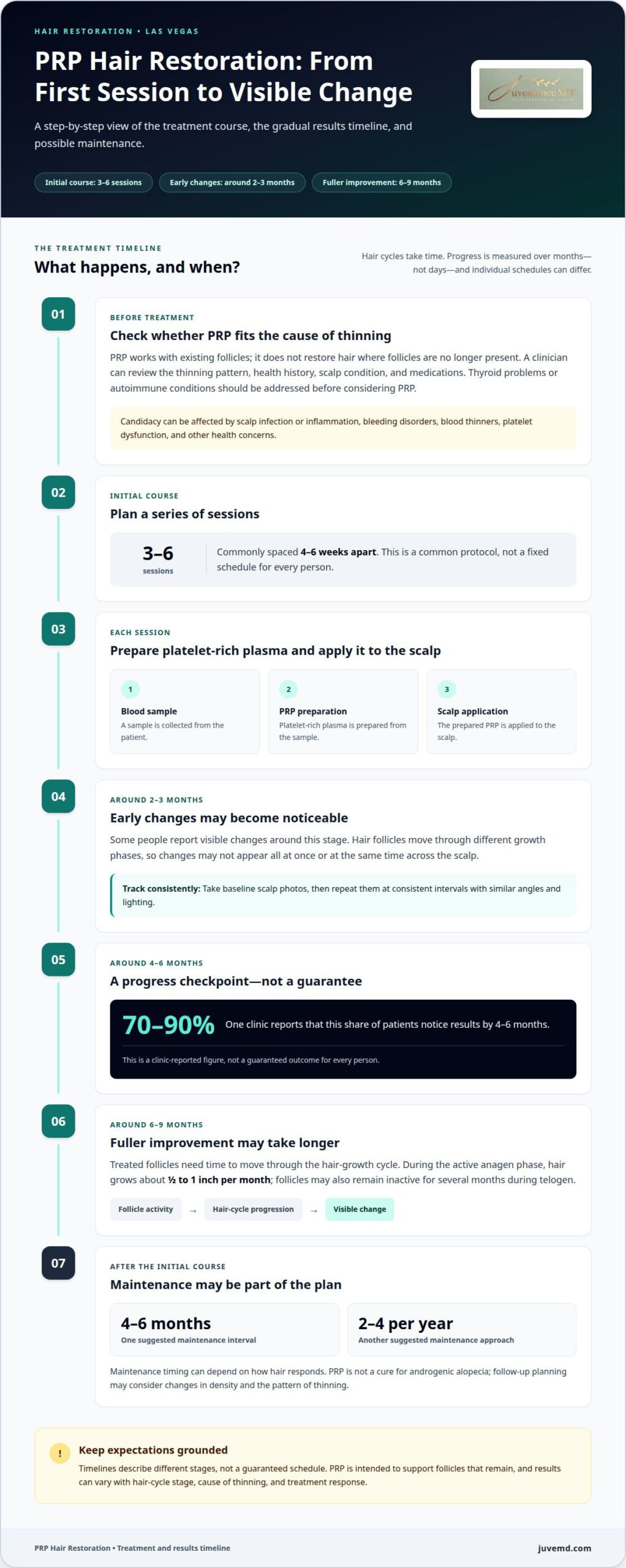
PRP for hair thinning in Las Vegas typically involves a course of 3-6 sessions, often spaced 4-6 weeks apart. Some people notice early changes around 2 to 3 months after treatment, while fuller improvement may take 6 to 9 months.
It’s understandable to want a clear sense of both the time commitment and when changes might become visible. This guide explains how many sessions are commonly involved, what happens during treatment, and why results develop gradually as hair moves through its growth cycle. You’ll also learn what can affect candidacy and how to think about PRP as part of a hair-restoration plan.
Key Takeaways
- Hair growth follows a cycle, so changes after PRP develop gradually rather than appearing immediately.
- Maintenance may be part of the plan after the initial treatment course, with timing shaped by how your hair responds.
- Learn how PRP injections compare with hair transplant approaches and what each option is designed to address.
- A session involves preparing platelet-rich plasma from a blood sample before applying it to the scalp.
- Health conditions, scalp concerns, and certain medications can affect whether PRP is an appropriate option.
What Results Can I Expect from PRP Hair Restoration?
PRP hair restoration develops gradually, so early changes may appear before fuller improvement. Hair growth cycles help explain why results take months rather than days.
A potential candidate may have thinning hair with follicles still present. Underlying health issues, including thyroid problems or autoimmune conditions, should be addressed before considering PRP.
Expected Results Timeline
Some patients notice changes as early as three months after treatment, while visible results are often reported around 2 to 3 months. Fuller improvement may take 6 to 9 months as treated follicles move through their growth cycle. One clinic reports that 70-90% of patients notice results by 4-6 months. These timelines describe different stages, not a guaranteed schedule for every person.
Hair biology explains the delay: follicles may remain inactive for several months during the telogen phase. During anagen, the active growth phase, hair grows about 1/2 to 1 inch per month. PRP results therefore require time for the hair cycle and visible strands to reflect follicle changes.
Patient Reviews and Before-and-After Results
One RealSelf reviewer reported that photos showed a thicker receding hairline 3 months after one PRP treatment. That account offers an individual example, not a prediction for every patient. Before-and-after images are most useful when they show the same scalp area, similar lighting, and a clear time interval, such as the starting point and a later three-month comparison.
When reviewing photos or patient accounts, look for the treatment count and the time between images. A single early comparison may show a different stage than photos taken after 6 to 9 months. Those details help readers interpret visible changes without treating one person’s experience as a universal outcome.
Active Hair Follicles and PRP Response
PRP works with existing follicles. It does not restore hair where follicles are no longer present. The treatment is described as stimulating dormant follicles and extending the hair-growth phase. That distinction matters when assessing thinning: remaining follicles provide a basis for possible rejuvenation, while the hair cycle influences when changes may become noticeable.
During telogen, the hair bulb can remain inactive for several months before regrowth. In anagen, hair grows about 1/2 to 1 inch per month. Because follicles may be at different stages, neighboring areas can show changes at different times. Active or dormant follicles, the hair cycle, and the cause of thinning all help frame expectations.
For PRP for hair thinning in Las Vegas, assess progress over months, not days. Take baseline scalp photos before treatment, then repeat them at consistent intervals and from similar angles. Compare density and the hairline across matching views instead of relying on daily observations. Consistent photos can make gradual changes easier to recognize and help put impressions in context.
PRP is not a cure for androgenic alopecia. Its role is to support a hair-restoration plan by targeting follicles that remain. Treatment timing, the stage of hair loss, and the underlying cause influence how progress is understood. A measured photo record and an understanding of the 2-to-3-month and 6-to-9-month milestones provide a clearer frame for evaluating results.
Is PRP hair restoration a safe treatment?
PRP hair treatment is generally elective and is not typically covered by insurance in Nevada. A consultation can assess the cause of thinning, treatment suitability, and a realistic schedule.
The initial course commonly involves 3-6 sessions, spaced 4-6 weeks apart. The interval gives time to complete each treatment while monitoring scalp response. After the initial course, maintenance may be scheduled every 4-6 months. Another suggested approach is 2-4 maintenance treatments per year. These schedules describe common protocols, not a single timetable for every patient.
Maintenance may help support results over time, especially when androgenetic alopecia continues to affect hair density. PRP is not a cure for this type of hair loss. A clinician can review changes in density and the pattern of thinning before discussing further sessions. For example, someone seeing gradual changes after an initial course may discuss maintenance differently from someone whose scalp shows little response.
Safety depends partly on health history and scalp condition. Active scalp infection or inflammation, bleeding disorders, and conditions that increase bleeding or bruising can make PRP unsuitable. Blood thinners, platelet dysfunction syndromes, some scalp conditions, smoking, and other blood-related conditions can also affect candidacy. A consultation should review medications and relevant health concerns before treatment. Do not stop prescribed medication without guidance from the clinician who manages it.
Temporary bruising or swelling can occur at injection sites. Stinging, redness, or swelling usually resolves within a couple of hours after the procedure. These effects differ from longer-lasting complications, so seek prompt medical attention for persistent or worsening symptoms. Discussing expected after-effects beforehand can help you know what to watch for.
PRP uses a patient’s own plasma, but that alone does not make it suitable for everyone. A clinician considers whether dormant follicles remain, what may be causing alopecia, and whether another health issue needs attention first. Thyroid problems and autoimmune conditions should be addressed before considering PRP for hair loss. These factors influence treatment suitability and maintenance planning.
For PRP for hair thinning in Las Vegas, ask how the proposed schedule will be reviewed over time. A clear plan should distinguish the initial sessions from maintenance and explain what changes in scalp density may guide follow-up. A dermatology assessment can also help clarify whether the pattern of hair loss fits the intended role of PRP. That context makes treatment decisions more informed than relying on a fixed calendar alone.
PRP injections and hair transplant alternatives
PRP uses a blood sample to prepare platelet-rich plasma for scalp injections. It is a nonsurgical approach, distinct from hair transplant surgery. The process includes preparation, injection, and recovery considerations.
Blood Collection and PRFM Injection
PRP preparation begins with collecting a blood sample, which is spun in a centrifuge for several minutes. This separates and concentrates platelets, growth factors, and cytokines to 3-5 times their normal blood concentration. The prepared plasma is then injected into targeted scalp areas.
PRFM is an enhanced form of platelet-rich plasma therapy. It uses a fibrin matrix as a scaffold, allowing growth factors to be released gradually. When reviewing a treatment plan, distinguish standard PRP from PRFM by asking which preparation it describes and how it will be applied.
Scalp Injection Duration
The injection portion of PRP hair restoration usually takes 3-5 minutes. That is only the injection time, not the full appointment: blood collection and centrifuge preparation also take time. The sample is processed for several minutes before the prepared plasma is ready for scalp use.
PRP injections target selected areas of the scalp rather than transplanting hair. Transplant surgery is a separate, surgical approach; PRP is a nonsurgical option used for androgenetic alopecia. The methods differ, so a useful comparison starts with the treatment goal and pattern of hair loss.
Short-Term Injection-Site Effects
Temporary bruising or swelling may occur where the scalp receives injections. Stinging, redness, or swelling around an injection site usually resolves within a couple of hours after the procedure. These short-term effects are distinct from the gradual changes in hair appearance that may follow treatment.
PRP generally does not require downtime, so patients can return to their routine afterward. Active scalp infection or inflammation, bleeding disorders, and conditions that may cause extensive bleeding or bruising can affect suitability. Blood thinners, platelet dysfunction syndromes, smoking, and certain scalp or blood-related conditions also matter. Share these factors during the treatment assessment.
PRP and transplant surgery are not interchangeable. PRP is a nonsurgical approach using a patient’s prepared plasma, while a transplant is surgery. PRP may support treatment for androgenetic alopecia, but it is not a cure. This distinction helps set realistic expectations before choosing a hair-restoration approach.
Preparation and injection are separate steps, and the injection itself is brief. If swelling, redness, or stinging lasts beyond the usual short period or worsens, seek medical guidance. A careful review of scalp condition, bleeding risks, and relevant medications helps determine whether PRP injections are suitable before treatment begins.
Is PRP for hair restoration a time consuming process?
PRP involves preparation and scalp injections, followed by an initial course of spaced visits. The total commitment depends on the number of sessions in the treatment plan.
What the PRP Session Involves
A session includes collecting blood, preparing platelet-rich plasma, and injecting it into the scalp. Collection typically takes 10-15 minutes, while the injection portion usually takes 3-5 minutes. The blood is processed in a centrifuge for several minutes before the plasma is ready.
Scalp anesthetic is a separate part of session planning. The treatment plan should clarify whether numbing is included and when it occurs in relation to blood collection and injection. This separates preparation time from the stated collection and injection durations. PRP is minimally invasive, but the scalp injection step still deserves a clear explanation.
Initial Treatment Schedule
Initial schedules vary across protocols. One described Las Vegas protocol uses 4 treatments spaced 1 month apart. Other treatment plans commonly involve 3-4 initial sessions, while broader PRP courses may range from 3-6 sessions. These figures reflect different protocols, so the proposed plan should specify its session count and spacing.
Sessions are typically spaced about a month apart. Another described approach schedules treatments every 4-6 weeks. Spacing gives the course a planned rhythm rather than requiring daily appointments. Patients can use the proposed interval and session count to understand how the initial treatment fits their calendar.
Plan for more than injection time during each visit. Blood collection takes 10-15 minutes, the sample then needs centrifuge processing, and scalp injections usually take 3-5 minutes. If anesthetic is part of the procedure, its timing should also appear in the appointment plan. These steps explain why the injection duration alone doesn’t describe the full visit.
PRFM is a related preparation approach. Its fibrin matrix acts as a scaffold for gradual growth-factor release. That describes how PRFM handles growth factors; it does not establish a separate session schedule or prove a particular hair-growth outcome. The initial treatment count and spacing remain practical details to review.
For example, a 4-treatment plan spaced 1 month apart means arranging repeat visits across the initial course, not completing all care in one appointment. A schedule using 3-6 sessions may require a different number of visits. The interval also matters: treatments spaced 4-6 weeks apart create a different calendar pattern than visits exactly 1 month apart.
Before starting, review three details in the proposed medical plan: the number of initial sessions, the interval between them, and whether scalp anesthetic is included. These clarify the time commitment without confusing brief injection time with the full course. They also make it easier to plan around work, travel, and other routine commitments.
PRP for hair loss providers near Las Vegas
Choosing care in Las Vegas means looking beyond proximity to understand the treatment plan. Focus on the clinician’s role, how PRP is prepared, and whether the approach fits your type of hair loss.
Finding Nearby PRP Providers
Start by clarifying what you need: PRP therapy, surgical hair transplant, or an assessment of thinning. These approaches are not interchangeable. PRP is a nonsurgical treatment using prepared plasma, while a hair transplant is surgery. Identifying your goal helps narrow the type of care relevant to your concern.
For an appointment in Las Vegas, consider the practical location alongside treatment details. A course may involve multiple sessions, so travel time can matter across repeat visits. A nearby address alone, however, does not explain the preparation method, treatment plan, or how progress will be assessed.
Evaluating Provider Credentials and Treatment Quality
Review the clinician’s stated qualifications and role in the procedure. A clear explanation should identify who assesses hair loss, prepares platelet-rich plasma, and performs scalp injections. The treatment discussion should also address health history, scalp condition, and factors that may affect suitability.
A specific plan is easier to assess. Look for an explanation of the blood-processing step, the scalp areas targeted, and why PRP fits the hair-loss pattern. For example, a plan should distinguish androgenetic alopecia from hair loss linked to an underlying health issue.
During an assessment, note whether the discussion connects your diagnosis to the proposed therapy. PRP is not a cure for androgenetic alopecia, and it is intended to work with existing follicles. This distinction sets a realistic purpose for care rather than implying that one procedure addresses every cause of thinning.
Ask how progress will be documented. Consistent scalp photographs can make changes easier to compare over time when taken from similar angles and in similar lighting. Treatment records can also show which areas were addressed and when sessions occurred. These details help put visible changes in context instead of relying on a single impression.
A useful consultation should leave you understanding the treatment sequence and relevant safety considerations. It should include a review of medications, bleeding risks, and scalp infection or inflammation. These factors can affect whether PRP is suitable, so they belong in the assessment before injections begin.
For people weighing PRP against a hair transplant, the key difference is the approach: PRP is nonsurgical, while transplantation involves surgery. The choice depends on the type and pattern of hair loss and the treatment goal. A clear explanation of those differences helps you understand what each option is designed to do.
If you’re considering treatment, discuss your hair restoration goals and the questions that matter to you. A focused conversation about diagnosis, preparation, and follow-up can help clarify the next step.
JuveMD: Hair Restoration
JuveMD offers hair restoration for people considering PRP as part of a plan for thinning hair. After reviewing treatment timelines, session schedules, and candidacy factors, the next step is a conversation about your hair-loss concerns and goals. A personalized discussion can help clarify whether this nonsurgical approach fits what you’re seeking and what questions to address before proceeding.
PRP is not a cure for androgenetic alopecia, and results develop gradually. Understanding these limits can help you approach hair restoration with informed expectations. To discuss your options, contact JuveMD about your hair-restoration goals.
Choose a Thoughtful Next Step for Your Hair Goals
Deciding whether to pursue PRP for hair thinning in Las Vegas starts with connecting the treatment to your priorities. Consider what you want to address, what questions remain, and whether a gradual, nonsurgical approach aligns with your expectations. Candidacy and response vary, so discussing your hair and health history can help clarify the decision.
Use that discussion to explore the concerns that matter most to you, from treatment suitability to how progress may be assessed. You do not need every answer before taking the next step. A focused conversation can help you understand your options and decide what feels appropriate for your goals.
Contact JuveMD about PRP for hair to discuss your questions and hair restoration goals. A clear, informed next step can make the path forward feel more manageable.
Frequently Asked Questions
How many treatments are required?
A common initial course includes 3-6 PRP treatments, although protocols differ. One schedule uses 4 treatments spaced 1 month apart, while another approach schedules sessions 4-6 weeks apart. The number of visits depends on the protocol and treatment plan. Before beginning, make sure you understand how many appointments the initial course includes and how far apart they’re planned.
Does the PRP injection procedure hurt?
PRP scalp injections can cause temporary stinging, redness, or swelling at injection sites. These effects usually resolve within a couple of hours. The injection itself is brief, but the experience can vary by patient. Ask how the scalp will be prepared and what sensations to expect, so you can plan with a clearer understanding.
How many PRP sessions will I need?
Many treatment plans use 3-6 initial sessions, while some protocols describe 3-4 sessions or a four-treatment course. The planned number depends on the protocol being used, rather than one fixed schedule for everyone. Ask for the initial session count and spacing together. For example, a four-visit plan spaced monthly is easier to plan around than a session count without intervals.
Is PRP a cure for baldness?
No. PRP is not a cure for androgenetic alopecia, a common form of pattern hair loss. It is a nonsurgical approach that may support existing follicles, rather than replace hair through surgery. If an area has extensive hair loss, PRP’s role is not the same as a hair transplant. Discuss the cause and pattern of hair loss when considering treatment.
Is there recovery time?
PRP treatment usually doesn’t require downtime, and patients can return to their routine afterward. For scalp care, avoid topical products for 24 hours after treatment and harsh hair dyes or chemicals for 48 hours. These specific limits can help you plan around styling and other scalp products. Follow the aftercare instructions provided for your treatment, particularly if they address your individual scalp needs.
What is PRP therapy for hair thinning, and how does it work?
PRP therapy uses platelet-rich plasma prepared from a blood sample. The sample is spun in a centrifuge to concentrate platelets, growth factors, and cytokines, then the prepared plasma is injected into selected scalp areas. This approach is intended to support follicles and the hair-growth phase. It is nonsurgical and differs from transplant surgery, which is a separate treatment approach.
How many PRP sessions are needed for hair thinning, and how often?
Initial plans commonly involve 3-6 sessions, often spaced 4-6 weeks apart. Some protocols instead describe 4 treatments spaced 1 month apart. Maintenance schedules also vary: treatments may be planned every 4-6 months, while another approach suggests 2-4 maintenance treatments per year. These are different schedules, so clarify which plan applies to your initial course and ongoing care.
What results can PRP hair treatment achieve, and how long do they take?
PRP may support hair density by stimulating dormant follicles and extending the growth phase, but it doesn’t cure androgenetic alopecia. Some people notice changes around 2 to 3 months, while fuller improvement may take 6 to 9 months. Because follicles move through different growth stages, visible changes can emerge gradually. Comparing scalp photos taken under similar conditions can help track change over time.