
Forehead lines often become more noticeable with repeated expressions, but they don’t have to define your appearance. Botox for forehead lines in Las Vegas uses injections to relax the muscles that create these wrinkles, softening their appearance while preserving a natural-looking expression. Results generally last 3 to 4 months.
If you’re considering treatment, it’s reasonable to want clear expectations before deciding. This guide explains what BOTOX® is, how forehead injections work, when results appear, how often treatment may be repeated, and what recovery involves, so you can understand the process and decide whether it fits your goals.
Key Takeaways
- Forehead injections work by relaxing the muscles that contribute to expression-related lines.
- Results develop gradually, with the full effect typically visible around two weeks after treatment.
- The smoothing effect generally lasts 3 to 4 months; repeat timing depends on your treatment plan and how results change.
- Plan to avoid rubbing or massaging the treated area for 24 hours after treatment.
- Learn what to expect during injections and how a personalized treatment approach can support your aesthetic goals.
Treatment frequency
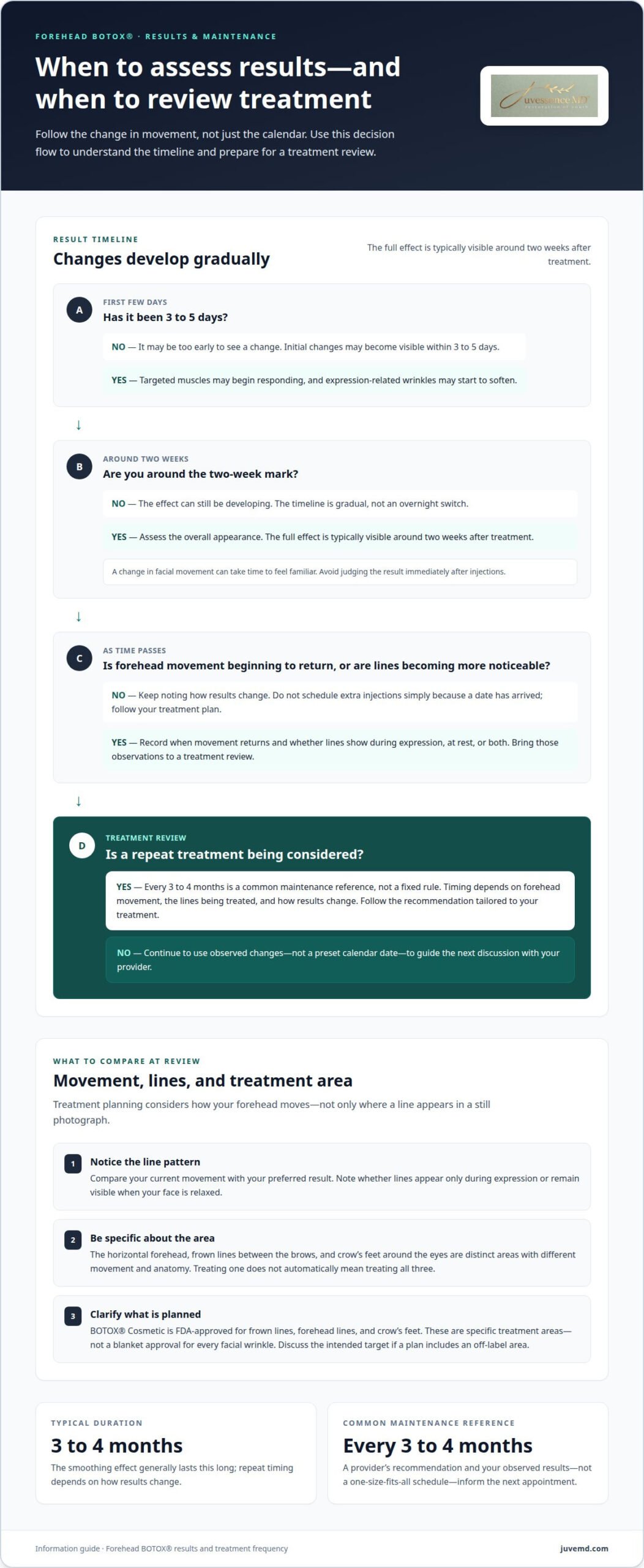
Botox maintenance is commonly scheduled every 3 to 4 months, or as a provider recommends. That interval gives the muscle-relaxing effect time to gradually wear off before another treatment is considered. It isn’t a fixed calendar rule for every person. Forehead movement, the lines being treated, and how results change over time all inform the next appointment. For Botox for forehead lines in Las Vegas, the goal is a plan that suits your facial anatomy and desired appearance.
Track changes between appointments. Note when forehead movement begins to return and whether lines appear only during expression or remain visible when your face is relaxed. This can help distinguish a change in muscle activity from a line that persists at rest. During a treatment review, discuss whether to repeat the plan or reassess the areas being treated. Don’t schedule extra injections simply because a date has arrived; follow your treatment plan.
Forehead lines are dynamic wrinkles: repeated expressions move the underlying muscles and crease the skin. Treatment planning considers how your forehead moves, not just where a line appears in a still photograph. The horizontal forehead is one area; frown lines between the brows and crow’s feet around the eyes are other commonly treated areas. Each has distinct movement and anatomy, so treating one doesn’t automatically mean treating all three.
BOTOX® Cosmetic is FDA-approved for frown lines, forehead lines, and crow’s feet. These are three specific treatment areas, not a blanket approval for every facial wrinkle. “Off-label” describes use outside the product’s FDA-approved indications. It doesn’t describe a separate product or a different interval between appointments. If a treatment plan includes an off-label area, discuss the intended target and how that use relates to your goals before proceeding. Keeping approved and off-label areas distinct helps make the plan easier to understand.
At each treatment review, compare your current movement and line pattern with your preferred result. A relaxed forehead may be your priority, while another person may focus on the frown area or wrinkles around the eyes. Those choices affect which areas are considered, but the maintenance interval still depends on how the effect changes. Use the 3-to-4-month interval as a common reference, then follow the recommendation tailored to your treatment. This keeps repeat appointments tied to observed results rather than a one-size-fits-all schedule.
What to expect during injections
A forehead appointment includes planning the injection points, preparing the skin, and administering the injections. A typical session takes 10 to 15 minutes; treating multiple areas can extend the visit.
Injection Comfort
Botox injections use a fine needle, and you may feel brief pinches or pressure at the injection points. Comfort varies with individual sensitivity and the area treated. A topical anesthetic may be discussed, but it isn’t automatically needed for every appointment. Share your comfort preferences and ask about available measures before treatment begins.
During injections, keep your facial muscles relaxed unless prompted to move them. If you feel uncomfortable, speak up; pausing can help the treatment proceed at a manageable pace. The aim is to place product in selected muscles, not numb the entire forehead.
Injection Process and Appointment Length
The process starts with reviewing the treatment area and identifying where forehead movement creates visible lines. The injector may assess your expression and facial anatomy before marking or selecting injection points. The injections then target the muscles involved in the lines. A typical session takes 10 to 15 minutes, while treatment in Las Vegas may take 15-30 minutes depending on the number of areas.
Adding frown lines or crow’s feet around the eyes can change the appointment’s scope. Share which lines concern you most so the plan reflects your priorities.
Single-Use Vials and Safety
Vial handling is one part of injection safety, but the vial alone doesn’t show how treatment was prepared. You can ask how the product is handled, whether the vial is intended for single use, and how sterile equipment is used. Clear answers help you understand the steps involved, rather than focusing only on the visible vial or packaging.
Safety also involves accurate product preparation and careful injection technique. Before treatment, make sure you understand which areas are planned and what product will be used. Raise any concerns about handling before the procedure starts.
Consultation Before Injections
A consultation connects your goals with the treatment plan. Describe whether lines appear during expression, remain visible at rest, or bother you most in a particular area. Mention prior injections and relevant health history so the discussion accounts for your circumstances. These details help define which muscles and areas are being considered.
Use the conversation to clarify the planned injection sites, comfort options, and appointment flow. If you’re exploring aesthetic care alongside other skin treatment options, keep the discussion focused on your goals and how each treatment fits.
How Long Do BOTOX® Cosmetic Results Last?
Forehead Botox results generally last 3 to 4 months. Initial changes may become visible within 3 to 5 days, while the full effect typically appears around two weeks after treatment.
The timeline is gradual, not an overnight switch. In the first few days, targeted muscles begin responding, and expression-related wrinkles may start to soften. Around two weeks, assess the overall appearance rather than judging the result immediately after injections. A change in facial movement can also take time to feel familiar.
After the effect fades, muscle movement returns and lines may become more noticeable again. A common maintenance reference is every 3 to 4 months, though the timing should reflect how your results change. Keep a simple record of the treatment date and when forehead movement starts returning. That can make future conversations about timing and dose more specific.
A natural-looking result depends on matching the treatment plan to your facial anatomy, muscle activity, and preferred appearance. The aim may be to soften lines while retaining some forehead movement, rather than making the area look immobile. Dose customization is part of that planning. More product isn’t automatically a better fit; the target is a balanced result that suits your expression.
When choosing a Botox provider in Las Vegas, look for a qualified medical professional who discusses your goals, facial anatomy, treatment areas, and expected timeline before injections. Clear explanations and a realistic discussion of results help you make an informed choice.
In Nevada, injections should be administered by a medical professional authorized to perform them within their professional scope and trained in injectable technique. Ask who will perform your treatment and how they assess facial muscles and anatomy.
Botox typically affects movement in targeted muscles, while fillers and surgical procedures address different aesthetic concerns. They aren’t interchangeable. If your main concern is a line that remains visible when your face is relaxed, describe that during treatment planning. This distinction can guide a discussion about an approach suited to your concern.
- Coming days: Early changes may become visible within 3 to 5 days.
- Around two weeks: Assess the full effect and how your expression looks.
- 3 to 4 months: Results commonly last this long before muscle movement gradually returns.
Botox treatment has no downtime, but results develop over time. Give it time to take effect before deciding whether the change matches your goals.
Does Botox Hurt, and What Does the Recovery Look Like?
A Botox appointment involves needle injections, so you may feel brief discomfort at each injection site. Recovery is usually straightforward: you can resume normal daily activities immediately, while following a few aftercare steps helps protect the treated area.
Comfort varies from person to person. The needle sensation is brief, and you can discuss a topical anesthetic if you’re concerned about sensitivity. Tell the injector about your comfort needs before treatment begins. The forehead and areas near the eyebrows move differently, so the plan should account for both your expression and the injection location.
Recovery doesn’t usually require time away from work or routine activities. Mild redness, swelling, or bruising can occur and typically fades within a day. For the first several hours, stay upright, and avoid rubbing or massaging treated areas for 24 hours. Avoid strenuous exercise for 24 hours as well. These steps reduce unnecessary pressure or movement around the injection sites.
Your medical history matters before cosmetic injections. Discuss health conditions, medications, and previous injectable treatments during the consultation. If you take anti-inflammatory medication, ask the treating professional whether pausing it is appropriate. Don’t stop prescribed medication on your own. Pregnancy and breastfeeding are important precautions: Botox treatment should be avoided during either.
Age alone doesn’t determine candidacy in Nevada. The age-related information describes the early 30s as a common time to start, when fine lines can become visible at rest rather than only during expression. It doesn’t establish a legal age cutoff. Suitability also depends on your medical history, the lines you want to soften, and whether your expectations match what injections can address.
Set specific expectations. For example, decide whether you want to soften horizontal forehead lines, frown lines, or movement around the eyebrows. Botox relaxes targeted muscles; dermal fillers address different concerns and aren’t interchangeable with muscle-relaxing injections. A consultation can clarify the concern being treated and what changes to facial movement fit your desired appearance.
For the question of risks and side effects, the documented common effects include mild redness, swelling, or bruising at injection sites, typically fading within a day. Follow the aftercare instructions you receive, and report concerns to the treating professional. Avoid rubbing the area for 24 hours, and keep your head elevated for several hours after treatment.
Before proceeding, review your medical history, pregnancy or breastfeeding status, medication use, and treatment goals. These details help frame a safe, individualized discussion and set clear expectations for recovery.
Botox for forehead lines
Forehead lines often form as the frontalis muscle lifts the eyebrows during expression. BOTOX® Cosmetic temporarily relaxes targeted muscles, reducing the repeated movement that deepens dynamic wrinkles. The aim is to soften visible lines while preserving an expression that feels like yours. Planning starts by observing how your forehead moves, not simply tracing lines at rest.
That distinction matters. A line that appears only when you raise your eyebrows behaves differently from one visible while your face is relaxed. Botox works on muscle activity, so it may soften expression-related creases. A line present at rest may not disappear fully with muscle relaxation alone. Describe when you notice each line, such as during a raised-brow expression or in a relaxed photograph.
The forehead also works in coordination with the glabella, the area between the eyebrows. Frown lines there are created by different muscles than horizontal forehead lines. Treating one area doesn’t automatically address the other. A plan can consider forehead lines, frown lines, or both, based on your movement pattern and desired appearance. The eyebrows are part of the assessment because forehead muscle activity contributes to their position.
BOTOX® Cosmetic is FDA-approved for frown lines, forehead lines, and crow’s feet around the eyes. These named indications distinguish approved cosmetic uses from other possible treatment areas. Forehead treatment should focus on the muscles contributing to your specific lines, rather than applying one pattern to every face. Facial anatomy and muscle strength differ, so placement and treatment amount are tailored to the individual plan.
To prepare, identify your priority. Is it horizontal forehead creasing, vertical frown lines between the eyebrows, or a combination? Share whether you want to smooth lines while keeping some movement. This gives the treating professional a practical starting point for discussing target muscles and the degree of relaxation that fits your goals.
Results develop over days, with the full effect typically appearing around two weeks after treatment. The effect generally lasts 3 to 4 months, then muscle movement gradually returns. That timeline can help you plan around an event, but injections immediately before an important occasion leave little time to assess the finished appearance. Build in time for the effect to develop.
For a forehead-focused treatment discussion, explore your injection options and describe the lines and expressions you want addressed. A clear conversation about movement, treatment areas, and your preferred result helps make the plan specific to your face.
JuveMD: Bioidentical Pellet Hormone Therapy
JuveMD offers Bioidentical Pellet Hormone Therapy for people exploring hormonal health alongside aesthetic care. Forehead injections address expression-related lines; hormone therapy is a separate wellness service, not a treatment for forehead wrinkles. JuveMD also offers injectables, skin treatments, and weight-loss programs for people with broader wellness or aesthetic interests.
Consider Bioidentical Pellet Hormone Therapy when you want to discuss hormonal health as a distinct part of your wellness goals. For forehead injections, focus the conversation on treatment areas, movement, and the result you hope to achieve. Keeping these needs separate can clarify which service aligns with each concern.
Contact JuveMD to discuss your interests and possible next steps.
Take the Next Step Toward a Treatment Plan
Let your priorities guide the next conversation. Before choosing Botox for forehead lines in Las Vegas, consider which expressions you want to soften and how much movement you’d like to retain. Bringing a clear example, such as a line that appears when you raise your eyebrows, can make the discussion more focused and personal.
A thoughtful plan should reflect your facial features and aesthetic preferences, not a trend or a one-size-fits-all idea of smooth skin. Use your consultation to discuss your goals, ask about treatment options, and decide whether injections feel right for you. Taking time to understand the approach is an important part of making a confident choice.
If you’re ready to explore treatment for forehead lines, contact JuveMD about Botox options. Start with your questions and the result you hope to achieve. A clear conversation can help you move forward with confidence and feel comfortable with your next step.
Frequently Asked Questions
What is BOTOX®?
BOTOX® Cosmetic is an injectable treatment that relaxes targeted muscles involved in expression-related wrinkles. It’s FDA-approved for frown lines, forehead lines, and crow’s feet. Forehead treatment, for example, targets muscle activity that contributes to horizontal lines. It differs from dermal filler, which addresses other aesthetic concerns. A treatment discussion can clarify which lines are related to movement and what result you’re seeking.
How long does it take to see results?
Early changes may become visible within 3 to 5 days, with the full effect typically appearing around two weeks after treatment. If you’re preparing for a photo, event, or work presentation, plan ahead rather than scheduling at the last moment. That allows time for the result to develop before you assess how your forehead looks and moves.
Which injectable should I get?
The right injectable depends on what you want to address. A treatment that relaxes muscles may suit expression-related forehead lines, while dermal fillers address different concerns and aren’t interchangeable. Consider whether lines appear with movement, remain visible at rest, or involve another area. Share those observations and your preferred appearance during a consultation so the discussion can focus on a treatment type that fits your goals.
Does it leave scars?
Botox treatment uses needle injections rather than surgical cuts, so it doesn’t create a surgical incision. Temporary redness, swelling, or bruising can appear at injection sites and typically fades within a day. Avoid rubbing or massaging treated areas for 24 hours. If you notice a skin change that concerns you or doesn’t follow the expected recovery pattern, contact your treating healthcare professional for guidance.
How Long Will It Last?
Forehead Botox results generally last 3 to 4 months. Rather than relying only on a calendar reminder, note when movement begins returning and whether the lines become visible again. That record can help make a future treatment conversation more specific. The effect gradually wears off, so the timing of another appointment can be discussed in relation to your results and preferences.
How much does Botox for forehead lines cost in Las Vegas?
The price depends on your case and is provided after a quote request. Cost factors include the treatment areas, amount of product used, and plan developed for your goals. Forehead-only treatment may differ from a plan that also addresses frown lines or another area. Discuss the areas you want treated so the quote reflects the intended scope.
What is the average Botox price per unit in Las Vegas?
The price depends on your case and is provided after a quote request, rather than being based on an average unit price. The total is influenced by the treatment area, amount used, and plan for your desired result. A unit figure alone won’t explain what a specific forehead treatment involves. Request a quote based on the areas and goals you want to discuss.
How many Botox units are typically needed for forehead lines?
There isn’t one unit amount that suits every forehead. The amount depends on muscle activity, facial anatomy, the area being treated, and how much movement you want to retain. A plan focused on horizontal forehead lines, for example, may differ from one that also considers frown lines. This information is educational only, not medical advice. Consult your healthcare provider about your individual treatment; results vary.