
Could a hormone imbalance explain a change in your weight, or is it one part of a larger picture? A search for “hormone testing for weight gain Las Vegas” often reflects a reasonable concern: your body feels different, and you want clear answers. A lab result alone rarely tells the whole story.
Thyroid hormones, insulin, cortisol, and sex hormones may be relevant in some evaluations. Whether testing makes sense depends on your symptoms, health history, and other clinical details, not weight gain alone. Even an out-of-range result needs context before it can guide a decision.
This article explains when hormone testing may help investigate weight changes, which hormones a clinician might consider, and what test results can and can’t show. You’ll also learn how to prepare for a useful conversation about next steps. JuveMD is a Las Vegas clinic focused on hormonal health and wellness, led by Dr. Andrea Dempsey. A personalized medical discussion can put your concerns in context without treating one lab value as a complete explanation.
Key Takeaways
- Learn which symptoms and health-history details may make hormone testing worth discussing with a clinician.
- See how hormone testing for weight gain Las Vegas can start with a focused clinical question rather than a one-size-fits-all panel.
- Compare targeted tests, broader panels, and clinician-guided discussions to understand what each approach may offer.
- Prepare for a useful conversation by noting weight changes, symptoms, medications, supplements, and relevant health history.
- Explore a practical next step for discussing hormonal health and weight concerns with JuveMD in Las Vegas.
Weight Gain in Las Vegas: When Might Hormones Be Part of the Picture?
Persistent weight changes can feel frustrating, especially when your usual routines haven’t changed in an obvious way. It’s understandable to wonder whether hormones are involved. Weight gain is a reason to investigate, not a diagnosis: sleep, medications, activity, nutrition, health conditions, and life stage can all matter, sometimes alongside hormonal factors.
Hormone testing measures selected hormone levels to help answer a clinical question. It supports, but doesn’t replace, an evaluation of your symptoms and health history. Hormones act as chemical messengers involved in many body processes. A basic overview of what hormones are can help explain why their effects are broad, but it can’t determine the cause of an individual’s weight change.
A possible hormonal contributor is a reason to investigate, not proof of a confirmed cause. That distinction matters when considering hormone testing for weight gain in Las Vegas. A useful evaluation looks at the full pattern rather than treating weight alone, or one lab value, as the answer.
Which hormone-related patterns may prompt a conversation?
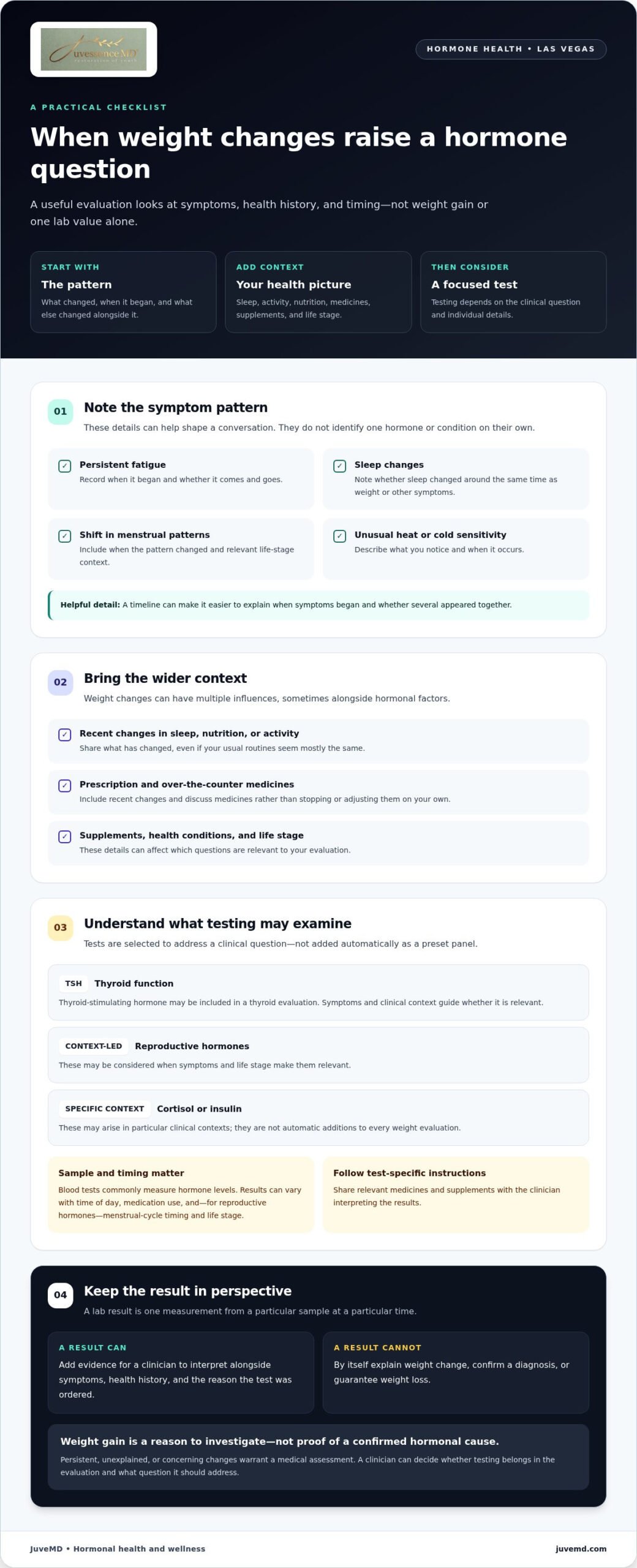
Weight changes alongside other symptoms can give a clinician more context. You might describe persistent fatigue, changes in sleep, menstrual patterns that have shifted, or unusual sensitivity to heat or cold. Note when each change began, whether it comes and goes, and whether several symptoms appeared around the same time. A timeline can make the pattern easier to explain during an appointment.
These clues can help shape a clinical conversation, but they aren’t specific to one hormone or condition. Low energy, for instance, can have many explanations, and sleep disruption doesn’t by itself identify a hormonal cause. Symptoms can overlap across hormonal and non-hormonal conditions. Weight gain alone doesn’t establish that hormone levels are out of balance or show which tests, if any, would be useful.
Why weight gain cannot identify a hormone imbalance by itself
The same change on the scale can occur in different circumstances. A clinician may consider recent changes in sleep, nutrition, activity, medications, and overall health, as well as hormonal symptoms. Life stage and the timing of symptoms can also affect which questions are relevant. Share changes in prescription or over-the-counter medicines and supplements rather than stopping or adjusting them on your own.
A lab result is a measurement taken at a particular time, not a standalone diagnosis. Its meaning depends on the test selected, the reason it was ordered, your health history, and other clinical findings. Sometimes a clinician needs additional information before interpreting a result or deciding whether further evaluation is appropriate. The number alone can’t confirm the explanation for weight gain.
If weight changes are persistent, unexplained, or concerning to you, arrange a medical assessment and bring a clear timeline of what you’ve noticed. Include accompanying symptoms and relevant medication and health-history details. This gives the clinician a stronger starting point for deciding whether hormone testing belongs in the evaluation and what question a test should address.
How Hormone Testing for Weight Gain Works
Hormone testing starts with a clinical question, not a preset checklist. A clinician considers your symptoms, health history, medications, and the timing of changes before deciding whether testing may help and which measurements are relevant. For someone with persistent fatigue and cold sensitivity, for example, thyroid function might be part of the discussion. A different symptom pattern may call for different questions, or none that require hormone testing.
Blood tests are a common way to measure hormone levels, but the sample and timing depend on what’s being assessed. Some results can vary with time of day, medication use, or, for reproductive hormones, menstrual-cycle timing and life stage. Follow the specific instructions provided for any test, and share relevant medicines and supplements with the clinician interpreting the results.
What hormone tests may examine
Thyroid evaluation may include thyroid-stimulating hormone (TSH), which helps assess thyroid function. Reproductive hormones may be considered when symptoms and life stage make them relevant. Cortisol or insulin testing may also arise in specific clinical contexts, but they aren’t automatic additions to every weight evaluation. The Centers for Disease Control and Prevention outlines several hormonal factors in weight gain, including certain conditions that may affect weight. This context supports a targeted discussion, not a universal panel.
What a hormone test can, and can’t, tell you
A test shows the level measured in a particular sample at a particular time. On its own, it doesn’t reveal why your weight changed or establish a diagnosis. Results outside a reference range may need follow-up, while results within range don’t necessarily explain every symptom. Interpretation depends on the test, the reason it was ordered, your health history, and the clinician’s assessment.
Test results are evidence to interpret alongside symptoms and medical history, not a conclusion on their own. A clinician may decide a result fits the broader picture, needs further evaluation, or doesn’t account for the concern. Testing also can’t guarantee weight loss; next steps depend on clinical evaluation and individual needs.
For hormone testing for weight gain in Las Vegas, start with the changes you’ve noticed and what you hope to understand. JuveMD is a Las Vegas clinic focused on hormonal health and wellness, led by Dr. Andrea Dempsey. Learn more about JuveMD’s hormonal health care as you consider what questions to bring to a clinician.
Targeted Hormone Tests or Broader Panels: How to Compare the Approaches
Once a clinician has identified what needs investigating, the next question is how much testing may help answer it. A focused test looks at a specific issue raised by symptoms or health history. A broader panel measures several markers, which may be useful when there are multiple clinical questions, but it can also produce findings that need explanation. Neither approach is automatically right for everyone.
Use this comparison to guide a conversation, not as a formula for choosing tests. The most useful testing scope is the one that addresses a defined clinical question.
| Approach | Purpose | Potential usefulness | Interpretation needs |
|---|---|---|---|
| Focused test | Assess a specific hormone or function related to a clinical question. | May suit an evaluation when symptoms or history point toward a particular area. | The result still needs context, including timing, symptoms, and health history. |
| Broader panel | Measure several selected markers at once. | May be discussed when the clinical picture raises more than one question. | Each included marker needs a reason for testing and careful interpretation. |
| Clinician-guided testing discussion | Clarify what the evaluation is meant to find out before selecting tests. | Helps connect symptoms and history to a relevant testing plan, which may be focused, broader, or may not require hormone testing. | Requires an individualized review of the results alongside the clinical picture. |
When a focused test may fit the clinical question
A targeted test may be considered when a person’s history and symptoms raise a specific concern. For example, a clinician assessing symptoms that could involve thyroid function might consider a relevant thyroid measurement. That doesn’t mean the same test is appropriate for everyone with weight gain. A focused approach keeps the evaluation centered on the question at hand rather than collecting information that may not be relevant.
When a broader panel may be discussed
If several symptoms or aspects of a person’s history raise different questions, a clinician may discuss measuring multiple markers. Panels vary in what they include, so the label “hormone panel” alone doesn’t explain what’s being measured or why. Understanding each test’s purpose helps prevent unrelated results from being mistaken for an explanation.
More tests don’t automatically mean a more accurate answer. The larger the set of measurements, the more important it is to know what each result can meaningfully address. A finding outside a reference range may need follow-up, while a result within range may not explain every symptom. Results should be reviewed in light of the reason for testing, relevant health history, and any sample-timing instructions.
If you’re considering hormone testing for weight gain in Las Vegas, bring a practical question to the conversation: “What are we trying to learn from each test?” This helps clarify whether testing is likely to add useful information and how the findings could inform next steps. It also helps avoid assuming that a broad panel or a single result will identify the cause of weight change.
Preparing for Hormone Testing and Understanding Your Results
A little preparation can make a testing conversation more useful. Before a sample is collected, confirm the instructions for the specific test with the laboratory or clinician arranging it. Requirements differ, so don’t assume that fasting, a certain time of day, or a particular point in your menstrual cycle applies to every test. If instructions are unclear, get guidance before the test rather than guessing.
Use this checklist to organize information your clinician may need:
- Write down current medications and supplements, including recent starts, stops, or dose changes.
- Note your symptoms, when they began, and changes in weight or daily routine.
- Bring relevant health history and details about life-stage changes that may relate to your symptoms.
- Follow the laboratory’s specific directions for preparation and sample timing.
Don’t stop a prescribed medication or change how you take it to prepare for testing unless the clinician responsible for your care directs you to do so. Sharing a complete, accurate list helps the clinician consider whether any medication, supplement, or recent change may affect the testing plan or interpretation.
Questions to discuss before the test
Before testing, make sure you understand what each proposed measurement is intended to assess. Ask whether your medications, supplements, symptom timing, or recent health changes affect the plan. Find out how and when a clinician will review the results with you, and who can explain what they mean in relation to your concerns. These questions connect the test to a clear purpose.
How to approach results without jumping to conclusions
A reference range shows how a measured result compares with values expected in a particular testing context. It isn’t, by itself, a diagnosis or a complete explanation of symptoms. A result outside the range may need follow-up, while a result inside it may not settle the clinical question. Interpretation depends on the test, why it was ordered, your health history, symptoms, and any relevant examination.
Use results as a starting point for discussion, not as a self-diagnosis or treatment plan. If a number surprises you, ask the clinician to explain its significance and whether follow-up is appropriate. Don’t start hormone treatment, stop medication, or adjust a dose based only on an isolated result. Decisions should follow a clinical review of the whole picture.
For a hormone testing for weight gain Las Vegas discussion, bring your notes and questions so the conversation can focus on your circumstances. Andrea Dempsey. Discuss your hormonal health and weight concerns with JuveMD as a next step toward understanding what results may mean and what options merit consideration.
Discuss Weight Gain and Hormone Health with JuveMD in Las Vegas
If weight changes have left you with questions, a focused clinical conversation is a practical next step. Rather than arriving with a conclusion about the cause, bring the pattern you’ve noticed and what you want help understanding. For people exploring hormone testing for weight gain in Las Vegas, this context can guide a discussion about whether hormonal factors merit consideration and what next steps make sense.
What to bring to a hormone-health discussion
A few notes can make it easier to describe changes clearly. Consider bringing:
- A timeline of weight changes, including when they began and whether they’ve continued or fluctuated.
- A list of related symptoms and when you first noticed them.
- Your current medications and supplements, plus any recent changes.
- Relevant health-history details and copies of prior test results, if you have them.
- Your main concern and what you hope to understand or address during the visit.
You don’t need to have every detail organized perfectly. Even a brief record of what changed, when it changed, and how it affects your day-to-day life gives the clinician a helpful starting point. If you’ve already had testing, bring the results for discussion rather than relying on an isolated number or online interpretation.
How JuveMD can support a personalized next step
Andrea Dempsey. A medical discussion can take your concerns and individual context into account. Any decision about testing or treatment depends on medical evaluation; weight changes alone don’t establish a diagnosis or determine which option, if any, is appropriate.
If you’d like more background before discussing potential care, explore this guide to bioidentical hormone replacement therapy. For readers considering women’s hormone care, JuveMD also offers an educational guide to hormone pellet therapy for women in Las Vegas. These resources can help you prepare questions, but they aren’t a substitute for a personalized medical conversation or a recommendation to begin treatment.
Bring your questions, weight-change history, and relevant health information to JuveMD. Visit JuveMD to learn about the clinic and its focus on hormonal health and wellness.
Take the Next Step Toward Clearer Answers
You don’t need to arrive with a diagnosis or a perfect explanation for your weight changes. Start with one clear question you want help answering, and bring the details that may help a clinician understand your experience. This shifts the focus from searching for a single “right” test to discussing what matters in your individual situation.
If you’re considering hormone testing for weight gain in Las Vegas, JuveMD offers a local setting to discuss hormonal health and wellness with Dr. Andrea Dempsey. Any next step depends on clinical evaluation. The goal is to consider your concerns thoughtfully rather than draw conclusions from one result alone.
Learn more about discussing your hormone health with JuveMD. A thoughtful conversation can be a positive first step toward understanding your options and deciding what feels appropriate for you.
Frequently Asked Questions
Can hormone testing explain unexplained weight gain?
Hormone testing may help investigate a specific clinical question, but it can’t establish the cause of weight gain on its own. A clinician considers results alongside symptoms, health history, medications, and other possible contributors. For example, noting whether a weight change followed a medication change can add useful context. Testing is most informative when there’s a clear reason for it, and results aren’t a guaranteed explanation or a promise of weight loss.
Which hormones are tested for weight gain?
There isn’t one hormone panel that’s right for everyone with weight gain. Depending on your symptoms and medical history, a clinician may consider thyroid or reproductive hormone function. The relevant question may differ based on life stage or accompanying symptoms, so a test selected for one person may not suit another. If hormone testing for weight gain in Las Vegas is on your mind, ask what each proposed measurement is intended to assess and how it could inform follow-up.
Do I need to fast before hormone testing?
Fasting depends on the specific test and the instructions for your testing plan. Don’t assume fasting or a particular sample time is required, and don’t change your medication routine to prepare unless the responsible clinician or laboratory instructs you to. Before the test, confirm the directions you’ve been given and mention any supplements or medicines you take. If instructions seem unclear or conflict, ask for clarification before proceeding.
Can hormone levels be normal even if I am gaining weight?
Yes. A result within its reference range doesn’t necessarily explain weight gain or account for every symptom you’re experiencing. A normal result for one measured hormone, for example, doesn’t assess every possible contributor to a change in weight. The reason the test was ordered and your broader clinical picture still matter. If the change continues or concerns you, discuss what the result does and doesn’t address rather than relying on that number alone.
Are at-home hormone tests enough to diagnose the cause of weight gain?
No. An at-home test may report a measurement, but that result alone can’t diagnose why your weight changed. Before drawing conclusions, note which hormones the test measured, how the sample was collected, and any timing instructions provided. Share that information and the result with a qualified clinician, particularly if you’re considering changes to medication, supplements, or treatment. A clinical discussion can help clarify whether the result is relevant to your concerns.
When should I discuss weight gain with a clinician in Las Vegas?
Consider arranging a clinical discussion if weight changes persist, seem unexplained, or occur with symptoms that concern you. A simple timeline can help: record when you noticed the change, relevant symptoms, and any medication or routine changes around that time. Bring prior test results if available. A clinician can help determine whether further assessment may be appropriate. For symptoms that feel sudden, severe, or emergent, seek urgent medical care.