
Could testosterone help restore your energy, or is that promise getting ahead of the evidence? If persistent fatigue is affecting your work, relationships, or daily routines, it’s understandable to look for a clear explanation. But testosterone therapy for women’s energy isn’t supported by current evidence as a general treatment for low energy, even when online claims make it sound like a proven solution.
That doesn’t make your symptoms any less real. Fatigue can have many possible causes, and hormone levels alone may not explain how you feel. Current guidance identifies hypoactive sexual desire disorder in postmenopausal women as the evidence-based indication for testosterone therapy, not energy, mood, or brain fog.
This article explains what testosterone may help with, where the evidence has limits, and why fatigue deserves a broader medical evaluation. You’ll also learn what symptoms, health factors, potential risks, and monitoring to discuss with a clinician. The goal is a thoughtful next step based on your health, not a self-diagnosis or a promise of an energy boost.
Key Takeaways
- Women produce testosterone, but its biological role doesn’t establish that treatment reliably improves everyday fatigue.
- Keep low sexual desire and low energy distinct when describing your symptoms. They may call for different clinical considerations.
- Testosterone therapy for women’s energy is not supported as a general treatment for fatigue.
- Before an evaluation, note when fatigue occurs, how you sleep, your medications, and what changes you hope to make.
- A personalized medical evaluation can put symptoms, test results, and health history in context when considering hormone care in Las Vegas.
Why women ask about testosterone therapy for energy
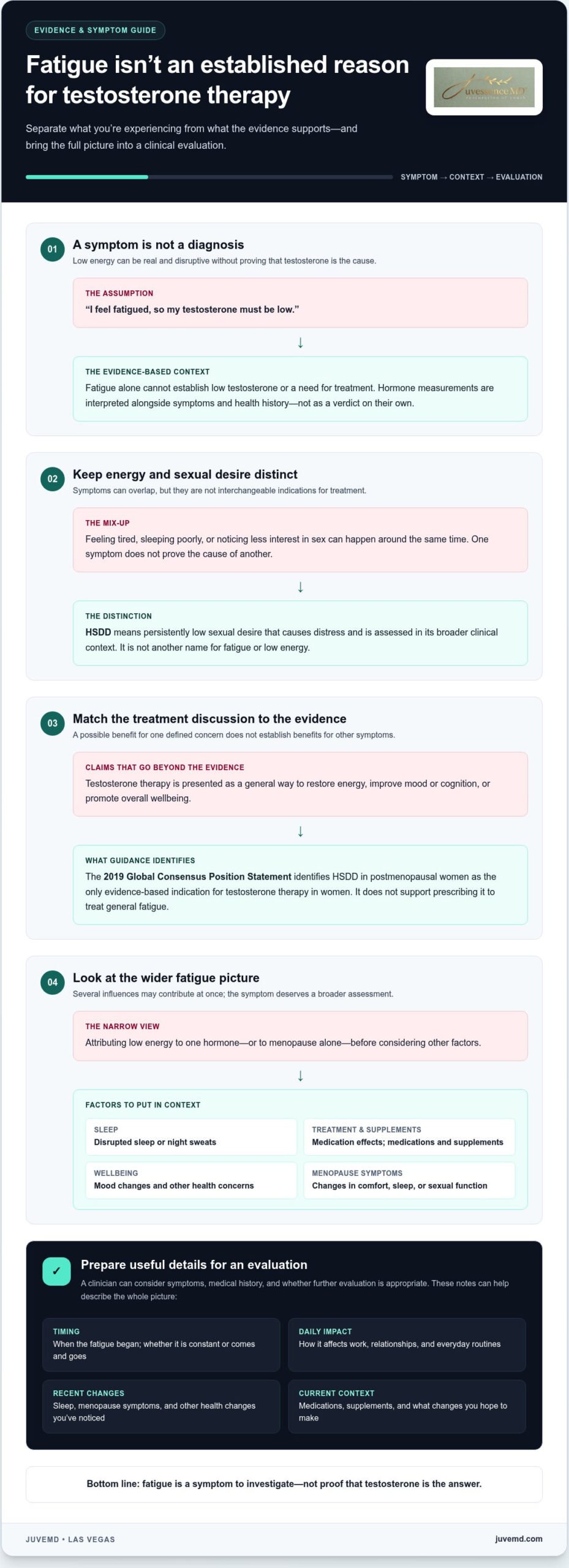
Persistent low energy can make ordinary responsibilities feel unusually demanding. If fatigue is disrupting your work, relationships, or daily routines, it’s understandable to wonder whether hormones are involved. The direct answer is that testosterone therapy for women’s energy is not an established general treatment for fatigue. A hormone’s role in the body doesn’t prove that taking more of it will restore day-to-day energy.
Testosterone is not exclusively a male hormone. Women produce it too, and hormone levels are only one part of a broader picture of health. Fatigue alone can’t establish that testosterone is low or that treatment is appropriate. Keep the distinction clear: “Fatigue is a symptom I experience; a hormone-related diagnosis requires clinical assessment, not an assumption based on that symptom.”
What testosterone does in women
Women produce testosterone mainly in the ovaries and adrenal glands, small glands located above the kidneys. The body also converts some hormone precursors into testosterone in other tissues. Testosterone is one of several hormones involved in complex processes, including sexual function and the maintenance of bone and muscle. You can read a general overview of testosterone and its role in the body.
Researchers continue to study how testosterone relates to different aspects of women’s health. But a plausible biological role is not proof that therapy reliably improves energy or overall wellbeing. A test result also can’t explain every symptom on its own. Clinicians interpret hormone measurements in context, including symptoms and health history.
Why fatigue deserves a wider view
Energy can be affected by several overlapping factors. Disrupted sleep, night sweats or other menopause symptoms, medication effects, mood changes, and other health concerns may all play a part. More than one factor can be present at once, so a single symptom or lab result shouldn’t be used as a do-it-yourself test for hormone deficiency.
For a useful conversation with a clinician, note when the fatigue began, whether it is constant or comes and goes, and how it affects daily activities. Include changes in sleep or menopause symptoms, medications and supplements, and other health changes you’ve noticed. These details can help guide an evaluation without presuming the cause.
If low energy persists or interferes with your routine, discuss it with a qualified clinician. An assessment can consider your symptoms and medical history and determine whether further evaluation is appropriate. The goal is to understand the whole picture before deciding whether hormone care belongs in an individualized plan, rather than treating fatigue as proof that testosterone is the answer.
How testosterone relates to energy, menopause, and sexual desire
Energy, sleep, mood, and sexual desire can all shift during midlife, sometimes at the same time. That overlap can make a hormone explanation feel intuitive. But a biologically plausible connection does not show that testosterone therapy reliably improves everyday energy, and menopause itself doesn’t prove that testosterone is deficient.
Fatigue alone cannot establish a need for testosterone therapy. It’s a symptom to investigate, not a stand-alone indicator of a hormone problem. This distinction matters because evidence-supported treatment discussions focus on a specific concern: hypoactive sexual desire disorder (HSDD) in postmenopausal women. HSDD involves persistently low sexual desire that causes distress and is assessed in its broader clinical context. It isn’t another name for feeling tired or having less energy.
What the evidence does and does not support
The 2019 Global Consensus Position Statement identifies HSDD in postmenopausal women as the only evidence-based indication for testosterone therapy in women. It doesn’t support prescribing testosterone to restore general energy, improve mood or cognition, or promote overall wellbeing. A possible benefit for a defined sexual-health concern shouldn’t be taken as evidence that treatment will address other symptoms.
Individual accounts of feeling more energetic after treatment may be meaningful to those people, but they can’t establish that testosterone caused the change or that others can expect the same result. Symptoms may shift for several reasons, and personal experience is not a substitute for consistent evidence from clinical research. The Testosterone for women fact sheet also explains the distinction between evidence for sexual desire and claims about energy or other symptoms.
Why symptom overlap can complicate the picture
Consider someone who feels exhausted, sleeps poorly because of night sweats, and notices less interest in sex. Those concerns may be connected, but one doesn’t prove the cause of another. Sleep disruption may contribute to fatigue; changes in desire may have physical, emotional, relationship, or other health influences. Each deserves to be understood rather than grouped under a single hormone label.
Menopause can bring changes in sleep, comfort, mood, and sexual function, but these changes don’t automatically indicate low testosterone. Nor should every midlife symptom be attributed to menopause alone. A clinician can consider when each concern began, how it affects daily life, relevant health history, and whether further evaluation is appropriate. Lab results are one part of that assessment, not a verdict in isolation.
If you’re weighing testosterone therapy for women’s energy, make the question specific: what symptom are you hoping to address, and what evidence supports that use? A personalized evaluation can help clarify the possibilities without assuming treatment will improve energy. For readers considering hormone-health support in Las Vegas, JuveMD offers personalized medical evaluations to discuss symptoms and individual care needs.
Can testosterone therapy improve women’s energy? Benefits and limits
Testosterone isn’t a proven general treatment for low energy in women. The 2019 Global Consensus Position Statement identifies hypoactive sexual desire disorder (HSDD) in postmenopausal women as the only evidence-based indication for testosterone therapy. That narrow potential benefit doesn’t establish that therapy will improve fatigue, mood, cognition, or overall wellbeing.
As of October 2026, there are no FDA-approved testosterone products specifically for women in the United States. Use is off-label, meaning clinicians may prescribe products approved for men or use compounded formulations. Off-label treatment isn’t automatically inappropriate, but the decision calls for careful discussion of evidence, individual circumstances, and monitoring. It isn’t a reason to self-treat with a product intended for another use.
| Reader’s goal | What the evidence supports | Questions for a clinician |
|---|---|---|
| More everyday energy | Not established as a general treatment goal. | What else could contribute to my fatigue, and what evaluation makes sense? |
| Relief from distressing low sexual desire after menopause | This is the specific indication supported by current consensus, following clinical assessment. | Does my experience fit this concern, and what benefits and risks apply to me? |
| Improved mood, focus, or overall wellbeing | Evidence doesn’t support promising these benefits from testosterone therapy. | How should these symptoms be assessed separately? |
What a realistic treatment goal looks like
A realistic goal starts with a defined, clinician-assessed concern, not a broad promise to feel energized. Before any treatment decision, describe what’s troubling you and how it affects daily life. If treatment is considered for an appropriate indication, recording symptoms beforehand and reviewing them during follow-up can help clarify whether the intended concern is changing. There’s no guaranteed result, degree of improvement, or timeline.
Safety, side effects, and evidence limits
Potential side effects include acne, unwanted hair growth, and voice changes. The Global Consensus guidance recommends against testosterone pellets and injections for women because they may raise levels above the normal female range and can be difficult to adjust. Decisions should weigh potential benefit against personal health context, formulation, side effects, and the limits of long-term safety evidence.
Monitoring matters, too. A clinician can explain what follow-up is appropriate and what changes should be reported. If energy is the main concern, discuss it directly rather than assuming that a hormone treatment supported for a different indication will address it. Testosterone therapy for women’s energy should not be presented as a proven solution; an individualized evaluation can help identify a more appropriate next step.
How to prepare for a medical evaluation of low energy
A little preparation can make a conversation about persistent fatigue more focused. You don’t need to arrive with a diagnosis or decide in advance that hormones are responsible. Instead, bring a clear account of what’s changed and what you’d like help understanding. That gives a clinician useful context for discussing possible causes and appropriate next steps.
What to note before the appointment
For several days or longer, jot down when your energy feels lowest and whether the pattern changes with sleep, work, activity, or other symptoms. Note when the fatigue began, whether it is getting better or worse, and which parts of daily life it affects. A brief record can be more helpful than trying to recall every detail during the visit.
- Symptoms and timing: Describe when fatigue started, how often it occurs, and whether you’ve noticed changes in mood, sleep, or menopause-related symptoms.
- Health context: List relevant medical history, current medications, and supplements. Include recent changes if you remember them.
- Sleep and routine: Note changes in sleep quality, interruptions during the night, and how rested you feel in the morning.
- Your goal: Write down what you hope to understand or improve, such as having enough energy to complete a workday or identifying why sleep has become less restful.
Appointment checklist: “When did this begin? What makes it better or worse? How is it affecting my life? What health changes, medications, or sleep concerns might be relevant? What would I like to understand?” Use your own words. The point is to share useful context, not to match your experience to a hormone-deficiency checklist.
Questions to discuss with a clinician
Ask what potential explanations should be considered before linking fatigue to hormones. Sleep disruption, medication effects, mood, menopause symptoms, and other health factors may matter, and an assessment should reflect your individual history. If testing is discussed, ask whether it’s appropriate for your situation and how the result would be interpreted alongside symptoms and medical history. A number by itself doesn’t establish a diagnosis or determine treatment.
If hormone treatment is raised, clarify the intended goal and how well it’s supported by evidence. You can also ask about possible risks, alternatives, and what follow-up would involve. For example: “If we consider treatment, what symptom are we aiming to address, and how will we assess whether the plan remains appropriate?” These questions keep the discussion centered on your health, not a promised energy boost.
Preparing this way can help you discuss testosterone therapy for women’s energy without assuming fatigue proves low testosterone. If you’re in Las Vegas and would like to explore your symptoms in a personalized medical evaluation, learn about hormone-health evaluations with JuveMD.
Discuss personalized hormone care with JuveMD in Las Vegas
Persistent low energy deserves attention, but it doesn’t automatically point to a hormone imbalance or a particular treatment. JuveMD is a Las Vegas clinic focused on hormonal health and personalized care. A medical evaluation can put symptoms, health history, and personal goals into context, then explore whether hormone care is appropriate for you. The aim is an informed discussion, not a promise that treatment will restore energy.
JuveMD offers bioidentical pellet hormone therapy and ongoing hormonal-health monitoring. Pellet therapy is one service within the clinic’s hormone care, but its availability doesn’t mean it is indicated for fatigue or right for every person. The decision should be grounded in an individualized assessment and a clear understanding of the evidence, potential benefits, and limitations.
What an individualized conversation should clarify
A useful discussion connects the concern you want to address with your symptoms, treatment goals, and medical history. For example, explain whether low energy is the main issue or whether you’re also concerned about sleep, menopause symptoms, or sexual desire. These experiences can overlap without having the same cause or calling for the same approach.
Ask what a proposed treatment is intended to address and what evidence supports that use. Discuss potential benefits alongside limitations and risks, and clarify how follow-up and monitoring fit into care. A clinician-led conversation should leave room for uncertainty: if a treatment is unlikely to address your primary concern, that distinction matters. JuveMD’s women’s hormone pellet therapy guide offers more context about this approach.
It can also help to bring a short list of questions: What could be contributing to my symptoms? What is the goal of any treatment being considered? How will we weigh potential benefits against risks? What follow-up would help determine whether the plan still makes sense? Clear questions support shared decision-making without assuming that a hormone level alone dictates the answer.
A thoughtful next step for Las Vegas readers
If you’re exploring hormone-health support in Las Vegas, JuveMD provides medical evaluations and personalized wellness plans. The clinic is led by Dr. Andrea Dempsey and offers ongoing hormonal-health monitoring as part of its care. A broader overview of treatment approaches is available in the complete bioidentical hormone therapy guide.
Keep the question specific: testosterone therapy for women’s energy isn’t an established general solution for fatigue. An individualized evaluation can help you discuss what you’re experiencing, understand relevant evidence, and consider next steps suited to your health goals. Explore personalized hormone care at JuveMD.
Take the next step with a clearer picture
You don’t have to arrive at an appointment knowing what’s causing your fatigue. A more useful starting point is a clear description of what has changed, what you’d like to understand, and which questions matter most to you. That can help shift the conversation away from online promises and toward options grounded in your health history and the evidence.
If you’re considering testosterone therapy for women’s energy, keep your goal specific and ask how any proposed care relates to it. JuveMD is a Las Vegas clinic focused on hormonal health and wellness, with personalized medical evaluations and ongoing hormonal-health monitoring. An individualized discussion can help you explore whether hormone care fits your circumstances, without assuming treatment will resolve fatigue.
Explore personalized hormone care at JuveMD and take a considered next step toward understanding your symptoms. A thoughtful evaluation can give you a clearer basis for decisions about your wellbeing.
Frequently Asked Questions
Can testosterone therapy increase energy in women?
Not reliably. Testosterone therapy isn’t established as a general treatment for women’s fatigue. Research-supported use is narrower, focused on postmenopausal women with hypoactive sexual desire disorder (HSDD), after clinical assessment. That evidence concerns distressing low sexual desire, not an expectation of feeling more alert through the day. If energy is your main concern, tell your clinician which activities fatigue is limiting and discuss an appropriate evaluation before considering hormone treatment.
Is testosterone therapy approved for women in the United States?
No testosterone product is FDA-approved specifically for women in the United States as of October 2026. Prescribing a product approved for men to a woman is off-label use; compounded formulations may also be used. Regulatory approval and clinical guidance are different: a consensus statement may describe a narrow evidence-supported use, but that doesn’t mean the FDA has approved a product for that use in women.
What symptoms can testosterone therapy help women with?
The evidence-supported context is hypoactive sexual desire disorder in postmenopausal women, a persistent loss of sexual desire that causes distress and is assessed clinically. This is different from simply feeling tired, experiencing a temporary change in interest, or seeking broad improvements in wellness. Before discussing therapy, describe how the concern affects you and whether it is persistent. A clinician can assess whether your experience fits the specific concern addressed in treatment guidance.
Can low testosterone cause fatigue in women?
Fatigue by itself can’t show that testosterone is low or causing the symptom. Tiredness may occur alongside sleep problems, menopause-related changes, medication effects, mood concerns, or other health factors. There’s also no established testosterone cutoff that identifies an androgen-deficiency condition in otherwise healthy women. A clinician considers symptoms and health context together rather than using fatigue or one test result alone to assign a hormone-related cause.
How is testosterone deficiency evaluated in women?
Evaluation begins with a clinician’s assessment of your concerns, health history, and relevant context, rather than a single lab value. Be ready to discuss when symptoms began, how they affect you, menopause status, medications, and any changes in sexual desire if relevant. A clinician decides whether testing is useful and interprets results alongside your overall picture. There isn’t one result that independently determines a diagnosis or need for treatment.
Is testosterone therapy safe for women?
Safety depends on the individual, the reason treatment is being considered, and the formulation. Possible effects include acne, unwanted hair growth, and voice changes. Pellets and injections can produce testosterone levels above the normal female range and may be difficult to adjust; expert guidance recommends against these forms. If therapy is considered, discuss potential harms, uncertainties, and appropriate medical monitoring with a clinician. Don’t use hormone products without medical supervision.
Should women consider testosterone therapy during menopause?
Menopause alone doesn’t establish a need for testosterone therapy. The evidence-supported context is a clinician-assessed concern involving persistent, distressing low sexual desire after menopause, not fatigue or general wellness goals. If you’re considering treatment, explain which symptom is affecting you and what you hope to address. A clinician can discuss whether the evidence applies to your circumstances, along with potential benefits, limitations, risks, and other relevant care options.