
Could mood swings point to changing hormones, or might stress, disrupted sleep, or another health factor be playing a larger role? If you’re searching for BHRT for mood swings Las Vegas, it’s understandable to want a clear answer when your emotions feel unpredictable. Hormone changes can coincide with mood shifts, particularly around perimenopause, but symptoms alone can’t identify the cause or show whether treatment is appropriate.
Estrogen and progesterone may affect sleep and emotional regulation, so a clinician may consider hormone patterns alongside symptoms such as cycle changes, hot flashes, or night sweats. BHRT may be an option for some people when an evaluation suggests a hormone-related concern. It isn’t a guaranteed way to improve mood swings, and it doesn’t replace care for anxiety or depression.
This guide explains how hormone changes may relate to mood, what BHRT can and can’t address, and what to discuss during an individualized evaluation. At JuveMD in Las Vegas, Dr. Andrea Dempsey leads personalized hormone-health discussions, including conversations about bioidentical pellet hormone therapy. Use the practical steps below to organize your concerns and prepare for an informed next step.
Key Takeaways
- Track when mood changes occur, how often they happen, how intense they feel, and how they affect daily life. This gives a clinician useful context.
- For BHRT for mood swings Las Vegas, an individualized evaluation matters more than symptoms alone when considering whether hormones may be involved.
- A possible connection between hormones and emotional well-being is not proof that treatment will resolve your specific mood symptoms.
- Use a consultation to discuss your health history, treatment goals, and potential benefits and risks before deciding on next steps.
- JuveMD’s personalized hormone-health approach, led by Dr. Andrea Dempsey, can inform a conversation about pellet therapy or injectables.
Mood Swings and Hormone Changes: What BHRT in Las Vegas Can, and Cannot, Explain
Mood changes can feel unsettling, especially when they arrive without an obvious explanation or begin to affect relationships, work, or daily routines. Irritability, tearfulness, or feeling unusually anxious doesn’t point to one cause by itself. Hormone changes may be part of the picture, but timing and symptoms need to be considered alongside other aspects of your health.
Bioidentical hormone replacement therapy (BHRT) is clinician-directed therapy using hormones designed to have the same molecular structure as hormones produced by the body. The term describes the hormones, not a guarantee of safety or effectiveness. A general overview of bioidentical hormone replacement therapy (BHRT) also outlines the distinction between bioidentical hormones and questions about their use.
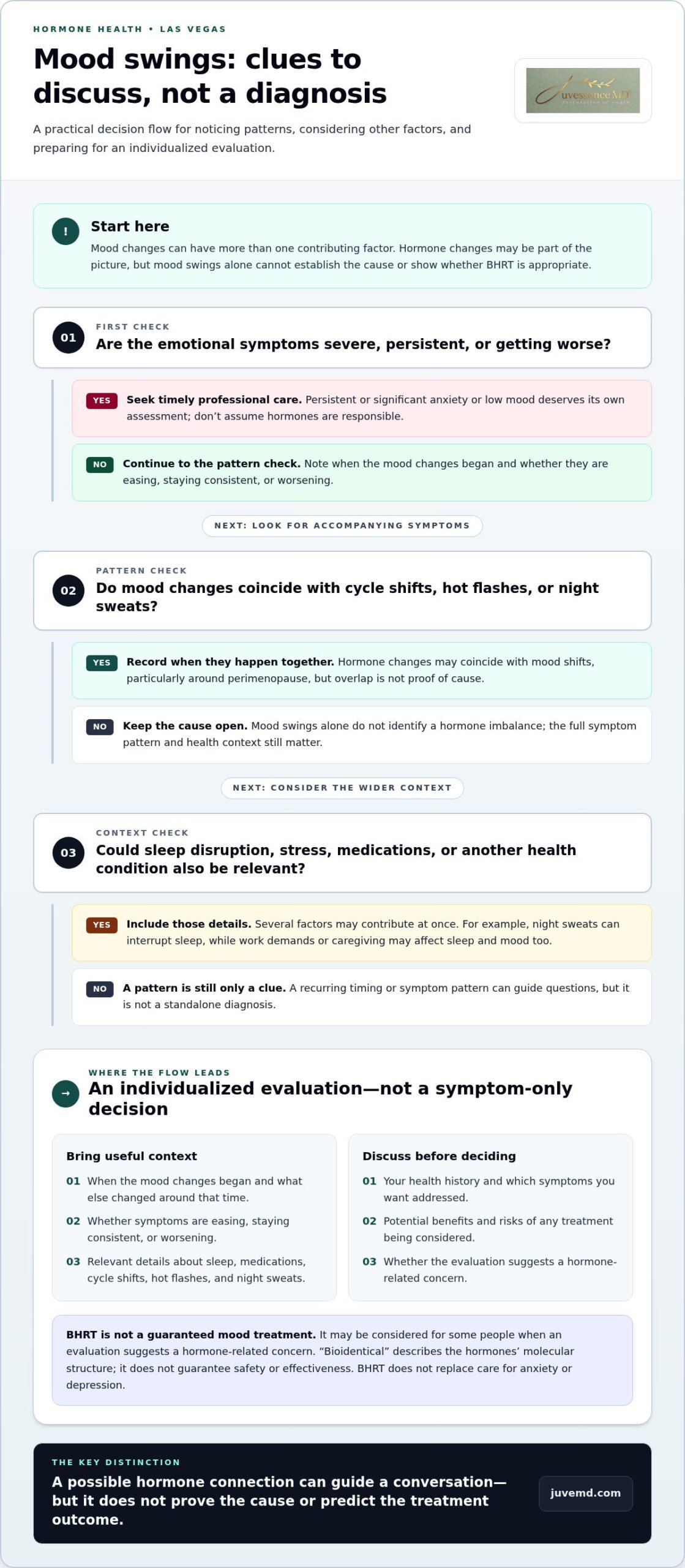
Mood swings alone cannot diagnose a hormone imbalance. They may be a reason to discuss hormone health, but they can’t establish that hormone levels are causing the changes or that BHRT is the right response. An assessment considers the full symptom pattern and health context.
When mood changes may coincide with perimenopause or menopause
Hormone fluctuations during perimenopause and menopause can coincide with mood changes for some people. Life stage can offer useful context, but it doesn’t explain every emotional symptom, and not everyone experiencing mood swings is in either stage. Note whether changes appear alongside cycle shifts, hot flashes, or night sweats, while keeping in mind that overlap does not prove a cause.
For example, interrupted sleep from night sweats may leave someone feeling less patient or emotionally resilient the next day. Work demands, caregiving, and other life stresses can also affect sleep and mood at the same time. Persistent or severe anxiety or low mood deserves a clinical assessment rather than an assumption that hormones are responsible.
Why mood swings deserve a broader view
Several factors may contribute to emotional changes, and more than one can be present. Sleep disruption, ongoing stress, medication effects, and other health conditions are relevant context for a clinician. A recurring pattern, such as symptoms appearing at a particular time, can help guide questions and evaluation. It is still a clue, not a standalone diagnosis or proof that hormone treatment will help.
Before an appointment, note when mood changes began, what else changed around that time, and whether symptoms are easing, staying consistent, or worsening. Include relevant details about medications and sleep. Seek timely professional care if emotional symptoms are severe, persistent, or getting worse. Considering the broader picture can help avoid settling on one explanation too soon and support a more informed discussion of next steps, including whether hormone health merits further attention.
How Hormones May Relate to Mood, and What the Evidence Does Not Prove
Hormones are part of interconnected systems that influence sleep, energy, and emotional experience. Changes in reproductive hormones may contribute to how someone feels, but a plausible biological connection isn’t proof that a hormone change caused one person’s mood symptoms. Nor does it establish that hormone therapy will resolve them.
A hormone can be a possible contributing factor without being the confirmed cause of a person’s mood changes. That distinction matters when weighing claims about BHRT for mood swings Las Vegas. A thoughtful evaluation considers which symptoms are present, when they occur, and what treatment is intended to address.
Hormone changes, sleep, and emotional wellbeing
Hormonal shifts may coincide with sleep changes and symptoms such as hot flashes or night sweats. When these interrupt rest, a person may feel more tired, less focused, or more emotionally strained during the day. That pattern can make hormones relevant to a conversation, but sleep, stress, and other factors may also shape the experience. No single pathway explains everyone’s mood.
Evidence must be interpreted in context. The Menopause Society identifies hormone therapy as the most effective treatment for vasomotor symptoms, including hot flashes and night sweats, and for genitourinary symptoms of menopause. That guidance addresses specific symptoms and goals. It shouldn’t be read as proof that BHRT is an established universal treatment for mood swings. Findings or recommendations may differ according to the hormone used, a person’s life stage, the formulation, and the reason for treatment.
Why BHRT is not a universal mood treatment
A treatment that may be considered for one hormone-related concern may not be appropriate for another. A clinician weighs the person’s health history, symptoms, and goals when discussing potential benefits and risks. The term “bioidentical” describes a hormone’s molecular structure. By itself, it doesn’t show that a treatment is safer or more effective than other options. Formulation and individual circumstances matter.
Persistent or significant anxiety or depression calls for its own assessment. BHRT shouldn’t replace evaluation of mental health symptoms or other possible medical causes, and a mood concern shouldn’t be assumed to be hormonal. If hormone therapy is discussed, useful questions include: Which symptoms is it intended to address? What evidence applies to that goal and formulation? What potential risks are relevant to my health history? How will we assess whether the plan is helping?
Clear answers should distinguish what is known from what remains uncertain. A personalized hormone-health discussion at JuveMD in Las Vegas can help you explore whether hormone factors deserve further consideration, without presuming that treatment is the inevitable next step.
BHRT for Mood Swings: Weighing Potential Benefits, Limits, and Safety
Start by separating what you hope to feel better from what the evidence can reasonably support. For someone exploring BHRT for mood swings Las Vegas, the discussion should connect symptoms and goals to an individualized review, rather than assume that mood changes alone point to a treatment.
A balanced conversation can cover possible relevance, what remains uncertain, and questions to explore with a qualified clinician:
| Potential relevance | Uncertainty or limit | Question to discuss |
|---|---|---|
| Mood changes occurring alongside other hormone-related symptoms may make hormone health relevant to an evaluation. | That timing doesn’t confirm hormones are the cause or predict a mood response to therapy. | What could explain this pattern, and what symptoms would treatment be intended to address? |
| Treatment may be considered for specific hormone-related concerns after clinical assessment. | Evidence and recommendations vary with the hormone, life stage, formulation, and treatment goal. | What evidence applies to my situation and the outcome I’m seeking? |
| A clinician can weigh possible benefits against personal health considerations. | “Bioidentical” doesn’t mean risk-free, automatically safer, or suitable for everyone. | How do my medical history and other medications affect potential benefits and risks? |
What a balanced benefit-and-limit discussion includes
Be specific about the change you hope to see. “I want fewer mood swings” is a useful goal to share, but it doesn’t establish what is causing them or whether hormone therapy is likely to help. A clinician can consider your current symptoms, relevant personal and family health history, medications, and treatment priorities before discussing options. Don’t start, stop, or adjust hormone treatment based only on an online symptom checklist.
Ask how a proposed treatment relates to the concern being addressed, what uncertainties remain, and which potential risks matter in your circumstances. The word “bioidentical” describes molecular structure, not a safety guarantee. FDA-approved hormone products and custom-compounded formulations don’t have identical regulatory review or evidence. A clinician can explain the distinction and its relevance to your care.
When mood symptoms may need care beyond a hormone conversation
Severe or persistent anxiety or depression deserves appropriate mental health evaluation. BHRT isn’t a stand-alone treatment for psychiatric disorders and shouldn’t replace established mental health care. Hormone-related questions can be considered alongside an assessment of emotional symptoms and other possible causes, not instead of one.
If you or someone else is in immediate danger, call 911 or go to the nearest emergency department. In the United States, you can also call or text 988 for the Suicide & Crisis Lifeline. Seeking urgent support is appropriate; you don’t need to wait for a hormone consultation.
Prepare for a Las Vegas BHRT Consultation: Symptoms, Questions, and Context
A little preparation can make a hormone-health conversation more useful. You don’t need to arrive with a diagnosis or decide in advance that BHRT is the answer. For a discussion about BHRT for mood swings Las Vegas, focus on describing what you’ve noticed, sharing relevant health context, and understanding how a clinician evaluates possible next steps.
What to track before the appointment
Keep brief, factual notes rather than trying to interpret each change. Record when symptoms happen, how often, how intense they feel, and whether they coincide with sleep disruption or other symptoms. These notes can help you recall details during an appointment, but they can’t determine the cause on their own.
- Describe the pattern. Note when mood changes began, how long they tend to last, and whether there are times when they ease. If relevant, record cycle changes or symptoms such as hot flashes and night sweats.
- Record sleep and daily effects. Note changes in sleep and how mood symptoms affect work, relationships, concentration, or everyday activities. A short example, such as “woke several times and felt unusually irritable the next morning,” is more useful than a conclusion about why it happened.
- Gather health context. Prepare a list of current medications and supplements, relevant medical history, and prior treatments or experiences. Include what helped, what didn’t, and any concerns or side effects you remember.
Questions to bring to a hormone-health discussion
Questions can keep the conversation focused on your priorities while leaving room for a broader evaluation. Ask what possible explanations should be considered and how a clinician will distinguish a hormone-related concern from other contributing factors. You can also describe the goal you hope to reach, such as more stable sleep or fewer disruptive mood changes, without assuming that a specific treatment will deliver it.
- What benefits might be relevant to my symptoms, and what remains uncertain?
- What risks or limitations should I understand in light of my medical history and medications?
- If we consider a treatment, what follow-up should I expect, and how will we assess whether it is helping?
- How should emotional symptoms be addressed if hormones are only one possible factor?
Bring your notes even if they’re incomplete. An accurate account of your experience matters more than a perfect log. A clinician can use your notes alongside your history and goals to guide an individualized discussion instead of relying on symptom matching alone. If you’re ready to discuss your hormone-health questions, schedule a conversation with JuveMD in Las Vegas.
Discussing BHRT for Mood Swings with JuveMD in Las Vegas
Learning about hormone changes can help you frame better questions, but it can’t tell you by itself what’s behind your mood symptoms. A hormone-health conversation is an opportunity to review your experience with a clinician and consider whether hormones are relevant alongside other possible factors. Seeking an evaluation doesn’t mean you’ve decided to pursue treatment.
At JuveMD, a Las Vegas clinic led by Dr. Andrea Dempsey, hormone-health care includes bioidentical pellet hormone therapy and injectable treatments. Whether either approach belongs in a discussion depends on the individual, not simply on having mood swings. Symptoms, health history, goals, and a clinician’s assessment all matter.
What an individualized conversation should clarify
Start with what you’ve observed and what you hope to address. For example, describe when mood changes began, whether they coincide with sleep disruption or other symptoms, and how they affect daily life. Share relevant medical history, current medications, supplements, and previous treatment experiences. These details provide context without assuming a hormone cause.
If a treatment option is raised, ask for a clear explanation of its purpose. Discuss what benefits may be realistic for your specific concern, what limitations or uncertainties remain, and what possible risks apply to your circumstances. You can also ask how progress would be discussed and what the next step would be if mood symptoms continue. A careful conversation should leave room for questions and alternatives, not make a particular treatment feel automatic.
It may help to state your priorities plainly: Are you seeking clarity about possible causes, support for a particular symptom, or information about hormone therapy options? Your answer can guide the conversation while leaving room for the clinician to consider your overall health. BHRT for mood swings Las Vegas should be approached as an individualized clinical discussion, not as a promise that treatment will change how you feel.
A measured next step for Las Vegas patients
You don’t need to arrive certain that hormones are responsible or that you want treatment. An evaluation can help you understand which questions are relevant and whether a hormone-focused discussion makes sense in your situation. Choosing to learn more is not the same as consenting to a treatment plan.
If you’d like to explore JuveMD’s hormone-health services and discuss your concerns, connect with JuveMD in Las Vegas. Bring your observations and questions, and keep the discussion focused on your symptoms, history, and goals. Any decision about pellet therapy, injectables, or another next step should follow an individualized assessment and a clear discussion of potential benefits, limitations, and risks.
Make Your Next Step an Informed Conversation
You don’t have to arrive with a diagnosis or a decision about treatment. You can begin with a question: What might be contributing to these changes, and what would be a thoughtful way to explore it? That keeps the focus on understanding your experience rather than matching a symptom to a promised solution.
If you’re considering BHRT for mood swings Las Vegas, bring your priorities to a clinician-led discussion and take time to understand whether hormone care fits your individual circumstances. The next step may be further evaluation, a conversation about treatment options, or a different approach to the concerns affecting your well-being. A clear discussion should leave room for uncertainty, questions, and your own preferences.
JuveMD offers personalized hormone-health care in Las Vegas. Discuss your hormone-health concerns with JuveMD and explore what may be appropriate for you.
Frequently Asked Questions
Can BHRT help with mood swings?
It may be relevant for some people if a clinician finds a hormone-related concern, but mood improvement isn’t guaranteed. Mood changes occurring alongside menopause symptoms may prompt a broader hormone-health discussion, yet that pattern doesn’t predict how an individual will respond. If you’re considering BHRT for mood swings Las Vegas, ask what specific concern treatment would address and how you’d assess whether it’s helping.
Is BHRT a treatment for anxiety or depression?
BHRT shouldn’t be treated as a stand-alone treatment for anxiety or depression. If anxiety or low mood is affecting concentration, relationships, sleep, or daily responsibilities, discuss those symptoms directly with a qualified clinician rather than assuming hormones explain them. A mental health evaluation can help identify appropriate care. Hormone-related questions may still be discussed, but they shouldn’t delay assessment or replace established support for mental health concerns.
How do I know whether mood swings are related to menopause?
You can’t determine the cause from mood swings alone. Menopause may be one possibility if emotional changes occur alongside signs such as changes in menstrual patterns or hot flashes, but symptoms vary and can overlap with other factors. Note what changed and when, including changes in your cycle, sleep, or daily routine. A clinician can use that context to consider whether menopause may be relevant.
Are bioidentical hormones safer than other hormone treatments?
Not simply because they’re called bioidentical. The term refers to hormones with a molecular structure matching hormones produced by the body; it doesn’t establish that a product is safer or right for a particular person. FDA-approved hormone products and compounded formulations also differ in their review and evidence. Ask which type is being discussed, what is known about its risks, and how your health history affects the decision.
What should I bring to a BHRT consultation in Las Vegas?
Bring a current medication and supplement list, relevant medical records you already have, and notes about when mood changes occur. If symptoms seem to follow a pattern, a calendar entry can be more useful than trying to recall everything during the visit. Include previous hormone treatments or other approaches you’ve tried and your experience with them. This information gives the clinician a practical starting point for discussing your concerns.
What happens if BHRT is not the right option for my mood swings?
If BHRT isn’t appropriate, the discussion can still help clarify what to explore next. Ask what other factors may be contributing, whether further assessment is warranted, and what type of care fits your symptoms and goals. Persistent or severe emotional symptoms deserve appropriate evaluation rather than being left unexplained. You can also ask how hormone questions and mental health concerns can be considered without treating one as a substitute for the other.