
The more familiar wrinkle injectable isn’t automatically the better fit. Choosing between Botox and Dysport for wrinkles can feel less straightforward in Las Vegas, especially when you’re searching “Botox vs Dysport for wrinkles Las Vegas.” Both are established options, but neither is universally better. The right choice depends on your treatment area, facial anatomy, goals, and clinical assessment.
You may want to soften lines without looking overtreated, and wonder whether one option works faster, lasts longer, or better suits your features. These are useful questions, but they don’t lead to the same answer for everyone.
This guide explains the differences between Botox and Dysport without overstating what either can do. You’ll learn what to discuss during an assessment, what to expect from treatment, and why comparing price per unit alone may not tell the whole story.
JuveMD is a Las Vegas medical clinic led by Dr. Andrea Dempsey that offers injectable treatments. Understanding your options can help you approach a personalized wrinkle plan with greater clarity.
Key Takeaways
- Botox and Dysport are prescription neuromodulators used to address dynamic wrinkles, but they aren’t interchangeable in every treatment plan.
- For Botox vs Dysport for wrinkles Las Vegas, compare the treatment area and your goals rather than relying on brand familiarity alone.
- Formulation differences may shape treatment planning, while onset and duration can vary from person to person.
- Use an assessment to discuss your goals, relevant medical history, and the areas you’d like to address.
- JuveMD offers injectable treatments at its Las Vegas medical clinic, led by Dr. Andrea Dempsey.
Botox vs. Dysport for Wrinkles in Las Vegas: What Is Being Compared?
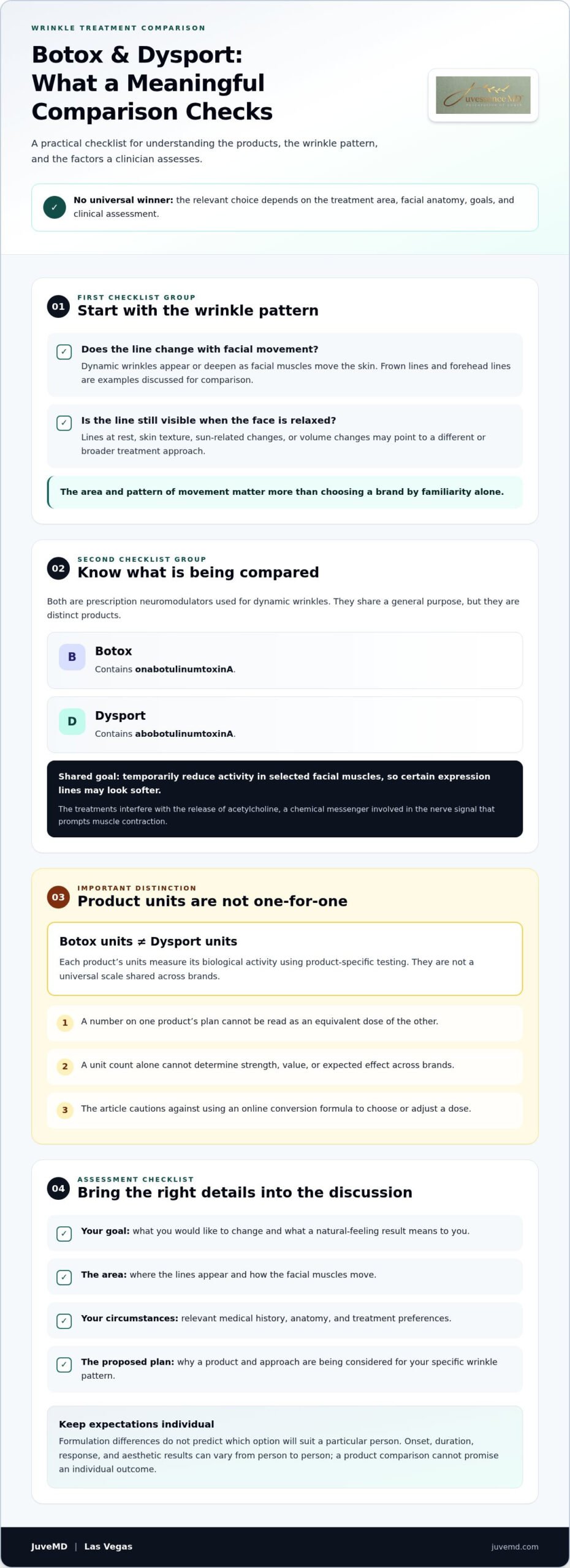
Choosing between Botox and Dysport starts with the wrinkle you want to address, not with a universal winner. Both are prescription neuromodulators, but the best fit depends on the person, treatment area, and clinical assessment. For readers comparing Botox vs Dysport for wrinkles Las Vegas, the useful question is how each option might fit an individual treatment plan.
Botox contains onabotulinumtoxinA, while Dysport contains abobotulinumtoxinA. Both are forms of botulinum toxin used in medicine, but they are distinct products with different active ingredients. The broader topic of Botulinum Toxin (Botox and Dysport) includes mechanisms and uses beyond cosmetic wrinkle care; this comparison focuses on facial lines.
Dynamic wrinkles are lines that appear or deepen as facial muscles repeatedly move the skin. A frown can bring out lines between the eyebrows, while raising the brows can make forehead lines more visible. An assessment considers those movement patterns alongside your goals, rather than treating every visible line as the same concern.
Which wrinkle patterns are people comparing them for?
People often compare these options for movement-related lines, including frown lines and forehead lines. That comparison can’t determine whether either treatment is appropriate for a particular person or area. A clinician evaluates the location and pattern of movement, along with the changes you want, before discussing possible treatment.
Some lines remain visible when the face is relaxed. Skin texture, sun-related changes, or volume changes can also affect how lines look. These concerns may call for a different or broader treatment approach, so comparing neuromodulators alone can’t identify the best option. First consider what may be contributing to the line, then discuss which options fit your goal.
What can a comparison answer, and what can’t it predict?
A product comparison can explain how the brands differ and outline factors a clinician may consider. It can’t predict your individual response or promise a particular aesthetic result. Two people considering treatment for a similar area may have different anatomy, movement patterns, preferences, or treatment plans.
Use the comparison to prepare for a focused conversation. Consider what you’d like to change, whether your lines show mainly during expression or remain at rest, and what a natural-feeling result means to you. Then discuss the treatment area, relevant medical history, and the reasoning behind any proposed plan. Brand-level information is a starting point, not a substitute for clinical judgment.
The question isn’t which name wins in general. It’s which option, if either, makes sense for your wrinkle pattern and goals. A personalized assessment can connect product-level differences to your circumstances.
How Botox and Dysport Work: Similar Goal, Different Formulations
Botox and Dysport share a basic purpose in wrinkle care: they temporarily reduce activity in selected facial muscles. Nerve signals normally prompt a muscle to contract. These treatments interfere with the release of acetylcholine, a chemical messenger involved in that signal, so the targeted muscle contracts less strongly for a time. With less repeated movement in the treated area, certain expression lines may look softer.
Botox and Dysport both reduce targeted muscle activity, but their product-specific units are not interchangeable. A unit count from one product can’t simply be read as an equivalent dose of the other.
What is different about the active ingredients?
Botox is the brand name for a product containing onabotulinumtoxinA; Dysport contains abobotulinumtoxinA. They are distinct botulinum toxin type A formulations, not interchangeable labels for the same product. Although they share a general mechanism, formulation differences alone can’t predict which will suit an individual or what aesthetic result they’ll experience. The Mayo Clinic overview of Botox injections also explains how the treatment works and discusses its uses and potential risks.
For Botox vs Dysport for wrinkles Las Vegas, separate what’s known about each product from what must be assessed for a specific person. Product labeling describes each medicine and its use, but it doesn’t replace an evaluation of facial movement, treatment goals, medical history, and the area being considered. Those details shape whether a product is appropriate and how a plan is developed.
Why treatment units should not be compared one-for-one
Units measure the biological activity of a particular product using its own product-specific testing. They aren’t a universal scale shared across brands. A larger or smaller number on a Dysport plan can’t be compared directly with a Botox number to judge strength, value, or expected effect. The labeled units are not directly interchangeable.
This is why an online conversion formula shouldn’t be used to choose or adjust a dose. Dosing depends on the product, treatment area, person’s anatomy and goals, and clinician’s judgment. The treating clinician determines the individual plan rather than translating one brand’s unit count into another as though the measures were identical.
A practical discussion can focus on the outcome you’re seeking, the areas involved, and how the proposed plan relates to your facial movement. For a personalized conversation about injectable care at JuveMD, a Las Vegas medical clinic led by Dr. Andrea Dempsey, bring those questions to your assessment.
Botox vs. Dysport for Wrinkles: Compare the Factors That Matter
A useful comparison looks beyond brand names. Consider the active ingredient, the wrinkle area, and how the treatment plan is tailored to your goals. In the United States, FDA-approved wrinkle-treatment indications differ: Botox Cosmetic is approved for certain forehead, frown, and crow’s-feet lines, while Dysport is approved for frown lines. Use outside a product’s approved indications is considered off-label and should be discussed with a clinician.
| Factor | Botox Cosmetic | Dysport |
|---|---|---|
| Active ingredient | OnabotulinumtoxinA | AbobotulinumtoxinA |
| Wrinkle-treatment context | FDA-approved for certain forehead, frown, and crow’s-feet lines in adults | FDA-approved for frown lines in adults |
| Planning | Plan depends on the area, facial movement, goals, and clinical assessment | Plan depends on the area, facial movement, goals, and clinical assessment |
| Useful consultation question | How does this option relate to my target area and desired expression? | How does this option relate to my target area and desired expression? |
Compare treatment plans and goals, not product units as interchangeable numbers. Each product has its own dosing units, so unit counts shouldn’t be used as a direct measure of equivalent treatment. The clinician determines the plan for the individual and the area being considered.
Do onset and duration differ between Botox and Dysport?
Published product information and clinical summaries commonly describe Dysport’s initial effect as potentially appearing in two to three days, while Botox may begin to show an effect in three to seven days. Both are generally described as reaching their full effect at about two weeks, with results often lasting around three to four months. These are typical ranges, not promises; individual response and duration vary.
Timing shouldn’t be the sole deciding factor. A reported difference won’t necessarily predict your experience or establish which product is better for you. Your treatment area, plan, and response all matter. A clinician can explain what to expect and when to assess the result.
How should readers compare treatment goals and expectations?
Start with the expression you want to preserve and the lines you’d like to soften. For example, tell the clinician whether you’re concerned about frown lines, forehead lines, or both, and whether you prefer subtle softening or a more noticeable change in movement. The assessment connects those preferences with your facial anatomy and an individual plan.
Popularity alone doesn’t show which option suits your goals. Ask how the proposed product and treatment area fit your priorities, what changes are realistic, and how the response will be evaluated. For broader context on injectable options, JuveMD’s cosmetic injectables guide offers another starting point for an informed discussion. For Botox vs Dysport for wrinkles Las Vegas, a side-by-side comparison is most useful when it leads to questions tailored to you.
Is Botox or Dysport Right for You? Candidacy, Risks, and Questions
Neither Botox nor Dysport is automatically safer or more suitable for every patient. Both are prescription medicines, and candidacy depends on an individual medical assessment, not brand preference alone. A consultation can connect your wrinkle concerns with your health history, the area being considered, and a realistic treatment plan. It can also clarify whether a neuromodulator is appropriate at all.
For Botox vs Dysport for wrinkles Las Vegas, use the comparison to frame questions, not to diagnose yourself or decide on a product or dose. Your clinician should explain the reasoning behind a recommendation and discuss relevant risks and precautions before treatment.
What should you discuss during a wrinkle-treatment assessment?
Be specific about the lines you want addressed and the facial expression you’d like to retain. Explain whether you’re concerned about lines that appear with a frown or raised brows, and whether maintaining movement in that area matters to you. The treatment area and your goals give the clinician useful context for assessing options.
Share relevant health information, including prior injectable treatments and your response, previous adverse reactions, known allergies, medical conditions, and current medicines or supplements. Mention treatments received elsewhere, too. Don’t stop or change a prescribed medication based on general information; discuss it with the treating clinician, who can consider the details in context.
What risks and precautions should the comparison explain?
Both products can cause side effects. Depending on the product and treatment area, these may include injection-site discomfort or bruising, headache, or temporary eyelid or brow drooping. The specific risks vary, and this list isn’t exhaustive. Review the current FDA prescribing information for the product being considered and ask the clinician to explain risks relevant to your circumstances. There’s no basis to assume one brand is risk-free or universally safer.
FDA labeling for botulinum toxin products also includes a warning that effects may spread beyond the injection site. Rarely, symptoms such as difficulty swallowing, speaking, or breathing can occur. Seek urgent medical care if these symptoms develop after treatment. Before an assessment, disclose relevant medical history, including neuromuscular conditions, prior reactions to botulinum toxin, allergies, and medicines that could affect treatment planning. The clinician can determine whether precautions or further evaluation are needed.
A thoughtful assessment should leave room for questions. Ask what the proposed treatment is intended to change, what movement may remain, what side effects to watch for, and what factors could make treatment unsuitable. An individualized recommendation depends on the answers, not on a one-size-fits-all comparison.
To discuss your wrinkle goals and injectable treatment options with JuveMD, a Las Vegas medical clinic led by Dr. Andrea Dempsey, connect with JuveMD about injectable care.
Exploring Botox or Dysport at JuveMD in Las Vegas
Online research can help you understand product differences, but it can’t determine which approach fits your face or goals. JuveMD is a Las Vegas medical clinic led by Dr. Andrea Dempsey that offers injectable treatments. A discussion of your wrinkle concerns and treatment options can turn the Botox vs Dysport for wrinkles Las Vegas comparison into a more informed, individual conversation.
You don’t need to arrive with a brand already chosen. Bring a clear description of what you notice and what you hope to preserve. A clinical discussion can consider your concerns, relevant health information, and treatment area when developing an appropriate recommendation.
How to prepare for a useful consultation
A few notes beforehand can help you explain your priorities clearly. Consider writing down:
- Which areas or lines draw your attention, and whether they show during expression, at rest, or both.
- How much facial movement you’d like to retain, such as natural brow movement when you speak or raise your eyebrows.
- Relevant medical history, current medications or supplements, and any allergies or prior reactions you’ve experienced.
- Previous injectable treatments, including what you liked, what you’d change, and any effects that concerned you.
You don’t need to know which product or dose is right before a clinical discussion. Your notes give the clinician a starting point, while the assessment helps shape a recommendation. Be open about your priorities, including if you’re unsure about treatment or prefer to take time before deciding.
A clear next step for Las Vegas readers
Keep four considerations in view: the treatment area, your personal goals, the clinician’s assessment, and informed expectations. These are more useful decision points than choosing a brand based on familiarity or a single comparison online. If you’re still learning about injectable options, JuveMD’s injectable treatment guide offers related educational context.
At JuveMD, you can explore injectable care and discuss your wrinkle goals in Las Vegas. Bring questions about the areas you’d like to address, the expression you want to maintain, and how a personalized recommendation is developed. The conversation is a practical next step, not a commitment to a particular product or outcome.
Explore injectable care at JuveMD and start a conversation about your wrinkle-treatment goals.
Make Your Next Step a Conversation
Choosing whether to explore treatment is a personal decision, and you don’t need to settle on a brand before discussing your goals. If you’re weighing Botox vs Dysport for wrinkles Las Vegas, use what you’ve learned to guide a focused conversation about the areas that concern you, the facial movement you want to maintain, and what feels like a comfortable outcome.
Bring your questions and relevant treatment history to an assessment. A clinician can consider your circumstances and explain whether an injectable approach may be appropriate. You can take time to understand the recommendation and decide what feels right for you.
Explore injectable care at JuveMD to take a thoughtful next step toward a wrinkle plan that reflects your goals. Clear information and an open conversation can help you move forward with confidence.
Frequently Asked Questions
Are Botox and Dysport the same thing?
No. Botox Cosmetic contains onabotulinumtoxinA, while Dysport contains abobotulinumtoxinA. They’re different prescription products that work through a related mechanism, but their names and dosing units aren’t interchangeable. A treatment plan’s unit count should be understood in the context of the specific product used, not compared as if the numbers represented identical amounts. A clinician can explain the product-specific plan being considered for your goals.
Which works faster for wrinkles, Botox or Dysport?
Dysport may begin to show an effect in as little as two to three days, while Botox often begins showing an effect in about three to seven days. These are general ranges, not a promise about your experience. Both typically take around two weeks to reach their full effect. If you’re planning around an event, discuss timing with a clinician rather than relying on a brand’s typical onset alone.
How long do Botox and Dysport last?
Results from either treatment commonly last about three to four months, though duration differs between individuals and treatment plans. The effect gradually wears off, so facial movement returns over time. Your experience may depend on factors such as the area treated and your response. Discuss follow-up timing with the clinician who understands your treatment history rather than scheduling based only on a general estimate.
Can Botox and Dysport units be compared or exchanged?
No. Their units are product-specific, so one unit of Botox doesn’t equal one unit of Dysport. Don’t use an online conversion or another person’s dose to estimate what you need. If changing products, share details of previous treatments, including the product and areas treated, with your clinician. They can determine an appropriate plan instead of translating unit counts as though they were equivalent measurements.
Which is better for forehead lines or frown lines?
Neither is automatically better for everyone. Botox Cosmetic is FDA-approved for certain forehead lines and frown lines in adults; Dysport is FDA-approved for frown lines in adults. Use of Dysport for forehead lines is off-label. Approval status is one consideration, not an individual recommendation. For Botox vs Dysport for wrinkles Las Vegas, the treatment area, your goals, and clinical assessment help guide the discussion.
Is Botox or Dysport available in Las Vegas?
Both products are used for cosmetic wrinkle treatment, and Las Vegas readers can explore injectable care locally. JuveMD is a medical clinic in Las Vegas that offers injectable treatments and is led by Dr. Andrea Dempsey. A discussion at the clinic can center on your wrinkle concerns and treatment options. Product-specific suitability and a treatment recommendation depend on an individual clinical assessment.
What should I ask before getting Botox or Dysport?
Ask what the recommended treatment is intended to address, what facial movement you may retain, and what side effects or precautions apply to your health history. Share current medications, relevant medical conditions, previous injectable treatments, and any past reactions. You can also ask how and when the result will be assessed. Clear answers help you understand the proposed plan and decide whether you feel comfortable proceeding.