
Erectile dysfunction (ED) isn’t always caused by low testosterone. A TRT clinic Las Vegas patients consider should look beyond hormone levels, because ED may also be associated with factors such as blood flow, diabetes, or nerve health. Testosterone may be part of the picture, but it isn’t an automatic solution.
If you’re unsure what’s behind the change or feel uncomfortable bringing it up with a clinician, you’re not alone. A respectful, focused conversation can help clarify what needs evaluation without jumping to conclusions or a one-size-fits-all treatment plan.
This guide explains what an ED assessment may cover, how testosterone therapy relates to erection difficulties, and what to look for in a clinic’s care process. At JuveMD, Dr. Andrea Dempsey leads personalized, hormone-focused care for men and women. Learn how to approach hormone evaluation with clear expectations and prepare for a conversation about your health needs.
Key Takeaways
- Erectile dysfunction is a symptom with several possible contributors, so low testosterone shouldn’t be assumed to be the cause.
- A thoughtful evaluation starts with a discussion of symptoms and health history before a clinician considers appropriate assessments and options.
- When comparing a TRT clinic Las Vegas patients may consider, look for individualized recommendations, physician involvement, and clear information about follow-up.
- Prepare for a consultation by noting when symptoms began, relevant health history, medications, and questions you want to discuss.
- JuveMD, led by Dr. Andrea Dempsey, focuses on personalized hormone care, including bioidentical pellet hormone therapy and injectable treatments.
Erectile Dysfunction in Las Vegas: When Is a TRT Clinic Relevant?
Erectile dysfunction (ED) means recurring difficulty getting or keeping an erection firm enough for sexual activity. It describes a concern, not its cause. An erection problem alone doesn’t confirm low testosterone, and a low testosterone result alone doesn’t explain every erection problem.
ED is a symptom; low testosterone is a diagnosis that requires clinical evaluation. That distinction matters when considering a TRT clinic Las Vegas men may visit. Hormone-focused care may be relevant if a clinician finds that a person’s symptoms and assessment support evaluating testosterone. It shouldn’t be treated as the default answer to erection difficulties.
ED can have several possible contributors, including physical health, emotional well-being, medications, and hormones. A general overview of Erectile Dysfunction describes its varied causes and symptoms, but an individualized clinical discussion is needed to put someone’s experience in context.
Can low testosterone contribute to erectile dysfunction?
Low testosterone can be one possible factor, but the relationship isn’t universal or necessarily direct. Testosterone may be relevant to sexual desire and other aspects of sexual function, while erection difficulty can have causes unrelated to hormone levels. These concerns can overlap, but one doesn’t prove the other.
Low libido, low energy, and difficulty getting or maintaining an erection are distinct symptoms. Someone may experience one, several, or none of the others. A clinician can review the overall picture and determine whether hormone testing is appropriate. A symptom checklist or online quiz can’t establish a diagnosis on its own.
Why erectile dysfunction deserves an individualized assessment
A symptom can have more than one contributing factor, and the relevant details differ from person to person. For example, a change that began after starting a medication may lead to a different discussion than a gradual change alongside other health concerns. Neither example identifies the cause by itself. Sharing the timeline and context gives the clinician a clearer starting point.
Before an appointment, consider noting:
- When the difficulty began and whether it is occasional or recurring.
- Any changes in sexual desire, energy, or general health.
- Relevant health conditions and current medications or supplements.
- Questions or concerns you want to raise, including whether hormone evaluation may be relevant.
Be factual and specific, even if the conversation feels personal. You don’t need to arrive with a diagnosis or decide in advance that testosterone is the answer. A TRT clinic Las Vegas patients consider should treat hormone evaluation as one possible part of a clinician-led assessment, guided by symptoms and health history rather than assumptions.
What an ED Evaluation at a Las Vegas TRT Clinic Should Cover
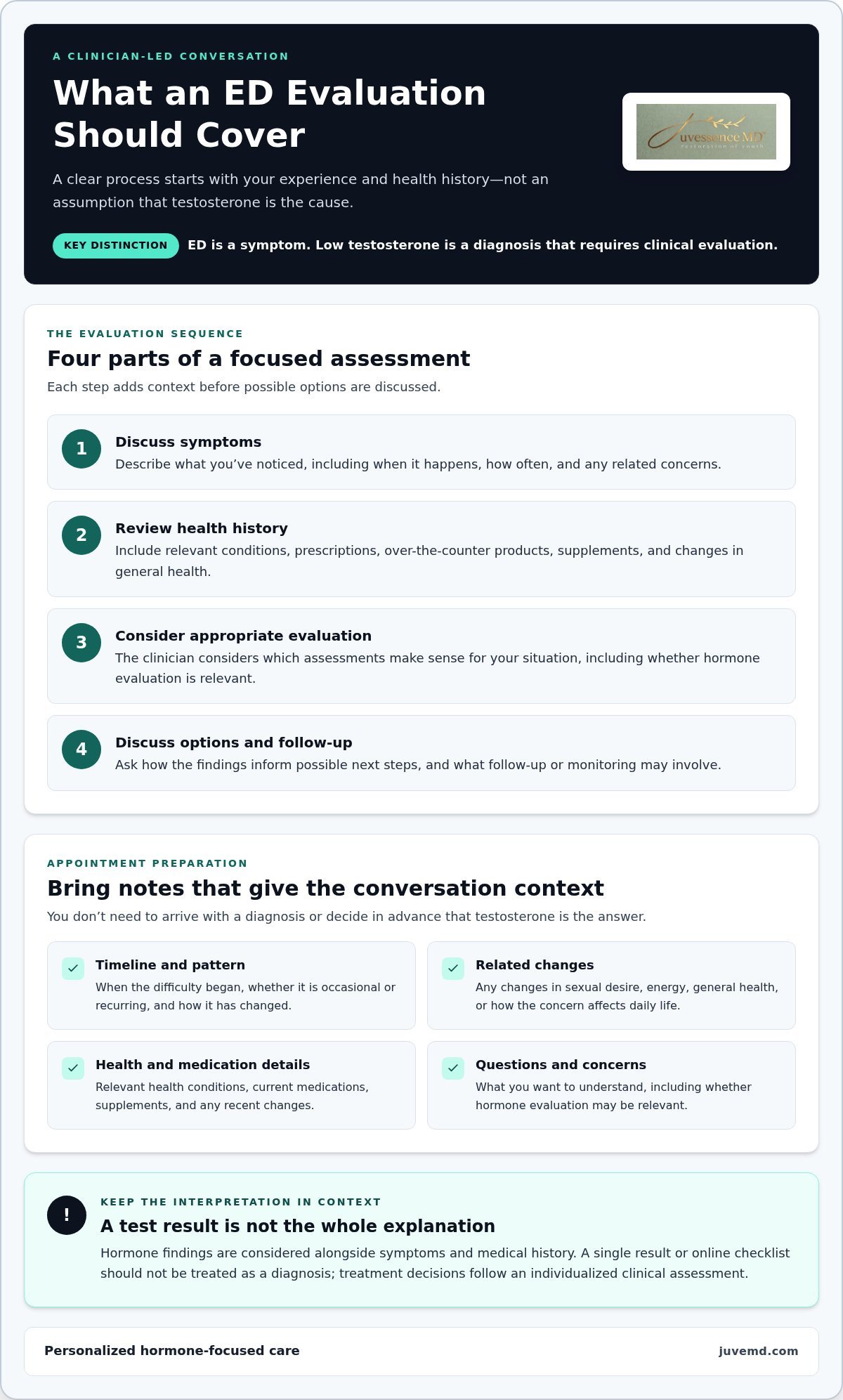
A useful evaluation follows a clear sequence: describe the concern, review relevant health history, consider which assessments are appropriate, and discuss options in light of what the clinician learns. This keeps the conversation focused on your health rather than assuming testosterone is the explanation or that a particular treatment is the answer.
The discussion may cover when erection difficulties occur, how often they happen, whether they’ve changed over time, and how they affect your well-being. Medication history matters too. Share prescriptions, over-the-counter products, and supplements, along with any recent changes. These details provide context, but they don’t identify a cause by themselves.
- Discuss symptoms. Describe what you’ve noticed in everyday language, including timing, frequency, and any related concerns.
- Review health history. Include relevant conditions, medications, supplements, and changes in your general health.
- Consider appropriate evaluation. The clinician decides whether further assessment, including hormone evaluation, makes sense for your situation.
- Discuss options. Ask how the findings inform possible next steps and what follow-up or monitoring may involve.
A marketing quiz or symptom checklist can prompt questions, but it can’t replace a clinician’s assessment or determine which evaluations are relevant. The National Institute of Diabetes and Digestive and Kidney Diseases provides an overview of erectile dysfunction treatment, including the role of discussing care options with a health professional.
What information should you prepare for the appointment?
A few notes can make a sensitive conversation easier and more complete. Write down when the concern began, whether it has changed, and how it affects daily life or relationships. Bring a current list of medications and supplements, relevant health history, and questions about your goals, concerns, and expectations. You don’t need to interpret the information yourself.
How hormone testing fits into a clinical discussion
Hormone testing is considered in context, not as a standalone explanation for erection difficulties. A clinician interprets findings alongside symptoms and medical history, then explains what they do and don’t suggest. A single result or online checklist shouldn’t be treated as a diagnosis. Treatment decisions follow an individualized clinical assessment, not an assumption based on one symptom or result.
For men considering hormone-focused care, a TRT clinic Las Vegas visit should leave room for questions and clear explanations about why an assessment is being considered. JuveMD, led by Dr. Andrea Dempsey, focuses on personalized hormone care. Learn about JuveMD’s hormone-focused care as you prepare for a clinician-led discussion.
How to Compare TRT Clinics in Las Vegas for ED Concerns
For erectile dysfunction, compare the care process, not just promises about energy, performance, or results. A meaningful evaluation makes room for your symptoms and health context before hormone care is discussed. The aim isn’t to find a clinic that assumes testosterone is the answer. It’s to understand whether hormone evaluation is appropriate and how recommendations are reached.
Use these criteria to assess how clearly a clinic explains its approach:
| Care area | What a clear process should explain |
|---|---|
| Clinical evaluation | How symptoms and relevant health history inform the discussion before options are considered. |
| Individualized recommendations | How recommendations relate to the person’s assessment and stated goals, rather than a standard package or broad promise. |
| Physician involvement | How a clinician participates in evaluating the concern and explaining the reasoning behind recommendations. |
| Follow-up clarity | What follow-up or monitoring may involve, and how questions can be addressed as care progresses. |
This framework helps distinguish useful clinical information from promotional language. Statements about guaranteed improvements or universal results deserve a precise explanation: what outcome is being discussed, for whom, and on what basis? A responsible conversation should acknowledge that testosterone therapy isn’t automatically indicated for every person with ED. Claims about specific outcomes should be supported by appropriate evidence, not inferred from general wellness messaging.
Questions that reveal whether care is individualized
Consider whether the process begins with a clinician-led discussion of symptoms and health history. Are recommendations explained in relation to the individual assessment and goals? Is there time to ask questions and understand possible follow-up? Clear answers help you see whether the clinic is discussing your situation or relying mainly on a standard pitch.
How to interpret TRT claims when ED is the concern
Broad promises about energy or sexual performance don’t explain whether hormone care fits a particular ED concern. Look for a measured explanation of how assessment informs the decision, including what testosterone therapy may and may not address. If a claim sounds guaranteed or applies to everyone, ask for a specific, evidence-based explanation before treating it as a clinical conclusion.
A TRT clinic Las Vegas patients consider should explain its hormone-focused approach without presenting testosterone as an automatic ED treatment. JuveMD is a Las Vegas clinic led by Dr. Andrea Dempsey, focused on personalized hormone optimization. That focus supports an individualized discussion about hormone health, while decisions about care remain grounded in a clinician’s assessment rather than assumptions about symptoms.
Preparing for an Erectile Dysfunction Consultation in Las Vegas
A little preparation can make a sensitive conversation feel more manageable. You don’t need to arrive with a diagnosis or know whether testosterone is involved. Your goal is to describe what you’ve noticed and get clear answers about how a clinician will understand the concern, consider relevant information, and discuss possible next steps.
What to bring and discuss at your appointment
Bring a current list of medications and supplements, along with relevant health information. A few notes can help you explain the concern clearly, especially if it feels difficult to discuss in the moment.
- Symptom timeline: Note when the erection difficulty began, how often it occurs, and whether you’ve noticed changes over time.
- Personal context: Describe when it tends to happen and how it affects daily life or well-being. Use your own words; there’s no need to find clinical terms.
- Health information: Include relevant medical history and any recent changes to medications, supplements, or general health.
- Questions: Write down what you want to understand about assessment, personalized recommendations, and follow-up.
Clear, factual details are more useful than trying to guess the cause. For example, “This started a few months ago and happens occasionally” gives the clinician a starting point without suggesting a diagnosis. You can also ask how findings will be explained, what factors shape recommendations, and what follow-up may look like.
How to set realistic expectations for the visit
An initial discussion is for understanding your concern, not guaranteeing a treatment outcome. The clinician may need to consider your symptoms alongside health history before discussing whether hormone evaluation or another next step is relevant. It’s reasonable to ask for plain-language explanations, including what an assessment can and can’t establish.
If hormone care is part of the conversation, make sure you understand why it’s being considered and how it relates to your individual goals. A testosterone pellet therapy guide for men in Las Vegas offers background on this hormone-care context, but it shouldn’t be used to determine whether a particular option is right for you.
There’s no need to feel embarrassed or blame yourself. Erection difficulties are a health concern worth discussing openly, and honest details help make the conversation more useful. A TRT clinic Las Vegas visit should give you room to ask questions and understand how clinical reasoning informs recommendations, rather than leaving you to interpret symptoms alone.
For a closer look at JuveMD’s hormone-focused approach, explore personalized hormone care as you consider what you’d like to discuss with a clinician.
Explore Personalized Hormone Care at JuveMD in Las Vegas
JuveMD is a Las Vegas medical clinic focused on hormonal health and wellness, led by Dr. Andrea Dempsey. Its hormone-focused care includes personalized hormone optimization for men and women, bioidentical pellet hormone therapy, and injectable treatments. For men exploring testosterone-related concerns, the central question is whether hormone evaluation fits their symptoms and clinical context, not whether a particular therapy is automatically the answer.
An article about erectile dysfunction can help you prepare and understand what to discuss, but it can’t establish a diagnosis or determine an individual treatment plan. ED may have different contributing factors, and testosterone therapy isn’t an automatic treatment for everyone experiencing erection difficulties. A clinician’s assessment is needed to understand whether hormone care is relevant to your situation.
How JuveMD’s hormone-focused care fits the decision
Personalized hormone optimization is best understood through an individual’s concerns and clinical context. Hormone-related questions belong in a considered conversation, not a one-size-fits-all promise. For background, JuveMD’s bioidentical hormone therapy guide in Las Vegas explains the broader hormone-care context. Educational information can help shape questions, while a clinician determines what is appropriate for an individual.
If you’re considering a TRT clinic Las Vegas patients may explore for hormone concerns, focus on whether the discussion helps you understand the reasoning behind any recommendation. Ask how your goals and clinical context inform the conversation, what a proposed approach is intended to address, and what follow-up may involve. Clear explanations support informed decisions without promising a particular result.
Choose a clear next step for your health questions
You can review JuveMD’s hormone-focused approach on its website and use what you learn to prepare questions for a clinician. If you want specific context about pellet therapy for men, the men’s testosterone pellet therapy guide offers related educational information. Neither a guide nor a symptom description replaces an individualized clinical discussion.
A thoughtful next step doesn’t require you to know the cause of ED in advance. Start with the concern you’ve noticed and the questions you want answered. A clinician-led conversation can help clarify whether hormone evaluation is relevant and explain the considerations involved, without assuming testosterone is the solution. You deserve clear information and space to make decisions based on your health needs.
Take the Next Step With Clearer Questions
You don’t need every answer before beginning a conversation about erectile dysfunction. A useful next step is to bring your questions forward and stay open to what an individualized clinical discussion may clarify. If you’re considering a TRT clinic Las Vegas men can turn to for hormone-focused care, look for an approach that helps you understand whether hormone evaluation fits your health picture, without presuming the cause or promising a result.
JuveMD is a Las Vegas clinic specializing in hormonal health and wellness, led by Dr. Andrea Dempsey. Its personalized hormone optimization care serves men and women. Exploring that focus can help you decide what you’d like to ask and whether a hormone-health conversation aligns with your concerns. It’s a measured step toward informed choices, not a commitment to a particular treatment.
Explore personalized hormone care at JuveMD and prepare your questions for a conversation about your health.
Frequently Asked Questions
Can low testosterone cause erectile dysfunction?
Low testosterone can contribute to erection difficulties for some people, but ED doesn’t by itself show that testosterone is low. Sexual desire and erection quality are related but separate concerns: a change in one doesn’t automatically explain the other. If you’ve noticed both reduced interest in sex and erection changes, mention each distinctly to a clinician. They can decide whether hormone evaluation is relevant in light of your overall health.
Is a TRT clinic in Las Vegas a good place to discuss erectile dysfunction?
A hormone-focused clinic can be relevant if you want to discuss whether testosterone evaluation fits your concerns. A TRT clinic Las Vegas residents consider should explain the role of hormone assessment without assuming testosterone is the cause of ED or the right treatment. JuveMD focuses on hormonal health and personalized hormone optimization. An article or general discussion can’t determine whether hormone care is appropriate for your individual situation.
What should I expect at an erectile dysfunction consultation?
Expect a conversation about what has changed and what you want help understanding. The clinician may ask whether erection difficulties happen consistently or in particular situations, and whether other health changes have occurred. You can also explain what you’re hoping to address, such as confidence, sexual function, or concern about a possible hormone issue. If a question feels uncomfortable, say so; clear, straightforward answers are enough.
Does testosterone therapy always improve erectile dysfunction?
No. Testosterone therapy isn’t a guaranteed or universal answer to ED, and it may not address factors unrelated to testosterone. Its relevance depends on an individual clinical assessment, not the presence of erection difficulties alone. Before considering hormone-related care, ask what concern it is intended to address, how the clinician reached that recommendation, and what limitations or uncertainties you should understand.
How do I choose a TRT clinic for erectile dysfunction in Las Vegas?
Look for a care process that explains how a clinician considers your concerns before discussing hormone options. A useful conversation should clarify why hormone evaluation might fit your situation, what the recommendation is based on, and how follow-up questions are handled. Be cautious about treating broad promises of improved performance as a personalized medical explanation. Choose a clinic whose approach helps you understand the reasoning, not just the proposed service.
What should I bring to a TRT clinic appointment about ED?
Bring a current medication and supplement list, relevant health information, and any notes that help you describe the concern. If you have questions about hormone care, write them down so you can ask them clearly. Note whether your main concern is erection function, sexual desire, or another change, since that distinction can keep the discussion focused. You don’t need to arrive with a self-diagnosis.