
What if how to get the most out of hormone pellets has less to do with chasing a perfect protocol and more to do with tracking your experience over time? It’s natural to wonder whether treatment is meeting your goals, especially when sleep, stress, health, and daily routines can also affect how you feel. And if symptoms change or side effects arise, adjusting treatment on your own isn’t the safest next step.
A clearer approach starts with realistic, personal goals and useful observations to share with your clinician. Rather than judging treatment by one good or difficult day, look for patterns and discuss what you notice during follow-up conversations. Your clinician can help put those observations in context and guide decisions about what to do next.
This guide explains how to define meaningful goals, keep track of symptoms and other influences on wellbeing, and prepare for informed conversations about pellet therapy. You’ll also learn when to raise concerns and why treatment decisions should be made with clinical guidance. JuveMD’s personalized pellet hormone therapy and hormone-health consultations in Las Vegas provide a setting to discuss individual questions with Dr. Andrea Dempsey.
Key Takeaways
- Define what meaningful progress looks like for you, rather than relying on a one-size-fits-all idea of success.
- Use a simple, consistent log to notice symptom patterns and relevant changes in sleep, stress, health, or routine.
- Bring a focused summary and questions about benefits, tolerability, monitoring, and alternatives to follow-up conversations.
- Support general wellbeing with healthy routines, but don’t try to change pellet treatment without clinical guidance.
- Learn how to get the most out of hormone pellets by turning your goals and observations into an informed next-step discussion with a hormone clinician.
Start with clear goals: what getting the most out of hormone pellets means
People consider hormone pellet therapy for different reasons, and their priorities and experiences can vary. One person may want to discuss changes in sleep; another may be concerned about a symptom affecting concentration, mood, or daily routines. These concerns deserve individual attention. A useful starting point isn’t assuming that every symptom will change, but clarifying what matters most to you and discussing it with a clinician.
In this context, getting the most out of hormone pellets means pursuing care that is informed, safe, and aligned with your personal goals. It doesn’t mean pursuing a particular lab result or expecting a guaranteed transformation. Hormone pellets are one approach within the broader category of hormone replacement therapy. JuveMD’s bioidentical hormone replacement therapy guide offers additional context, while this Hormone Replacement Therapy Overview provides a general introduction to types and uses of hormone therapy.
Choose meaningful goals before judging progress
Before deciding whether treatment is helping, name the symptoms or everyday activities you want to discuss. Make the goal observable and personal. For example, rather than “feel better,” you might note that you want to talk about waking during the night or finding it harder to focus during a usual workday. These are conversation goals, not predictions that treatment will resolve them.
Choose a few priorities instead of expecting every concern to change at once. You could write down:
- The symptom or activity that matters most to you.
- How it affects your day, in your own words.
- What you’d consider a meaningful change or a reason for concern.
Bring these priorities to a qualified clinician, who can help assess whether they are appropriate and how they fit your overall health and treatment plan. Goals can be revisited as your circumstances or concerns change.
Keep expectations individualized and evidence-aware
People can differ in how they respond to treatment and how well they tolerate it. Symptoms may also have influences beyond hormones, so a change in how you feel doesn’t automatically establish its cause. Discussing your health history, concerns, and treatment options with a clinician helps keep decisions grounded in your individual situation rather than in someone else’s experience.
Be cautious of promises that pellets will produce a specific outcome or work for everyone. It’s reasonable to ask what benefits are being considered, what uncertainties remain, and what options may be appropriate if your experience doesn’t align with your goals. Keep the focus on decisions made together, not on adjusting treatment based on assumptions.
Treatment success is individualized, monitored care that weighs your goals, experience, and safety with a clinician. That principle offers a more useful standard than expecting a perfect result. It also gives you a practical starting point for learning how to get the most out of hormone pellets: define what matters to you, then use those priorities to guide an informed conversation.
Track your experience with hormone pellets in a useful, consistent way
A brief, repeatable record can help you describe what you’re experiencing between visits without relying on memory alone. It doesn’t need to be a detailed diary or a verdict on whether the pellets are working. Think of it as a practical reference for you and your clinician: what changed, when you noticed it, and what else was happening in your life at the time.
What to include in a personal symptom log
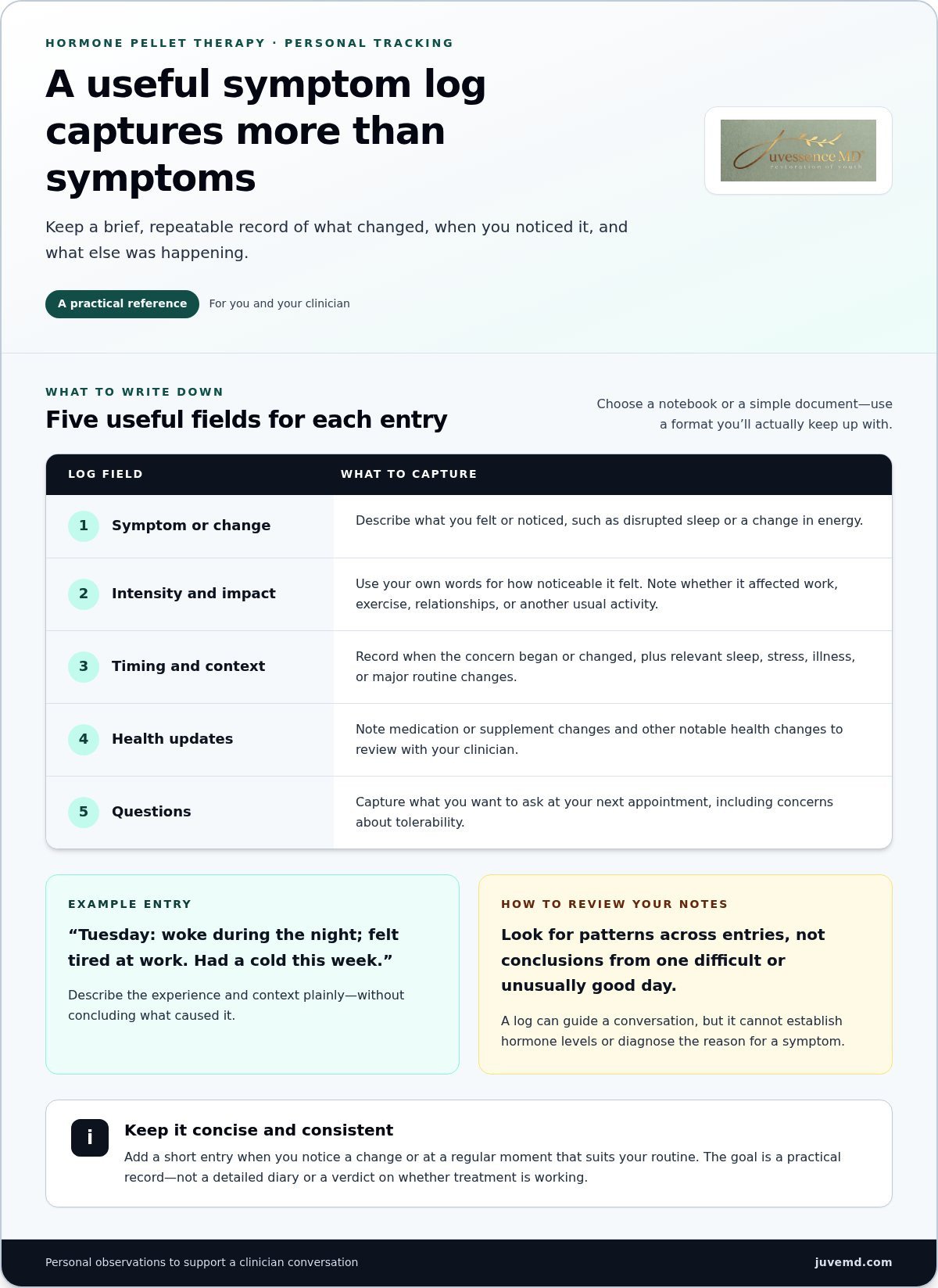
Choose a format you’ll actually use, such as a notebook or a simple document. Add a short entry when you notice a change or at a regular moment that suits your routine. Include the date, the symptom or wellbeing change, how noticeable it felt to you, and its effect on daily activities. Describe your experience plainly rather than trying to label its cause.
- Symptom or change: Note what you felt, such as disrupted sleep or a change in energy.
- Perceived intensity and impact: Use your own words, and mention whether it affected work, exercise, relationships, or another usual activity.
- Timing and context: Record when the concern began or changed, along with relevant sleep, stress, illness, or major routine changes.
- Health updates: Note medication or supplement changes and other notable health changes to review with your clinician.
- Questions: Capture anything you want to ask at your next appointment, including concerns about tolerability.
Keep the notes concise. For example: “Tuesday: woke during the night; felt tired at work. Had a cold this week.” This describes the experience and context without concluding that a hormone change caused it. If a concern begins or shifts, write down when you first noticed the difference as accurately as you can.
How to notice patterns without self-diagnosing
Look across entries rather than drawing conclusions from one unusually good or difficult day. You might notice that a symptom appeared during an illness or a stretch of poor sleep. Record that connection as an observation, not an explanation. Your log can help guide a conversation, but it can’t establish hormone levels or diagnose the reason for a symptom.
Context turns symptom notes into a clearer account of what changed and what was happening around it. That’s why a short entry with relevant details may be more useful than frequent checking or a long list of isolated sensations. If tracking starts to increase worry, simplify it: write only about meaningful changes and questions you want to raise.
At follow-up, bring a few representative entries and summarize the main changes since your last conversation. You don’t need to present every detail. For individualized questions about pellet therapy, JuveMD’s hormone-health consultations in Las Vegas with Dr. Andrea Dempsey offer an opportunity to discuss your observations with a clinician.
Make hormone-pellet follow-ups more productive with focused questions
A follow-up is a chance to put your observations into context and decide together what questions or next steps deserve attention. You don’t need to arrive with a theory about why a symptom changed. A concise update about what you noticed, when it happened, and how it affected you gives your clinician a clearer starting point for discussion.
Prepare a concise update for your clinician
Before the visit, look over your notes and select a few meaningful changes rather than reading every entry aloud. Include what’s improved, what hasn’t, and anything that feels new or concerning. Bring a current list of medicines and supplements, including recent changes, so these can be considered as part of your clinical review.
- What changed: Summarize the symptom or daily activity that feels different.
- When it changed: Share when you first noticed it and whether it has continued, eased, or worsened.
- What else was happening: Mention relevant illness, stress, sleep disruption, or routine changes.
- What concerns you: Describe side effects or other worries plainly, even if you’re unsure they’re related to treatment.
For example, you might say, “My sleep has been more disrupted, and I’ve felt less rested during the day. This began around the time I was sick.” This is more useful than trying to decide on your own whether a hormone level or the pellet caused the change.
Questions that support shared decision-making
Direct questions can help clarify how your experience will be assessed and what choices may be relevant. Clinical decisions depend on your health history, symptoms, goals, and the clinician’s assessment, so the right follow-up steps can differ from person to person.
- How will we assess whether the treatment is helping me and whether I’m tolerating it?
- What should I do if my symptoms persist, change, or worsen?
- Which follow-up steps are appropriate for my health history and current concerns?
- What alternatives could we discuss if the benefits don’t align with my goals or the treatment is difficult to tolerate?
- Are there symptoms or side effects I should raise promptly?
You can also ask what information would be helpful to bring to future visits and how to reach the practice with a concern. These questions don’t require you to make treatment decisions alone. They help create a clear conversation about potential benefits, tolerability, appropriate monitoring, and alternatives, without assuming a particular result or changing treatment on your own.
Preparing this way is a practical part of learning how to get the most out of hormone pellets: bring focused observations, ask what matters to you, and use the discussion to understand your options. For individualized questions, JuveMD’s hormone-health consultations in Las Vegas with Dr. Andrea Dempsey offer a setting to discuss your treatment experience and concerns.
Support your wellbeing without trying to alter pellet treatment yourself
Healthy routines can support general wellbeing, but they shouldn’t be treated as a way to make hormone pellets work better or as a substitute for clinical care. Sleep, movement, stress, illness, and other health factors can influence how you feel. Keeping these areas in view may help you discuss changes with your clinician, but it can’t establish what caused a symptom or determine whether your treatment needs to change.
Separate supportive habits from treatment claims
Focus on realistic routines that suit your health and circumstances. That might mean keeping a regular sleep schedule, choosing movement that feels appropriate for you, or making space for stress management. These are general wellness practices, not pellet-specific treatments. You don’t need a restrictive plan, a supplement protocol, or a hormone “boosting” routine to take an active role in your care.
Be cautious of advice that promises a lifestyle change or supplement will increase pellet effectiveness. Don’t add supplements or make a major change to your routine to try to influence treatment without discussing it with your clinician. Share significant changes in your health, activity, sleep, or stress, since that context may be useful when reviewing your experience.
Recognize when professional guidance matters
If a symptom persists, changes, or concerns you, seek a clinical assessment rather than trying to diagnose the cause through online advice. Describe what you’ve noticed and when it began. Unexpected symptoms and possible side effects also deserve discussion, even if you’re unsure they’re related to treatment.
Don’t seek an extra pellet dose or change prescribed treatment on your own. Don’t start, stop, or adjust medicines without guidance from the clinician responsible for your care. If you’re worried that treatment isn’t meeting your goals, ask about appropriate next steps, potential risks, and alternatives for your situation instead of trying to correct it yourself.
For severe or rapidly worsening symptoms, seek urgent medical attention rather than waiting for a routine follow-up. For other concerns, contact your treating clinician and ask how they recommend proceeding. The right response depends on the symptom and your individual health circumstances, so avoid relying on a general online checklist to decide what is safe for you.
Learning how to get the most out of hormone pellets includes knowing what you can support through everyday habits and what requires a clinical decision. Personalized guidance can help you discuss both. Schedule a hormone-health consultation with JuveMD to discuss your pellet therapy questions with Dr. Andrea Dempsey in Las Vegas.
Build a personalized next-step plan with a hormone clinician in Las Vegas
A practical plan brings the earlier steps together: define what you hope to address, keep a manageable record of your experience, prepare focused questions, and review them with a clinician. That process won’t guarantee a particular outcome. It can help make the conversation more specific, so decisions reflect your goals and health rather than assumptions or someone else’s experience.
A personalized review may be useful if your priorities have changed, symptoms persist or shift, or you have concerns about how you’re tolerating treatment. Your clinician can consider your health history alongside your current symptoms and questions. Be open about what’s going well, what isn’t, and what you’re uncertain about. You don’t need to arrive with a preferred treatment decision; the purpose is to understand your situation and discuss appropriate options.
When a personalized review may be helpful
Consider asking for a review when your original goals no longer fit, a concern is affecting daily life, or you’re unsure what to do next. The assessment should be individual, taking your medical history and present concerns into account. If your questions relate specifically to testosterone pellets for men, JuveMD’s testosterone pellet therapy guide offers additional context to bring into that discussion.
For women looking for more context on this treatment approach, the guide to hormone pellet therapy for women in Las Vegas can help frame questions for a personal conversation. Educational information can be a starting point, but it can’t replace an assessment tailored to your history, symptoms, and preferences.
Continue the conversation with an informed next step
JuveMD is a Las Vegas clinic focused on hormonal health and wellness. Dr. Andrea Dempsey can discuss individualized questions about personalized pellet therapy without presuming that one approach or outcome is right for everyone. Bringing your priorities and concerns to a consultation can help keep the conversation focused on what matters to you.
In short, how to get the most out of hormone pellets is less about chasing a perfect protocol and more about making informed decisions with clinical guidance. Use your observations to clarify what you want to address, then discuss the options and appropriate next steps together. If you’re ready to explore your questions, schedule a hormone consultation with JuveMD for a measured, individualized conversation.
Take your next step with confidence
Your experience deserves a thoughtful conversation, not pressure to fit a preset expectation. You can bring questions even if you’re unsure what they mean or whether a change is related to treatment. That openness gives you and your clinician room to consider what matters to you and discuss an appropriate path forward.
Understanding how to get the most out of hormone pellets starts with staying engaged in decisions about your care. If something feels unclear, ask for an explanation. If your goals or concerns have shifted, say so. You’re an important part of the conversation, and your perspective can help shape a plan that reflects your individual needs.
JuveMD focuses on hormonal health and wellness, with personalized hormone education and bioidentical pellet hormone therapy led by Dr. Andrea Dempsey. If you’re ready to discuss your questions and possible next steps, schedule a personalized hormone consultation with JuveMD. A clear, informed conversation is a meaningful place to begin.
Frequently Asked Questions
Can I do anything myself to make hormone pellets work better?
You can support your general health, but don’t try to change how your pellets work by altering treatment yourself. There isn’t a self-care routine that guarantees a stronger or more predictable response. Keep following the instructions your clinician gave you, and discuss questions about activity, recovery, or symptoms directly with them. For questions about how to get the most out of hormone pellets, focus on safe, informed decisions rather than trying to intensify treatment.
Should I take supplements while using hormone pellets?
Don’t add a supplement specifically to change hormone levels or improve pellet results without discussing it with your clinician. Supplements can have active ingredients and may affect other medicines or health conditions. For example, bring the product label or a clear photo of the ingredients to your appointment, along with the amount you plan to take. This helps your clinician review the exact product rather than relying on its marketing claims.
Can hormone pellets be combined with other hormone treatments?
Sometimes a clinician may consider more than one hormone treatment, but whether that’s appropriate depends on your individual care plan. Don’t add another prescription, cream, or hormone product on your own, even if it was previously prescribed or seems similar. Tell your clinician about every hormone product you use, including its form and how often you take it. They can assess potential overlap and discuss options in light of your history.
Are hormone pellets appropriate for everyone?
No. Whether pellets are appropriate depends on factors such as your symptoms, medical history, health risks, and treatment preferences. A clinician needs to assess these details rather than relying on age, a single lab result, or another person’s experience. If you have a complex medical history or take medicines for ongoing conditions, bring those details to the discussion. A hormone-health clinician in Las Vegas can help you consider whether pellets or another approach merits discussion.
What should I do if I feel worse after starting hormone pellets?
Contact the clinician overseeing your treatment and describe what changed, when it began, and how it affects you. Don’t wait for a routine appointment if the symptoms are severe, rapidly worsening, or feel urgent; seek urgent medical care. Avoid trying to counter a new symptom by changing medication, taking extra hormones, or adding supplements. Clear details help the clinician determine what assessment or next step is appropriate.
Can I use online hormone test results to change my pellet treatment?
No. Don’t use an online result to change, add, or delay treatment without discussing it with your clinician. A test result needs to be interpreted alongside your symptoms, medical history, the specific test, and the circumstances in which it was taken. If you’ve already received results, share the complete report, including the date and test name. Your clinician can explain whether the information is relevant to your care.