
A more intensive hair-loss treatment isn’t automatically the better fit. The right choice in the PRP hair treatment vs minoxidil comparison depends on what may be causing your hair loss, how it’s progressing, and which treatment routine you can manage.
It’s understandable to feel unsure when online claims promise dramatic results, especially when timelines, side effects, and treatment commitments differ. PRP uses a concentrated portion of your own blood in scalp injections, while minoxidil is a medication used regularly to support hair growth. Neither option works the same way for everyone, and research can’t guarantee an individual result. This guide explains how the treatments differ, what the evidence can and can’t tell you, and why hair-loss patterns and follicle health matter. You’ll also find practical questions to bring to a clinician so you can discuss an approach that fits your circumstances.
Key Takeaways
- Compare PRP hair treatment vs minoxidil by considering the cause and pattern of hair loss, not by looking for a universal winner.
- Understand how PRP injections and topical minoxidil take different approaches, and why their proposed effects don’t guarantee results.
- Weigh the evidence, practical routines, and limitations of each option.
- Include your hair-loss history, scalp assessment, medications, and overall health in the treatment discussion.
- Prepare focused questions about goals and monitoring for a personalized conversation with a hair-restoration clinician.
PRP Hair Treatment vs. Minoxidil: What Is Being Compared?
PRP hair treatment and topical minoxidil are distinct options, not interchangeable versions of the same therapy. PRP is a procedure that uses a component of your own blood, while minoxidil is a medication applied to the scalp. A useful comparison starts with the type of hair loss being addressed: treatments used for gradual pattern thinning may not suit hair loss caused by another condition.
Gradual thinning around the crown, temples, or part can have a different context from sudden shedding or distinct patches of hair loss. Rapid changes, scalp symptoms, or hair loss without a clear explanation deserve assessment rather than self-diagnosis. A clinician can consider the pattern alongside your health history and other possible causes before discussing treatment options.
What is PRP hair treatment?
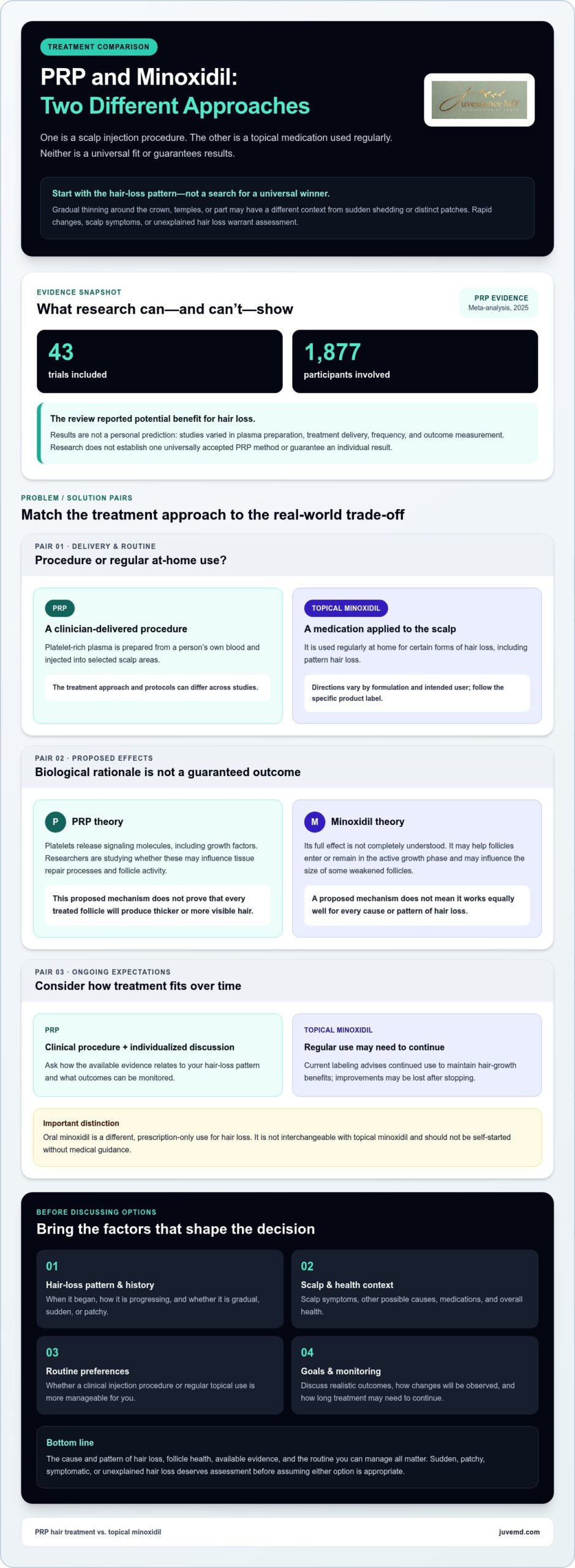
PRP hair treatment is a clinical procedure in which platelet-rich plasma prepared from a person’s own blood is injected into selected areas of the scalp. The plasma contains platelets and related growth factors. Researchers are studying whether these may support hair follicle activity, but this proposed role does not guarantee a result. A 2025 meta-analysis of 43 trials involving 1,877 participants reported potential benefit for hair loss, while reflecting a body of research with varied methods and treatment protocols.
Preparation and injection approaches differ across published studies, so results from one protocol may not translate directly to another. The evidence does not establish a single universally accepted method or predict how an individual will respond. PRP also differs from a medicine used at home: it involves a clinical procedure and an individualized discussion of whether the available evidence applies to your hair-loss pattern.
What is minoxidil used for?
Topical minoxidil is a medication used for certain forms of hair loss, including pattern hair loss. It is applied to the scalp rather than injected. Product labeling and directions can vary by formulation and intended user, so check the current label for the specific product and discuss suitability with a clinician. An overview of its uses and background is available at Minoxidil on Wikipedia, but it doesn’t replace product instructions or personalized medical guidance.
In the PRP hair treatment vs minoxidil comparison, the practical difference is clear: one is an injection-based procedure, and the other is a topical medication. Neither should be selected solely because thinning is visible. The cause, pattern, health context, and treatment preferences all matter. If hair loss is sudden, patchy, or unexplained, seek an assessment before assuming either option is appropriate.
How PRP and Minoxidil Work: Two Different Treatment Approaches
The main difference is how each treatment is delivered and what it is intended to influence. PRP places platelet-rich plasma into the scalp, while topical minoxidil is a medication applied regularly. Neither mechanism guarantees regrowth. Understanding the proposed biology can clarify what researchers are studying, but treatment decisions still depend on clinical outcomes and individual circumstances.
How PRP is thought to affect hair follicles
Platelets release signaling molecules, including growth factors, that may influence processes involved in tissue repair and follicle activity. In PRP treatment, clinicians prepare platelet-rich plasma from a person’s blood and inject it into targeted scalp areas. The theory is that these signals may support the local environment around follicles. This is a proposed mechanism, not proof that every treated follicle will produce thicker or more visible hair.
Clinical evidence offers a separate perspective. A 2025 meta-analysis of 43 trials involving 1,877 participants reported that PRP may improve hair-loss outcomes. However, studies can differ in how plasma is prepared, how treatment is delivered, how often it is given, and how outcomes are measured. Those differences make direct comparisons difficult and limit how confidently any one result can predict an individual response.
How minoxidil supports hair growth
Minoxidil’s full effect on hair growth isn’t completely understood. It may help shift follicles toward or maintain the active growth phase of the hair cycle, and it can influence the size of some weakened follicles. These proposed actions help explain why it’s used for certain forms of pattern hair loss, but they don’t establish that it will work equally well for every cause or pattern.
Clinical benefit is assessed by observing changes over time, not by assuming that a proposed mechanism ensures a result. Current labeling for topical minoxidil advises continued use to maintain hair-growth benefits; improvements may be lost after stopping. Follow the directions for the specific formulation and discuss concerns or unexpected effects with a clinician. Topical minoxidil is applied to the scalp. Oral minoxidil is a different, prescription-only use for hair loss, and it should not be treated as interchangeable with the topical product or self-started without medical guidance.
In brief, PRP is a clinician-delivered injection procedure, while topical minoxidil is an ongoing medication routine at home. That difference affects the time commitment, follow-up, and how each option fits your preferences. In the PRP hair treatment vs minoxidil discussion, ask which evidence applies to your hair-loss pattern, what outcomes can reasonably be monitored, and how long treatment may need to continue.
A personalized hair restoration discussion can help connect the science with your goals, health history, and practical preferences.
PRP vs. Minoxidil: Compare Evidence, Practicalities, and Trade-Offs
There isn’t a universal winner. Evidence depends on the type of hair loss studied, and practical differences can determine whether a treatment fits your routine. Research findings describe groups of participants, not a guaranteed outcome for one person.
| Factor | PRP | Topical minoxidil |
|---|---|---|
| Format | Blood-derived plasma is prepared and injected into the scalp in a clinical procedure. | A medication applied to the scalp according to the specific product’s directions. |
| Evidence context | Studies report potential benefit, but protocols and research methods vary. | FDA-approved topical formulations are used for pattern hair loss; results still vary by person. |
| Practical commitment | Requires clinical visits, with timing determined by the treatment plan. | Requires regular use at home; continued use may be needed to maintain benefit. |
| Key limitation | There is no single standardized approach, and response can’t be predicted with certainty. | It may not fit every hair-loss cause, and results depend on consistent use. |
What does the evidence say about PRP and minoxidil?
For pattern hair loss, topical minoxidil has an established role reflected in FDA-approved product labeling. PRP has also been studied for pattern hair loss, but the evidence is harder to interpret because preparation methods, treatment schedules, and study designs differ. A 2025 meta-analysis covering 43 trials and 1,877 participants reported potential benefit from PRP. That finding supports continued study, but it doesn’t establish one protocol as best for every patient.
Direct comparisons are useful, but they have limits. A 2025 meta-analysis reported no significant difference in hair-density outcomes between PRP and topical minoxidil, while patient satisfaction was higher with PRP. A separate 2025 systematic review described PRP’s efficacy as nearly comparable to topical minoxidil. These findings don’t prove the treatments are equivalent for every diagnosis or individual. Differences among studies and limited consistency in PRP methods make firm conclusions difficult. Evidence for one pattern of hair loss shouldn’t be assumed to apply to sudden shedding, patchy loss, or other diagnoses.
How do commitment and day-to-day use differ?
PRP concentrates treatment in clinical appointments, while minoxidil puts the routine in the patient’s hands at home. Neither approach is commitment-free: appointments take planning, and topical treatment calls for consistent application. A routine that’s difficult to maintain may affect real-world results, even when a treatment has supportive evidence.
When weighing PRP hair treatment vs minoxidil, consider the research alongside your hair-loss diagnosis, comfort with injections, and ability to sustain the routine. Individual results vary, and neither option guarantees a specific outcome. A clinician can help interpret the evidence for your situation rather than treating study averages as a personal forecast.
Which Hair-Loss Factors Matter Before Choosing PRP or Minoxidil?
Start with the pattern and possible cause before comparing treatments. Gradual thinning across the crown or a widening part may lead to a different discussion than sudden shedding, distinct bald patches, scalp discomfort, or rapid change. These patterns don’t diagnose a condition on their own. They help a clinician decide what questions to ask and whether further assessment is needed before discussing hair-restoration options.
- Notice the pattern: Is thinning gradual and spread across an area, or sudden and patchy?
- Consider the timeline: When did it begin, and has it changed quickly or followed a health or life event?
- Review your context: Share relevant health history, scalp symptoms, medications, and products you use.
- Discuss fit: Weigh treatment goals and practical commitment after possible causes have been considered.
Start with the pattern and possible cause
Hair loss can have different causes, and an approach commonly discussed for gradual pattern thinning may not address sudden shedding or patchy loss. Pain, irritation, or other scalp changes are also useful details to report. A clinician may review when the change started, where it appears, and whether anything else changed around the same time. This context helps make the treatment conversation more relevant.
Gender-specific concerns can also influence the questions to bring to an appointment. Changes in hair density and their possible causes may call for a tailored discussion; JuveMD’s guide to hair loss treatment for women in Las Vegas explores this topic.
A procedure isn’t automatically more effective because it involves injections or a clinical visit. The PRP hair treatment vs minoxidil decision should be grounded in the likely diagnosis, evidence relevant to that type of hair loss, and your circumstances, not the perceived intensity of a treatment.
Discuss safety, expectations, and treatment fit
Bring a current medication and supplement list, along with relevant health history and details about any scalp condition. Ask how these factors could affect the suitability of PRP or topical minoxidil. Minoxidil labeling differs by formulation and intended user, so review the directions and warnings for the product you’re considering with a clinician rather than assuming one label applies to every product.
Pregnancy, breastfeeding, and scalp irritation or disease may affect whether a treatment is appropriate. Mention these factors before starting anything, and don’t apply a product to an affected scalp without checking its label and getting medical guidance. The same careful review can help identify questions to discuss before a procedure.
Agree on what will be monitored, how progress will be reviewed, and when the plan may need reassessment. Results are uncertain, so include what to do if hair loss continues or the approach doesn’t fit your routine. For a personalized hair-restoration discussion in Las Vegas, schedule a conversation with JuveMD.
Discussing PRP and Minoxidil With a Hair-Restoration Clinician in Las Vegas
A useful treatment discussion covers more than choosing between an injection-based procedure and a topical medication. A clinician can review when your hair loss began, how it has changed, your goals, and relevant health factors. That context helps frame which options may be reasonable to consider and what questions remain. Bring a medication and supplement list, relevant health history, and notes about scalp symptoms or recent changes you’ve noticed.
Dated photos can also help make the conversation more practical. If you have them, choose photos taken in similar lighting and from similar angles to show how the pattern has changed. They don’t diagnose the cause, but they may help focus the discussion on what you’ve observed.
Questions to bring to a treatment discussion
Ask questions that clarify the reasoning behind a recommendation, not just the treatment name. For example:
- What hair-loss pattern or possible cause are you considering, and what features support that assessment?
- What evidence for PRP or minoxidil applies to my situation, and what remains uncertain?
- What risks, product warnings, or alternatives should I understand before deciding?
- How would we monitor progress, and what changes might lead us to reassess the plan?
These questions can help distinguish an evidence-informed discussion from a promise of a particular result. They also make room to talk through treatment routines, comfort with procedures, and what you’d consider a meaningful change. In the PRP hair treatment vs minoxidil comparison, the best-informed next step depends on how well each option fits your assessment and preferences, not on a universal ranking.
A personalized next step at JuveMD
In Las Vegas, JuveMD provides hair-restoration services. Led by Dr. Andrea Dempsey, the practice can help you organize the factors you want to discuss, including your history, goals, and treatment considerations, without presuming a specific treatment or outcome.
You don’t need to arrive with a decision already made. A thoughtful discussion can help you understand the options, uncertainties, and monitoring considerations relevant to your circumstances. Explore JuveMD’s medical hair restoration care.
Make Your Next Step a More Informed One
Before choosing a treatment, decide what you most need from the conversation: a clearer understanding of the cause, a realistic view of the ongoing commitment, or help weighing uncertainty against your personal goals. You don’t need to arrive with a preferred option. Being ready to discuss what matters most to you can make the next step more manageable.
The PRP hair treatment vs minoxidil decision is personal, and a clinician can help connect the available options to your circumstances. JuveMD is a Las Vegas medical clinic led by Dr. Andrea Dempsey, with hair restoration among its services. Explore personalized hair-restoration care at JuveMD as a starting point for a thoughtful discussion.
To discuss your hair-restoration goals and options in Las Vegas, connect with JuveMD.
Frequently Asked Questions
Is PRP hair treatment more effective than minoxidil?
Current evidence doesn’t establish PRP as more effective overall. A 2025 meta-analysis found no significant difference in hair-density outcomes between PRP and topical minoxidil, but that doesn’t prove they work equally well for every person or diagnosis. Study methods and PRP protocols vary, so a clinician can help interpret the findings in light of your hair-loss pattern, goals, and health history.
Can PRP hair treatment and minoxidil be used together?
They may be considered together in some treatment plans, but the combination isn’t automatically suitable or necessary. Using two approaches can also make it harder to tell which one is affecting your results or causing an unwanted effect. Before combining them, discuss timing, application instructions, possible risks, and how progress would be tracked with a clinician who understands your medical history.
How does PRP hair treatment compare with topical minoxidil?
PRP is an in-office procedure involving injections of prepared plasma, while topical minoxidil is a medication applied to the scalp at home. That difference affects how each treatment fits into everyday life: PRP involves clinical appointments, and minoxidil requires regular application. The options also have different evidence and limitations, so compare them based on your diagnosis and preferences rather than assuming one format is inherently better.
How long does it take to see results from PRP or minoxidil?
Visible changes generally take time. The research summarized for this guide reports that minoxidil results may appear after four to six months of consistent use, while PRP studies commonly assess changes over three to six months of treatment. These ranges aren’t promises or guaranteed deadlines. Ask how your clinician would document a baseline and evaluate change, since hair appearance can vary with styling, lighting, and shedding cycles.
What happens if you stop using minoxidil?
If you stop, hair-growth benefits associated with minoxidil are usually lost over time, with the research brief reporting that this can happen within three to six months. Hair may then move toward its untreated pattern; stopping doesn’t necessarily mean the medication caused new hair loss. If you’re considering a break because of irritation, inconvenience, or another concern, discuss alternatives and next steps with a clinician.
Is PRP hair treatment safe for everyone?
No treatment is appropriate for everyone, and using a person’s own blood doesn’t remove the need to assess suitability. Before considering PRP, discuss relevant medical conditions, medications, scalp health, and any history that could affect a procedure. A clinician can explain potential risks and whether further evaluation is needed. In a Las Vegas consultation, bring your medication list and be clear about recent health changes or concerns.
Can PRP or minoxidil help with every type of hair loss?
No. Both treatments are most relevant to certain patterns of thinning, and neither should be assumed to address hair loss from every cause. For example, sudden shedding or distinct patches may call for assessment before selecting a hair-growth treatment. More advanced loss may also respond differently if follicles are no longer active. A clinician can help identify what needs evaluation and whether either option fits your situation.